
The traveller who reached Zaytun
In 1345 Ibn Battuta reached Zaytun, a harbour he ranked among the world’s greatest. Today it is Quanzhou, and parts of his story are doubted.
In 1345, by his own account, a traveller from Tangier reached a busy harbour on the south-east coast of China. Ibn Battuta had already been on the road for twenty years. Muslim merchants called the port Zaytun. The name is generally thought to come from the Chinese 刺桐 (cìtóng), the coral tree that gave the city its nickname, but in Arabic the word means olive, and he remarked that he could not find a single olive tree there. Today the place is Quanzhou, in Fujian.
A harbour he ranked with the greatest
Years earlier, when he reached Alexandria in 1326, he admired its port and compared it with others. Among all the ports he had seen, he says in the Rihla, only a few were its equal: Quilon and Calicut in India, a port at Sudak in the Crimea, and Zaytun in China. That sentence was dictated long afterwards, with China already behind him, but it shows where he placed the city in his mind. Marco Polo, who sailed from the same coast in the early 1290s, had called it one of the two greatest havens for trade.
What the Rihla says he found
The book was not written by his own hand. Back in Morocco he dictated it in 1354 to a scholar named Ibn Juzayy, at the suggestion of the Marinid ruler Abu Inan, and nothing suggests he had kept notes during his years of travel. According to the Rihla, when he arrived in Quanzhou the head of the Muslim merchants and a senior religious scholar came out to meet him with flags, drums, trumpets and musicians. The Muslim community lived in its own part of the city, with mosques, bazaars and hospitals. He mentions local painters who made portraits of newly arrived foreigners, which he took to be a security measure. He praises the silk and porcelain, comments on the advantages of paper money and describes how large ships were built. He also met two notable Iranians in the city and climbed a hill to visit a Taoist monk who lived in a cave.
The port behind the story
Whatever one makes of the narrator, the harbour was real. A maritime trade office was set up in Quanzhou in 1079 or 1087. An inscription of 1095 records two convoys of twenty ships a year arriving from the southern seas, and Fujian’s kilns were then turning out mostly celadon made for export. In 1277, under the Mongol-led Yuan dynasty, a superintendent of foreign trade named Pu Shougeng, himself a Muslim, was appointed and revived the port’s fortunes; Marco Polo reports that the Yuan emperors took a ten percent duty on its cargo. A ship found in the mud of Quanzhou Bay in 1973 and excavated in 1974 shows what the vessels looked like: about 24 metres of hull survive, from a seagoing junk estimated at around 34 metres long, which sank in the later 13th century.
Where historians disagree
Here the Rihla needs careful reading. Scholars have pointed to errors in his chapters on China, such as mixing up the Yellow River with the Grand Canal. Some go further and ask whether he reached China at all: they suggest that parts of his description were taken from earlier writers, and they note passages that closely resemble Marco Polo’s. Historians disagree, and there is no settled answer. Other parts of his journey have found some independent support; manuscripts copied in Damascus in 1326, for example, match the date he gives for his stay there.
Two smaller doubts concern the harbour itself. In the nineteenth century some scholars argued that Zaytun was Xiamen rather than Quanzhou. Chinese records make clear that Quanzhou was the great port of the age, though a few details in his description may fit nearby Zhangzhou better. So read his Zaytun as the portrait of a world-famous harbour that may blend memory, hearsay and borrowed pages.
A harbour that faded
Under the Ming dynasty the court discouraged foreign trade except formal tribute missions. By 1473 Quanzhou was no longer the headquarters of the customs service for Fujian, and its trade office closed completely in 1522. Meanwhile sand built up in the bay. By the early twentieth century sandbars had made the old harbour unusable for big ships, and the sea trade moved to Anhai.
Quanzhou today
In 2021 UNESCO inscribed “Quanzhou: Emporium of the World in Song-Yuan China”, a group of sites around the city that tell the story of its medieval sea trade. Which of them Ibn Battuta saw is not recorded, but they belong to the world he describes.
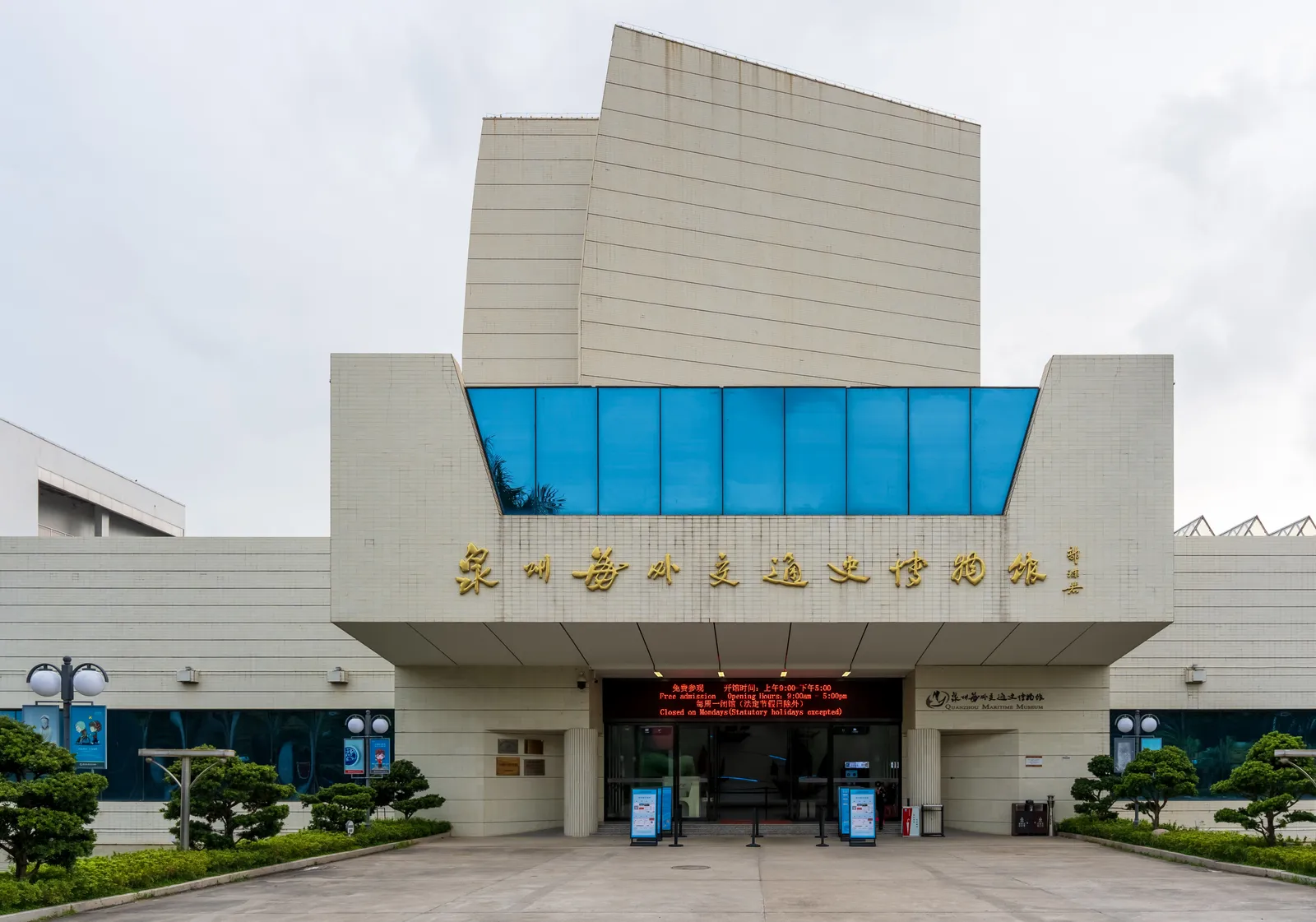
The Quanzhou Maritime Museum, founded in 1959, holds the recovered ship, models and carved gravestones from the city’s medieval trading communities.
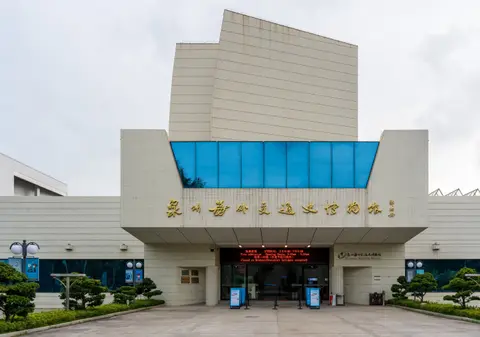 Sight in QuanzhouQuanzhou Maritime Museum 泉州海外交通史博物馆China’s main museum of maritime trade history, founded in 1959: ship models, Arabic, Syriac and Tamil gravestones and inscriptions that show how many peoples and faiths lived in medieval Quanzhou.
Kaiyuan Temple, traditionally founded in 686, has two stone pagodas rebuilt in the 13th century, each over 40 metres tall, and carved pillars left by traders from southern India.
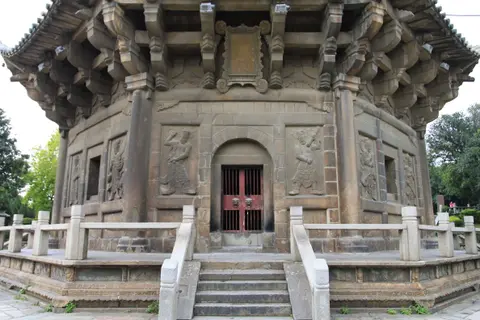 Sight in QuanzhouKaiyuan Temple 开元寺Quanzhou’s great Buddhist temple, founded in the late 7th century, with a vast main hall and twin 13th-century stone pagodas over 40 metres high; behind the hall stand pillars carved for a Hindu temple. A UNESCO component site.
The Qingjing Mosque, dated to 1009, has a tall granite gateway in a Middle Eastern style beside the ruined walls of the old prayer hall.
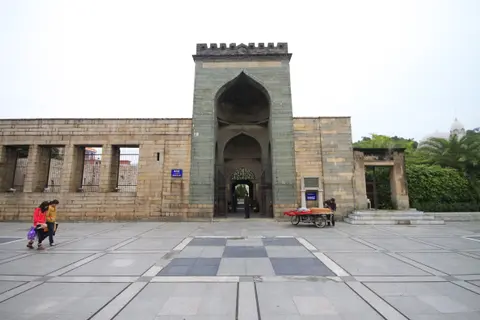 Sight in QuanzhouQingjing Mosque 清净寺One of the oldest mosques in China, founded in 1009 by Arab merchants: a tall granite gateway in Middle Eastern style and the roofless walls of the old prayer hall. A UNESCO component site.
Two Song-dynasty stone bridges show the engineering behind the trade: Luoyang Bridge, built between 1053 and 1059, and Anping Bridge, built between 1138 and 1151 and more than two kilometres long.
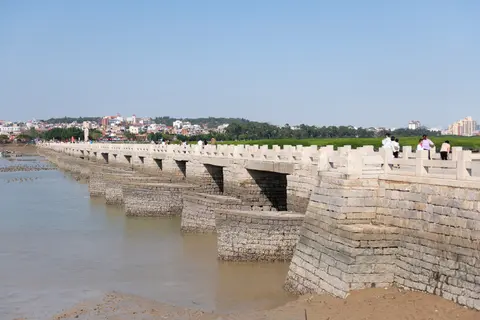 Sight in QuanzhouLuoyang Bridge 洛阳桥A granite beam bridge across the Luoyang River estuary, built 1053–1059 under the official Cai Xiang — its piers were bound by cultivated oysters. Still walkable, with Song statues and steles; a UNESCO component site.
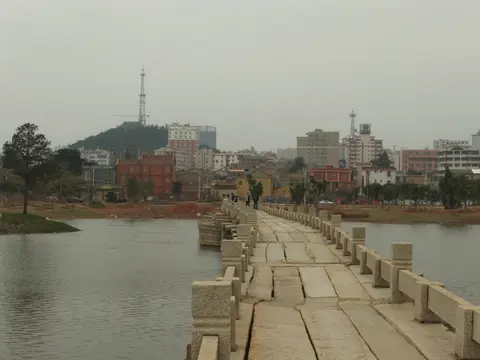 Sight in QuanzhouAnping Bridge (Five-Li Bridge) 安平桥Built 1138–1151 and over 2 km long, this flat granite bridge was for centuries the longest in China; it crosses the tidal flats at Anhai with five pavilions along the way. A UNESCO component site.
For the wider city, see [[city:quanzhou]].
Places in this story
Sources
- Ibn Battuta, Travels in Asia and Africa 1325–1354 (Gibb translation, selections), Internet Medieval Sourcebook, Fordham University (sourcebooks.fordham.edu)
- Wikipedia: Ibn Battuta (en.wikipedia.org)
- Wikipedia: Quanzhou (en.wikipedia.org)
- Wikipedia: Quanzhou ship (en.wikipedia.org)
- Wikipedia: Quanzhou Maritime Museum (en.wikipedia.org)
- Wikipedia: Kaiyuan Temple, Quanzhou (en.wikipedia.org)
- Wikipedia: Qingjing Mosque (en.wikipedia.org)
- Wikipedia: Luoyang Bridge (en.wikipedia.org)
- Wikipedia: Anping Bridge (en.wikipedia.org)
Legends are told as legends. Where historians disagree, we say so.
More stories
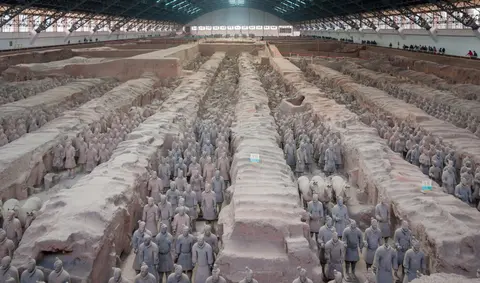 HistoryThe well that found an armyIn 1974 farmers digging a well near Xi’an hit pieces of clay. They had found the First Emperor’s army, and the tomb it guards is still sealed.
 LegendsThe White Snake and Leifeng PagodaA snake spirit in love, a monk who stood in her way, and a real pagoda on West Lake that fell in 1924 and rose again.
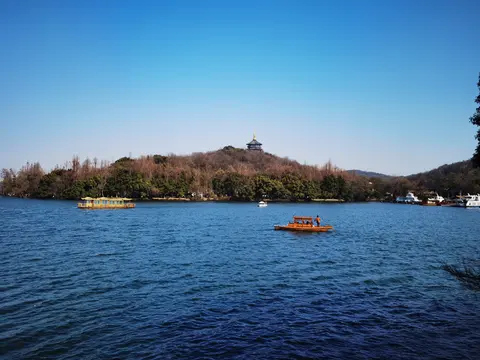 Travelers of the pastMarco Polo’s City of HeavenIn the 13th century a Venetian called Hangzhou the finest city in the world. What did he really see, and what is still there at West Lake?