
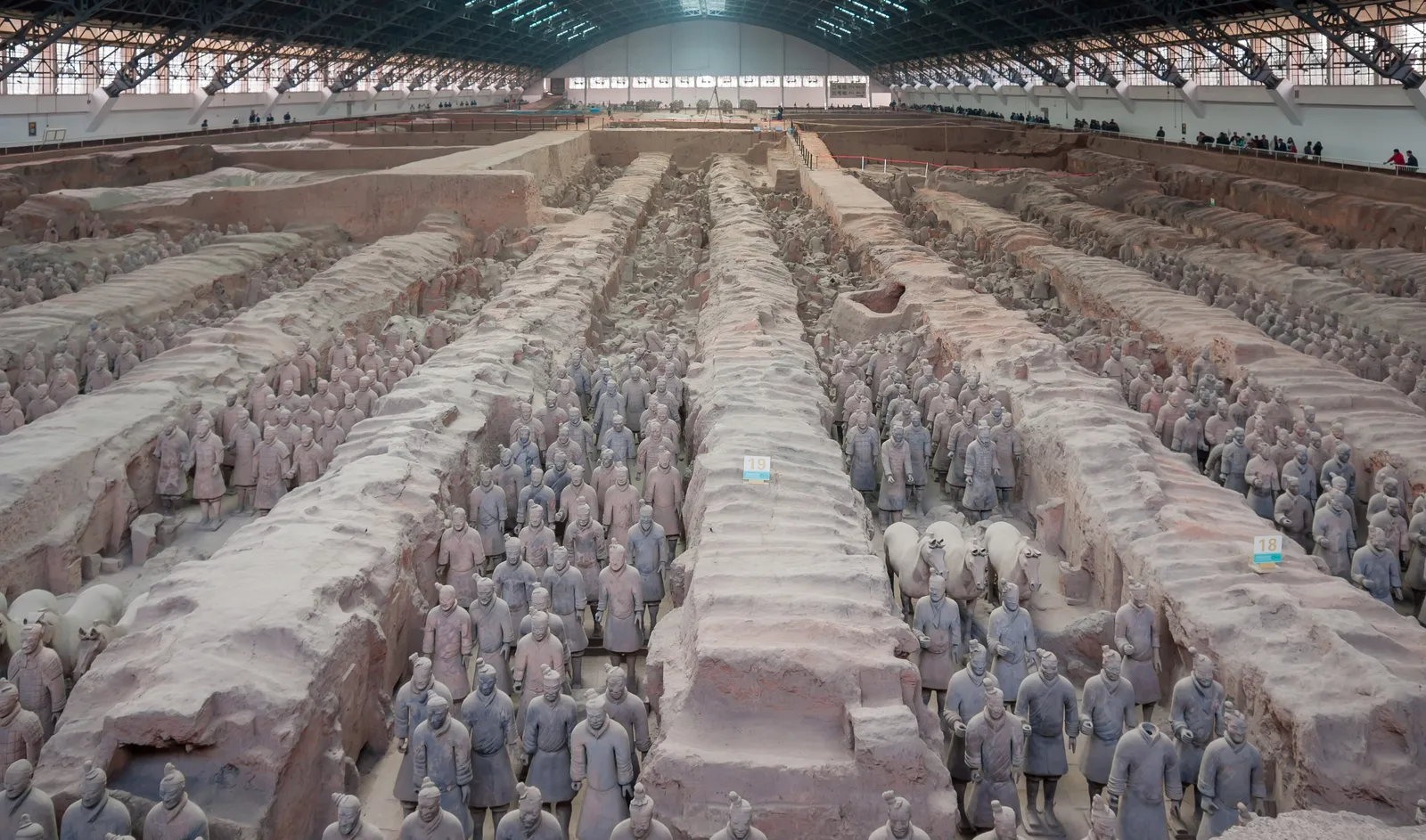
The well that found an army
Photo: CEphoto, Uwe Aranas · CC BY-SA 3.0
In 1974 farmers digging a well near Xi’an hit pieces of clay. They had found the First Emperor’s army, and the tomb it guards is still sealed.
In the spring of 1974 the fields east of Xi’an were dry. In the village of Xiyang, below Mount Li, a farmer named Yang Zhifa, his brothers and a neighbour, Wang Puzhi, set out to dig a well. A couple of metres down, their spades struck something hard: fired clay. Then came more fragments, and small bronze arrowheads.
Nobody in the village knew what they were. There was no local story about soldiers under the fields, and no old book that mentioned any. The pieces might easily have been thrown away. Archaeologists later found older graves nearby where diggers had clearly hit terracotta before and simply shovelled it back into the ground. This time word reached Zhao Kangmin at the county cultural centre in Lintong. He came to the village, collected every piece the farmers had found, bought back the arrowheads that had already been sold off, and began fitting the fragments together. What took shape was a soldier, life-size.
A pit, then an army
Formal digging began that July. It took more than a year of test trenches to understand what lay there. The first pit alone is 230 metres long and 62 metres wide. From the density of figures in the trial digs, the site museum estimates it holds about 6,000 clay soldiers and horses, lined up in eleven long corridors, with real bronze weapons among them.
Two more pits turned up nearby: one with cavalry, chariots and kneeling archers, and a smaller one that looks like a command post of officers. A fourth pit was empty, perhaps never finished. More than 2,000 figures have been excavated so far. Most of the army is still underground.
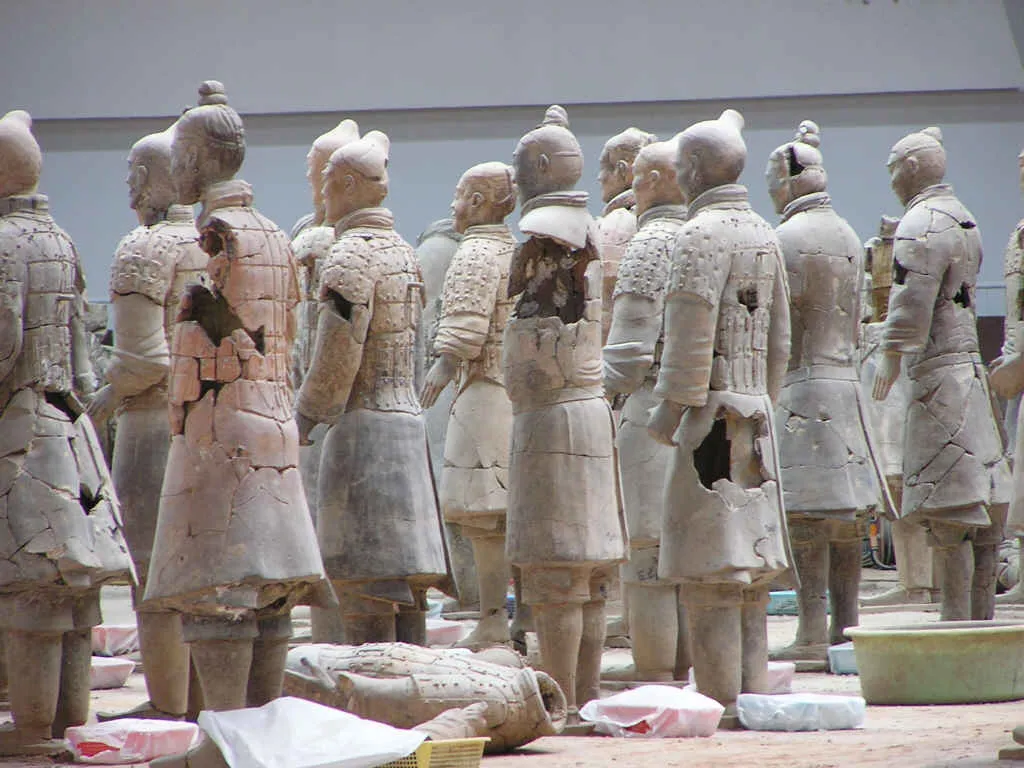
Up close, they are people. The bodies were assembled from a limited set of moulded parts, but faces, hair, beards and belts were finished by hand, so the ranks feel crowded with individuals. They were once brightly painted, in reds, greens, blues, pinks and a pigment now called Han purple. In Xi’an’s dry air much of that paint curls and flakes within minutes of being uncovered, which is one reason the digging goes so slowly.
 Sight in Xi'anTerracotta Army 秦始皇帝陵博物院(兵马俑)Thousands of life-size clay soldiers guarding the tomb of China’s first emperor.
What Sima Qian wrote
The army faces east, about 1.5 kilometres from a great earth mound. The mound is the tomb of Ying Zheng, the king of Qin who completed his conquest of the other warring states in 221 BC and took the title Qin Shi Huang, the First Emperor.
The only detailed written account of the tomb comes from the historian Sima Qian, who wrote about a century later in the Records of the Grand Historian. He says work began as soon as the emperor came to the throne as a boy of thirteen, and that more than 700,000 convicts and forced labourers were sent from across the empire. They dug down through three layers of groundwater and lined the burial chamber with bronze. Palaces, officials and rare treasures filled it. Craftsmen set crossbows to shoot anyone who broke in. Mercury was made to flow as the rivers and seas, the ceiling showed the heavens and the floor the lands below, and lamps of “man-fish” fat, usually read as whale or seal oil, were meant to burn for a very long time. When the emperor had been buried, Sima Qian adds, the workers who knew the secrets of the tomb were sealed inside.
For centuries this sounded like a tall tale. Then soil surveys over the mound found unusually high levels of mercury, which many scholars take as support for his account; others suggest different causes. And there is a twist. Sima Qian, so detailed about the tomb, says nothing at all about a clay army. The soldiers were a complete surprise.
The tomb nobody has opened
The mound itself has never been excavated. Archaeologists have mapped walls, gates and buildings around it and hundreds of pits holding bronze chariots, clay acrobats and officials, stone armour and bronze water birds. They have studied the mound with scientific instruments. But the chamber stays closed: China’s heritage authorities have said that research and a plan to protect it must come first, including those painted surfaces that vanish in open air.
So nobody knows what is really down there. Sima Qian also reports an accusation that the rebel leader Xiang Yu dug into the tomb after the dynasty fell; whether anyone ever reached the inner chamber is still debated. For now, the emperor keeps his secrets, and his army keeps watch.
Visiting today
Great halls now stand over the pits, so you look down on the soldiers in their trenches, sometimes with archaeologists at work among them. A free shuttle links the pits to the park around the emperor’s mound, where you can see the wooded hill that no one has opened. See the Terracotta Army page for tickets and how to get there.
Places in this story
Sources
- Emperor Qinshihuang’s Mausoleum Site Museum: About the museum and the mausoleum (bmy.com.cn)
- Emperor Qinshihuang’s Mausoleum Site Museum: Pit 1 (bmy.com.cn)
- Sima Qian, Records of the Grand Historian, chapter 6: Basic Annals of Qin Shi Huang (Chinese text) (zh.wikisource.org)
- National Museums Liverpool: Top 10 facts about the Terracotta Warriors (liverpoolmuseums.org.uk)
- Wikipedia: Terracotta Army (secondary) (en.wikipedia.org)
Legends are told as legends. Where historians disagree, we say so.
More stories
 LegendsThe White Snake and Leifeng PagodaA snake spirit in love, a monk who stood in her way, and a real pagoda on West Lake that fell in 1924 and rose again.
 Travelers of the pastMarco Polo’s City of HeavenIn the 13th century a Venetian called Hangzhou the finest city in the world. What did he really see, and what is still there at West Lake?
 Food originsThe poet, the causeway and the porkSu Dongpo governed Hangzhou, saved West Lake and left his name on a causeway, and, people say, on its most famous braised pork.