
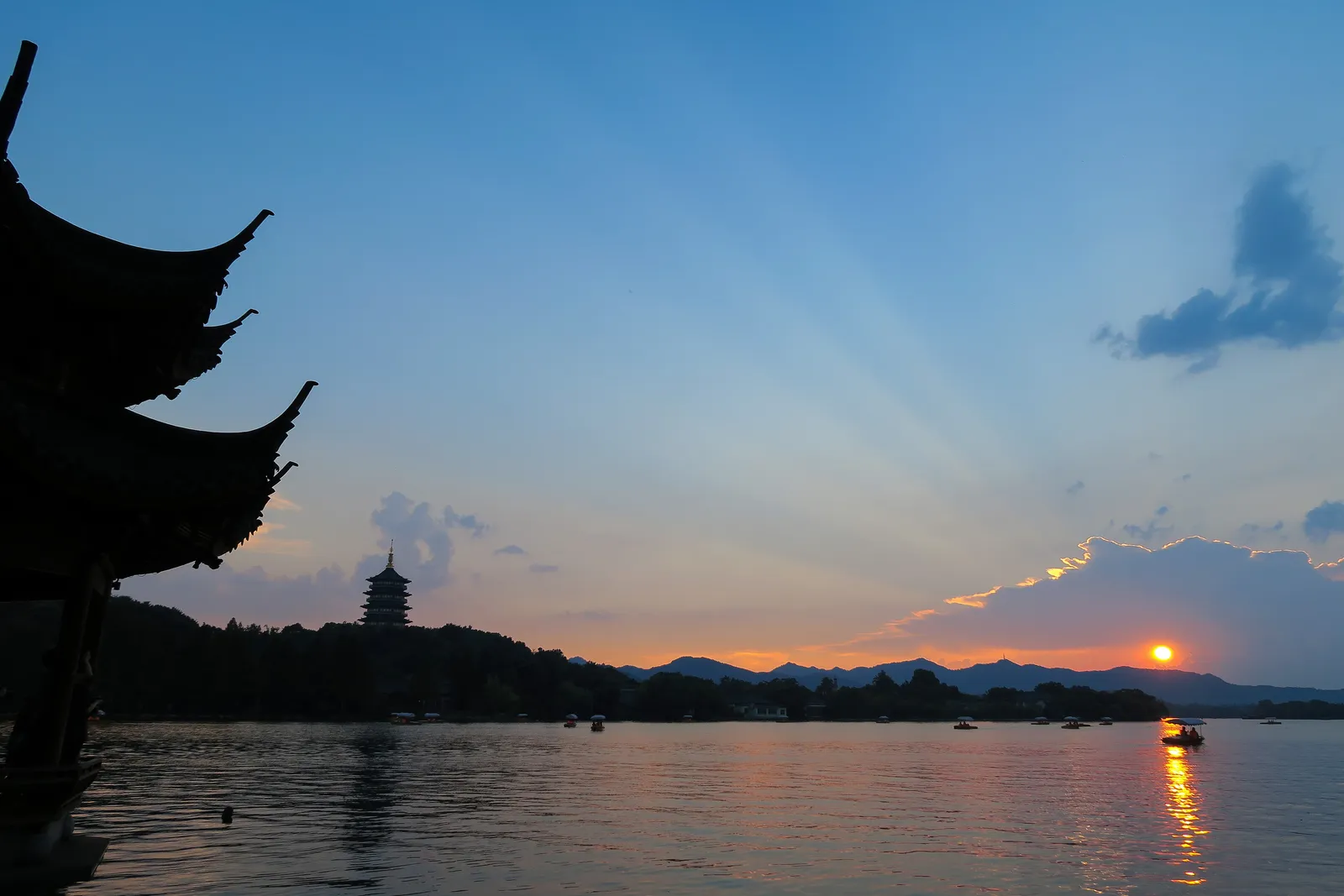
The White Snake and Leifeng Pagoda
Photo: Yinweichen · CC BY-SA 4.0
A snake spirit in love, a monk who stood in her way, and a real pagoda on West Lake that fell in 1924 and rose again.
Of all the stories told about West Lake, one is known to almost every child in China. It begins on a spring day, in the rain, on a bridge.
A borrowed umbrella
Legend says that two snake spirits spent centuries, a thousand years in many tellings, cultivating magic in the mountains until they could take human form. The elder became Bai Suzhen, the White Lady; the younger became her companion Xiaoqing, “Little Green”. Around the Qingming festival they came down to see West Lake. Near the Broken Bridge a sudden shower caught them, and a young man named Xu Xian, who worked in a herbal pharmacy, lent them his umbrella and shared a boat with them. He went back for the umbrella the next day, and before long the two were married and running a medicine shop of their own.
Then the monk Fahai appears. He sees what Bai Suzhen really is and warns her husband. At the Dragon Boat Festival, when families drank realgar wine to keep snakes and insects away, Xu Xian persuades his wife to drink a cup. She turns back into a great white snake, and he dies of fright. In the best-loved episode, Bai Suzhen, already pregnant, flies to a sacred mountain, steals a magic herb and brings him back to life. Later, when Fahai keeps Xu Xian at Jinshan Temple, she and Xiaoqing raise the waters against the temple to win him back, and fail. In the end the monk catches her in his alms bowl and seals her beneath Leifeng Pagoda.
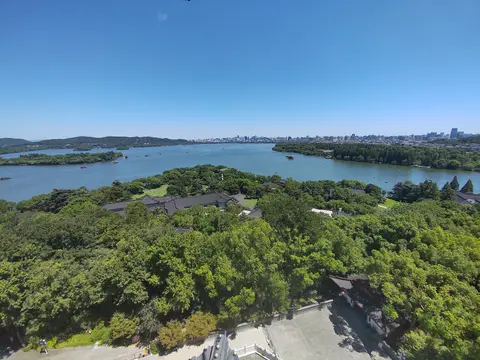 Sight in HangzhouWest Lake 西湖Hangzhou’s famous lake, ringed by hills, pagodas and willow-lined causeways. A UNESCO World Heritage site.
One story, many endings
The legend grew over centuries, and it has no single correct version. Its earliest forms were closer to a warning: a beautiful woman who is really a dangerous serpent. The first full written version is by the Ming writer Feng Menglong, in his 1624 collection Stories to Caution the World, under the title “Madame White Is Kept Forever Under Leifeng Pagoda”. There the young man is called Xu Xuan, the White Lady is still more feared than pitied, and the tale ends with a verse promising that she will come out only when the pagoda falls and the lake runs dry.
In 1771 the playwright Fang Chengpei reshaped the story for the stage. His White Lady is gentle and loyal, and she carries a child. Later operas added happier endings: in some, her son grows up, comes first in the imperial examinations and kneels before the pagoda until she is freed; in others, Xiaoqing returns with new powers and brings the pagoda down. Peking opera, Yue opera, films and television have retold it ever since, and in 2006 the legend joined China’s first national list of intangible cultural heritage.
The pagoda that really fell
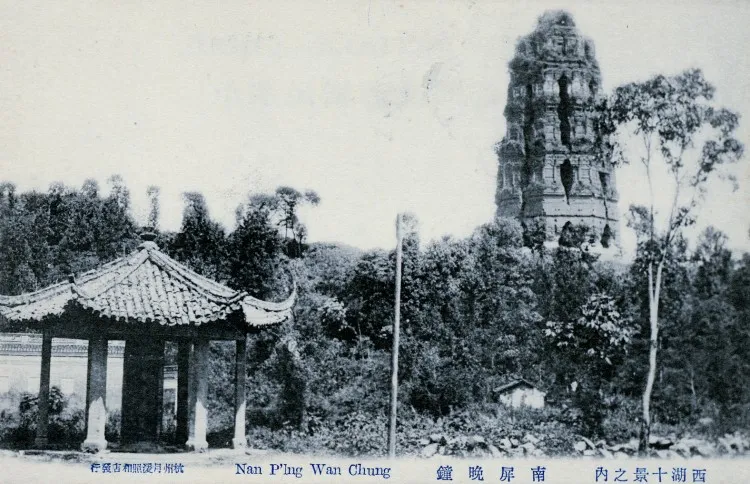
Leifeng Pagoda, unlike the White Lady, is history. It was built around 975–977 by Qian Chu, the last king of Wuyue, a small kingdom with its capital at Hangzhou. It stood on a low hill on the south shore and was first called the Huangfei Pagoda, after a royal consort; people soon named it after the hill instead. It was built to house a Buddhist relic, and some of its bricks held tiny rolled printed sutras dated to 975. War and fire damaged it more than once, and in the 16th century its wooden galleries burned away, leaving a bare brick tower. Its outline at sunset was already one of the Ten Scenes of West Lake.
Over generations people came to believe the bricks could cure illness or bring luck, and they carried them off one by one. On 25 September 1924 the old tower collapsed. Everyone who knew the legend noticed at once: the pagoda had fallen, even if the lake had not run dry.
In 2001 archaeologists opened the chamber beneath the ruins. Inside an iron casket was a silver stupa said to hold a hair relic of the Buddha, with gilt bronze statues and other offerings around it. A new pagoda, opened on 25 October 2002, now stands directly over the old foundations, which are protected inside it.
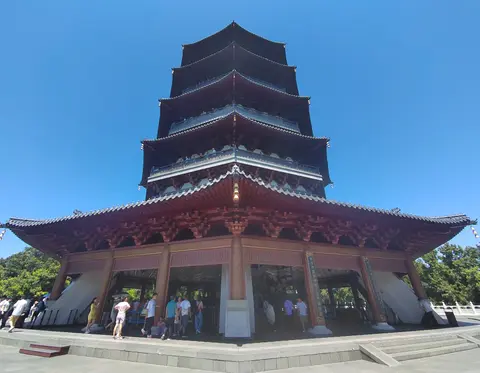 Sight in HangzhouLeifeng Pagoda 雷峰塔A rebuilt pagoda on the south shore, tied to the Legend of the White Snake, with wide views over the lake.
Visiting today
Today you ride up the hill to the pagoda and, on the lowest level, look down at the brick ruins of the thousand-year-old base. Upper floors show carvings of the White Snake story, and the top gallery looks out over the whole lake, best in the late afternoon light. Afterwards, cross the water to walk the Bai Causeway to the Broken Bridge, where the story began. See Leifeng Pagoda and West Lake for practical details.
Places in this story
Sources
- Hangzhou CPPCC: 100 years since Leifeng Pagoda fell, the story of its rebirth (Chinese) (hzzx.gov.cn)
- The Paper: A first-hand account of the 2001 excavation of the Leifeng Pagoda underground palace (Chinese) (thepaper.cn)
- CPPCC News: How the Legend of the White Snake evolved (Chinese) (rmzxw.com.cn)
- Wikipedia: Legend of the White Snake (secondary) (en.wikipedia.org)
- Wikipedia: Leifeng Pagoda (secondary) (en.wikipedia.org)
Legends are told as legends. Where historians disagree, we say so.
More stories
 HistoryThe well that found an armyIn 1974 farmers digging a well near Xi’an hit pieces of clay. They had found the First Emperor’s army, and the tomb it guards is still sealed.
 Travelers of the pastMarco Polo’s City of HeavenIn the 13th century a Venetian called Hangzhou the finest city in the world. What did he really see, and what is still there at West Lake?
 Food originsThe poet, the causeway and the porkSu Dongpo governed Hangzhou, saved West Lake and left his name on a causeway, and, people say, on its most famous braised pork.