
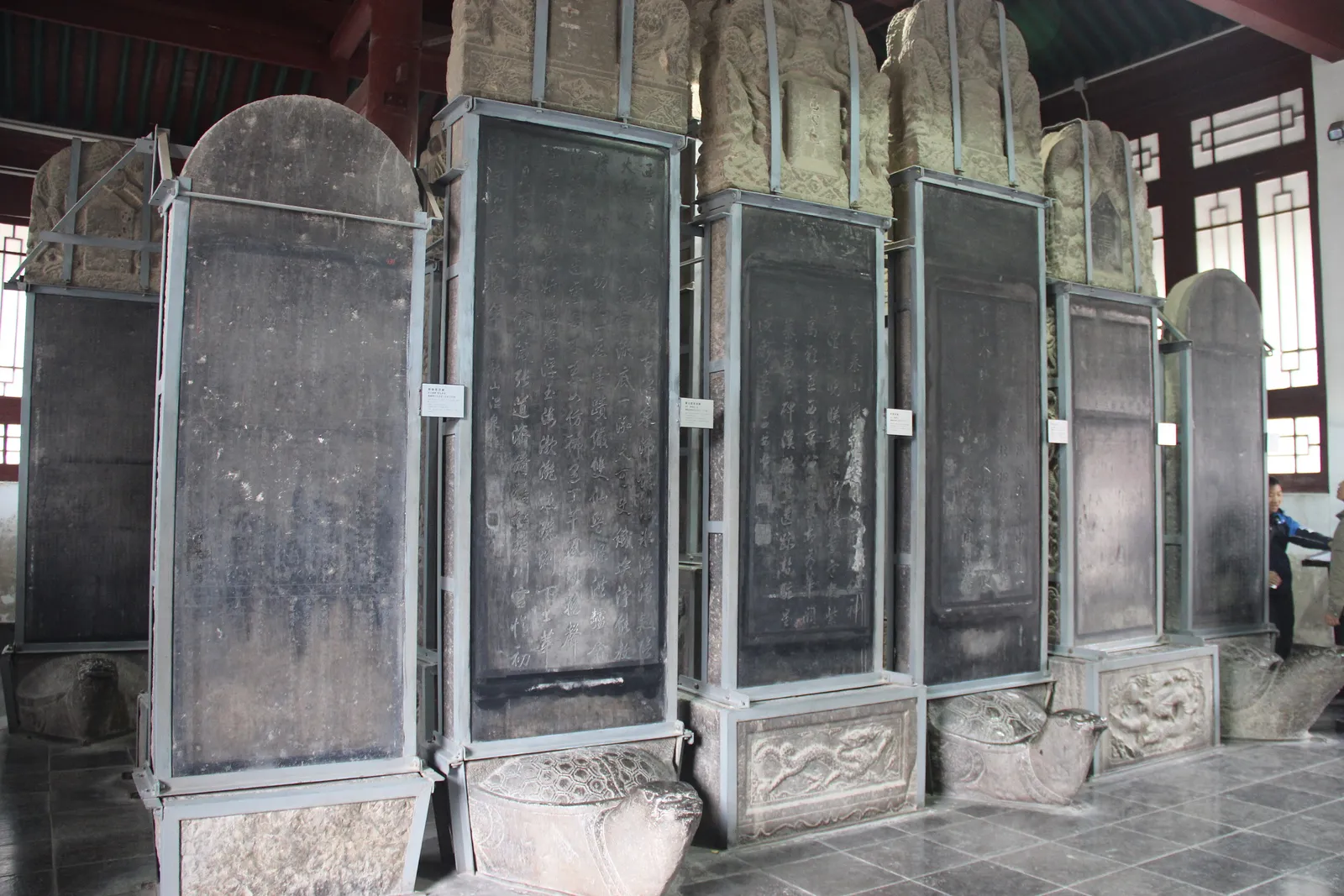
The library written in stone
Photo: Gary Todd from Xinzheng, China · CC0
In 837 Tang scholars finished carving twelve Confucian classics into 114 stones. An earthquake broke them; the Ming repaired them. They still stand.
Step into the first hall of Xi’an’s Beilin Museum and the noise of the city drops away. In front of you, in long rows, stand grey slabs taller than a person: 114 of them, each about 2.16 metres high, carved on both sides with tiny, even characters. There are more than 650,000 of them.
You are standing inside a book. More exactly, inside twelve books: the core texts that every educated man in Tang China was expected to know. The museum calls it a “stone library”, and that is no exaggeration. The whole set is known as the Kaicheng Stone Classics, after the reign period in which it was finished, in 837.
A problem of copies
Why carve a library? Because in the 9th century, books were copied by hand, and hand copies drift. Each scribe adds a slip, a variant character, a missing line. By the mid-Tang, students preparing for the civil service exams could not even be sure their copy of a classic said the same thing as their examiner’s.
The government had tried simpler fixes. In the 760s and 770s an official named Zhang Can checked the Five Classics and had a guide to their correct characters written up on the clay walls of the Imperial Academy’s lecture hall. Clay does not last: some sixty years later the walls were stained and flaking. A later head of the Academy had the work rewritten on wooden boards.
Then, in 830, a scholar-official named Zheng Tan put a bolder idea to Emperor Wenzong. The classics were full of errors, he wrote, and teachers passed them on uncorrected. He asked for learned men to check the texts and for the result to be cut in stone at the Academy, as the Han dynasty had once done, to serve as the standard for all time. The emperor agreed.
Four years of carving
Work began in 833 and ended in 837. Zheng Tan led a team of more than twenty scholars and officials, among them Ai Juhui and Chen Jie, who wrote out and checked the text. Stonecutters then carved it face by face.
The result is twelve works in 160 scrolls: the Book of Changes, the Book of Documents, the Book of Songs, three ritual classics, three commentaries on the Spring and Autumn Annals, the Analects, the Classic of Filial Piety and the Erya, an early dictionary. Titles are in the older clerical script; the text itself is in clean regular script, the standard hand of the Tang. Two small character guides were added at the end, so readers could check the correct form of a word. One of them is Zhang Can’s guide from the clay walls, now safe in stone.
The care shows. The scholar Yu Wanli notes that when researchers compared the stones with Tang dictionaries of correct characters, non-standard forms turned up only about once in a thousand characters, or even less.
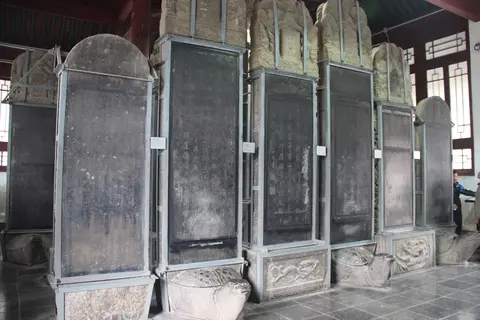 Sight in Xi'anBeilin Museum (Forest of Stone Steles) 西安碑林博物馆Halls of carved stone tablets, from Confucian classics to masterpieces of Chinese calligraphy, plus Buddhist sculpture.
One of seven
The Tang were not the first to try this. The Beilin Museum lists seven recorded projects to carve the Confucian canon in stone, from the Eastern Han, which began its set in 175, to the Qing. Five of them now survive only as broken fragments. Two are complete: the Kaicheng set in Xi’an, the only Tang one, and the Qianlong set in Beijing.
That Beijing set is worth knowing about. In the 18th century the Qianlong Emperor had the Thirteen Classics, copied out by the scholar Jiang Heng, carved on 189 tablets, about 630,000 characters in all. They still stand in the Imperial Academy. Next door, in the Confucius Temple, rows of other steles record the names of men who passed the highest exams. So Beijing has both: a complete stone canon and a stone roll of honour.
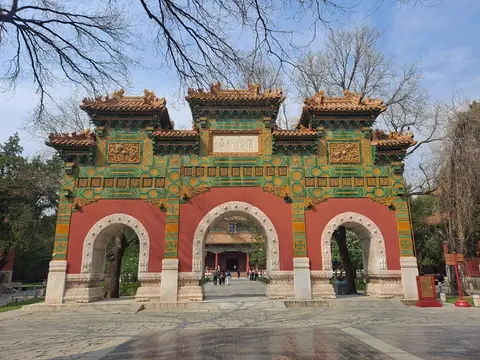 Sight in BeijingConfucius Temple and Imperial Academy 孔庙和国子监博物馆The imperial Confucian temple and the empire’s highest school side by side, with stone tablets naming centuries of exam graduates.
Moving a library
A library of this weight does not move easily, but this one has moved several times. At the end of the Tang the city of Chang’an was shrunk, and the old Academy ended up outside the new walls. The stones were taken into the Confucian temple.
In 1087 an official named Lü Dazhong found them on low, wet ground, soaked by rain and floodwater, and had them moved to the prefectural school. In 1103 the school, the temple and the stones were moved together to a new site in the south-east of the city. They have stood there ever since, and the Forest of Steles, the Beilin, grew up around them.
When stone broke
“Written in stone” sounds permanent. In January 1556 it was not. One of the deadliest earthquakes in recorded history struck the region, centred on Huaxian, east of Xi’an. Around forty of the 114 stones were broken or knocked down, and many others lost characters.
For three decades the damage stayed. Then, in 1588, a provincial official named Yao Jike organised a full repair. According to Yu Wanli, worn strokes were corrected, moss was cleaned off, leaning stones were set straight, and missing passages were restored by consulting printed books. About 53,000 replacement characters were carved on 96 smaller stones, 113 faces in all, and set beside the originals.
Those patches kept the classics readable, but they have a catch. They were based on the editions current in the Ming, not on the Tang text. Scholars therefore treat the Ming characters separately from the Tang carving.
The library kept growing, too. In the Qing, in the Kangxi era, the Mencius was carved and added, making a set of thirteen classics. And in the 1930s the architect Liang Sicheng drew up a plan to brace the heavy slabs against future earthquakes.
What you see today
The Kaicheng Stone Classics fill the first exhibition hall of the Beilin Museum. Walk the length of the rows first, just to feel the scale: this is a whole school curriculum, standing upright.
Then look closely. Find a face where the strokes are sharp and even, and you are reading the Tang. Look for cracks running across the lines, chipped edges and slightly different hands, and you are reading the history of 1556 and the repairs that followed. The small Ming supplement stones stand nearby.
Before you go in, notice the tall stele under its own roof in the courtyard in front: the Classic of Filial Piety, carved in 745 in the calligraphy of Emperor Xuanzong. It and the stone classics were the reason the Beilin was created. Our page on steles explains how to read a stele’s parts.
These books were made never to change. They did change: they broke, were patched and were added to. They are still here because each generation chose to look after them.
Places in this story
Sources
- Kaicheng Stone Classics (114 stones, 228 faces, seven recorded stone-classics projects) — Xi’an Beilin Museum (beilin-museum.com)
- Yu Wanli on the making, moves (1087, 1103), 1556 earthquake losses and 1588 Ming supplements of the Kaicheng Stone Classics — Sina News (news.sina.cn)
- Zheng Xuefu, The Kaicheng Stone Classics (Zheng Tan’s petition, Ai Juhui and Chen Jie, Qing Mencius supplement) — China Reading Weekly via Rujiawang (rujiazg.com)
- Yang Bing, Liang Sicheng’s 1930s seismic protection design for the Kaicheng Stone Classics — The Paper via Rujiawang (rujiazg.com)
- Guozijian (Imperial Academy) and the 189 Qianlong Stone Classics — Visit Beijing, Beijing Municipal Bureau of Culture and Tourism (english.visitbeijing.com.cn)
- The 1556 Huaxian earthquake: 40-plus Kaicheng stones toppled — Gansu Earthquake Agency (gsdzj.gov.cn)
Legends are told as legends. Where historians disagree, we say so.
More stories
 HistoryThe well that found an armyIn 1974 farmers digging a well near Xi’an hit pieces of clay. They had found the First Emperor’s army, and the tomb it guards is still sealed.
 LegendsThe White Snake and Leifeng PagodaA snake spirit in love, a monk who stood in her way, and a real pagoda on West Lake that fell in 1924 and rose again.
 Travelers of the pastMarco Polo’s City of HeavenIn the 13th century a Venetian called Hangzhou the finest city in the world. What did he really see, and what is still there at West Lake?