
How an Emperor Got the Lanting Preface
The most admired calligraphy in China is lost. Old accounts say an emperor's agent tricked it from a monk, then the emperor took it to his grave.
The Lanting Preface (兰亭序, Lántíng Xù) is the most celebrated piece of writing in Chinese calligraphy, and nobody alive has seen the original. Tradition says Emperor Taizong of the Tang dynasty (reigned 626 to 649) got it from an old monk by a trick and had it buried with him. The best-known version of that tale comes from one writer, and another Tang account contradicts it. Here is what each says.
An afternoon by a stream
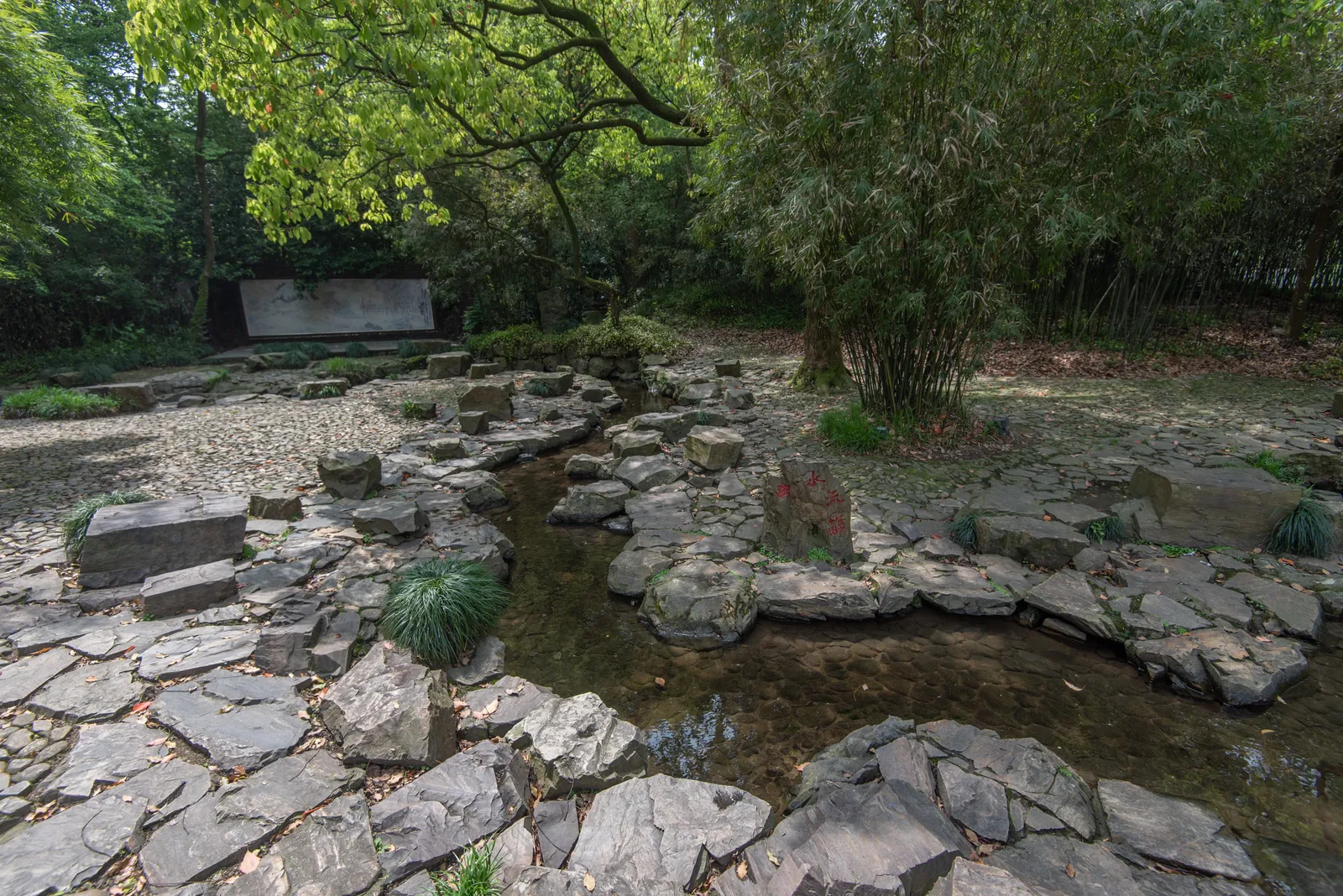
On the third day of the third lunar month in 353, Wang Xizhi (王羲之, 303 to 361) gathered friends and relatives at the Orchid Pavilion near Kuaiji, today's Shaoxing, for a spring purification. About 41 or 42 people came. They sat beside a winding stream and floated cups of wine on it. Whoever a cup stopped near had to make a poem or drink. Twenty-six of them produced poems, 37 in all.
Wang wrote a preface for the collection. The Tang writer He Yanzhi describes 28 columns and 324 characters, on silk-cocoon paper with a mouse-whisker brush. Tradition says the character 之 appears about twenty times, each one written differently; the original is lost, so this rests on the copies and old descriptions. He Yanzhi adds that Wang tried again later many times, after the wine wore off, and never matched it.
The monk's roof beam
The great story comes from *Record of the Lanting* (《兰亭记》), written by He Yanzhi in the early 8th century. He says he heard it from Yuansu, a disciple of the monk at its centre, who was 93 years old when they spoke in 703.
In He's telling, the scroll passed down Wang's family to a descendant who became a monk, Zhiyong, who left it to his pupil Biancai (辩才). Biancai cut a hidden space into the roof beam above his bed and kept it there.
Emperor Taizong loved Wang's writing and had collected everything except this. Three times he summoned the old monk to court and questioned him. Three times Biancai said it had been lost in the wars. Taizong told his ministers he lost sleep over it. His chief minister, Fang Xuanling, proposed an agent: Xiao Yi, a censor with a talent for scheming.
Xiao Yi refused to go as an envoy. He asked for some of Wang's letters from the palace collection and travelled south by merchant boat, dressed as a scholar down on his luck, claiming to sell silkworm eggs. At the temple he happened to pass Biancai's door. They played go and the qin, drank, and wrote poems to each other. It went on for weeks. Then Xiao Yi showed him the palace letters. Biancai looked them over, said they were not bad, and announced that he owned something better.
He took the scroll down from the beam. Xiao Yi pretended to find fault and called it a tracing. Stung, the old man stopped hiding it and left it out on his desk to practise from. One day, when Biancai had gone out to a meal, Xiao Yi called at his room and told the pupil he had left something behind. He picked up the scroll and rode for the post station, where he showed his imperial order. Biancai was called in, and saw that the censor was his friend. He fainted.
Taizong spared the monk and later sent him gifts. Biancai did not dare use them himself and spent them on a three-storey pagoda. He could eat only gruel after that, He says, and died a little over a year later.
A different account
Liu Su's *Sui Tang Jiahua*, another Tang collection, tells it very differently. The scroll left the imperial collection during the wars of the 6th century, and passed through monks and imperial hands. The future Taizong saw a rubbing and offered a high price for the original, without success. When he learned that the monk Biancai had it, he sent Xiao Yi (written 萧翊) to Yue, the Shaoxing area, who "sought and got it". There is no mention of disguise or go. Liu even says it reached his palace in 621, when he was still a prince.
So the great trick cannot be proved, and it may be largely a good story. Later historians have also argued over how much of it to believe. Treat it as a tale from the Tang, not a police report.
Into the tomb
Both accounts agree on the ending. He Yanzhi has the dying emperor ask his son for a last favour: "I want to take the Lanting with me." Liu Su says a minister, Chu Suiliang, advised that it should not stay above ground. According to these Tang accounts, it was sealed in Taizong's tomb, Zhaoling. The original has never been found. A warlord named Wen Tao is recorded as looting Zhaoling in the 10th century. The records say he took writing by Zhong Yao and Wang Xizhi but do not name the Preface, which only feeds speculation.
Before that, Taizong had his court craftsmen make copies. The most admired one now, the Shenlong copy attributed to Feng Chengsu, is in the Palace Museum in Beijing. Every image of the Preface you see descends from copies like this. In the 1960s scholars even argued about whether Wang wrote it at all, and most accept today that he did.
Visiting
In Shaoxing, the Orchid Pavilion has a winding stream and a pavilion, and Wang's old home is remembered at Shusheng Guli. Neither has the original. Nobody does.
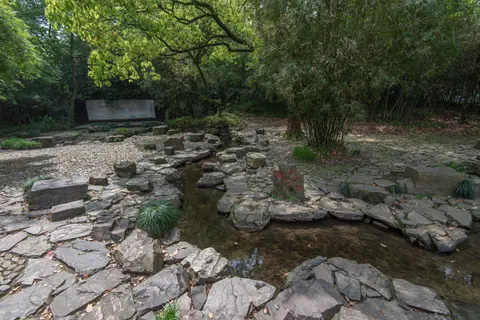 Sight in ShaoxingOrchid Pavilion (Lanting) 兰亭The garden remembered for 353, when Wang Xizhi and over 40 guests met to write poems and he wrote the Lanting Preface, China’s most admired calligraphy.
Places in this story
Sources
- He Yanzhi, Record of the Lanting (Chinese text) (zh.wikisource.org)
- Liu Su, Sui Tang Jiahua (Chinese text) (zh.wikisource.org)
- Qi Gong: A study of the Lanting rubbing, on the differing accounts (Chinese) (aisixiang.com)
- Wikipedia: Lantingji Xu (secondary) (en.wikipedia.org)
- Wikipedia (Chinese): Lanting Preface, on Zhaoling and Wen Tao (secondary) (zh.wikipedia.org)
- Wikipedia (Chinese): Wang Xizhi (secondary) (zh.wikipedia.org)
Legends are told as legends. Where historians disagree, we say so.
More stories
 HistoryThe well that found an armyIn 1974 farmers digging a well near Xi’an hit pieces of clay. They had found the First Emperor’s army, and the tomb it guards is still sealed.
 LegendsThe White Snake and Leifeng PagodaA snake spirit in love, a monk who stood in her way, and a real pagoda on West Lake that fell in 1924 and rose again.
 Travelers of the pastMarco Polo’s City of HeavenIn the 13th century a Venetian called Hangzhou the finest city in the world. What did he really see, and what is still there at West Lake?