
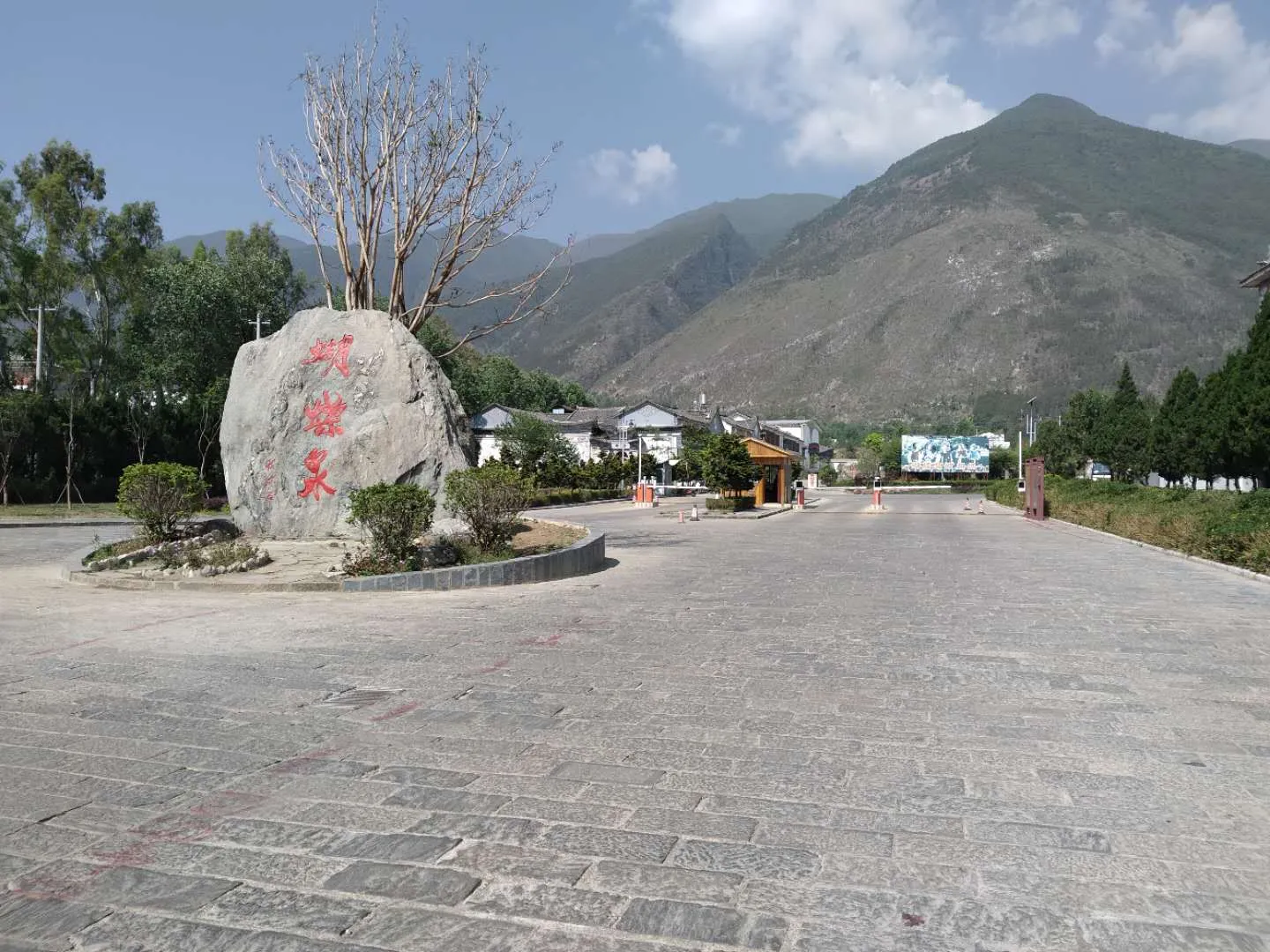
Two Lovers and a Spring Full of Butterflies
A Bai legend says two lovers leapt into this pool and came back as butterflies. A Ming traveller saw the butterflies, and never heard of the lovers.
Butterfly Spring (蝴蝶泉, Húdié Quán) is a small square pool at the foot of the Cangshan mountains, north of Dali. Bai legend says it was once a bottomless pool, and that it got its name when two young lovers leapt in to escape a cruel king and rose again as butterflies. The legend cannot be dated. The butterflies, though, are on record: a traveller described them in 1639, and his description is as strange as the story.
The legend
There are several versions. This is the one most often told today.
Long ago, in a village called Yangjiao below Yunnong Peak, lived a young woman named Wengu, known for her skill and hard work. On the peak above lived a young Bai hunter named Xialang, strong and kind. They met at the mountain fair on the third day of the third lunar month, fell in love at once and promised themselves to each other.
Below the mountains ruled a cruel king, Yu Wang. He heard about Wengu's beauty and decided she would become his eighth consort. His men seized her and carried her off to his palace.
Xialang crept into the palace at the risk of his life and got her out. The king found out and chased them with soldiers. Exhausted, the two reached the edge of the Bottomless Pool (无底潭) with torches and spears close behind them. They jumped in together.
The next day, villagers came to search for the bodies and found nothing. Instead a great bubble rose from the depths, and out of it flew a pair of bright butterflies. They danced together above the water, and butterflies came from all sides to join them. From then on, people called the pool Butterfly Spring. Legend says that day was the 15th of the fourth lunar month, and that the butterflies gather every year to retell the story.
If it sounds familiar, you may know the Liang-Zhu story from eastern China, The lovers who became butterflies. The two tales are not the same, but they end in the same way.
The traveller who came too early
The geographer and traveller Xu Xiake (徐霞客, Xú Xiákè) came through in 1639. He had heard about the spot long before, from a man he met in Guangxi, so he sent his porter ahead and went to look. At a village called Boluo, west toward the foot of the hills, he found a big tree leaning against the cliff, with clear water running out from among its roots, and a smaller tree and spring beside it. The two springs made one pool.
Here is what his diary says about the tree. Early in the fourth lunar month it flowers, and the flowers look like butterflies, with whiskers and wings. Real butterflies then come in their thousands. They hang from the top of the tree down to the surface of the spring, linked to each other foot to foot, in all five colours. Visitors come in crowds that month, he writes, and the sight ends after the fifth month.
He had come too early. The tree was not in flower. He asked the locals why it happens. Some said the butterflies were the flowers transformed, others that the insects came because the flowers looked like them. He could not decide. In the end, he broke off a branch to take with him and drew a picture of its leaves.
Two details matter. Xu's long entry says nothing about any lovers, which does not disprove the legend but does mean we have no early record of it. And one researcher, Ludwig Brinckmann of the YunnanExplorer site, suspects that Xu's spring may lie a little to the south of the park you visit today. It is not settled.
How it became famous
The modern fame of the spring owes a great deal to a film. *Five Golden Flowers* (《五朵金花》, 1959), a musical comedy about young Bai people, used a scene set at the spring and made its name known across China. Bai people still hold a Butterfly Festival (蝴蝶会) there on the 15th day of the fourth lunar month, the day given in the legend, with songs and dances.
What you will see
Be ready for less than Xu saw. Local writers say the great gatherings have become rare, and they point to the loss of an old flowering hedge over the water and to pesticide use in nearby fields. Today the site is a park with a pool of about 50 square metres, edged in marble, and the clear water still comes from under an old tree. Our own page says butterflies are most numerous around April and May, and at other times of year it is a pleasant garden rather than a spectacle.
For hours and tickets, see Butterfly Spring.
 Sight in DaliButterfly Spring 蝴蝶泉A clear spring under an old tree at the foot of Cangshan, made famous by a Bai love story and a classic 1959 film.
Places in this story
Sources
- Xu Xiake, Travels: Diary of Yunnan, part 8 (Chinese text) (zh.wikisource.org)
- Bendibao: Butterfly Spring, the legend and what has changed (Chinese) (m.bendibao.com)
- YunnanExplorer: Butterfly Spring (yunnanexplorer.com)
- YunnanExplorer: Butterfly Festival (yunnanexplorer.com)
- Wikipedia (Chinese): Butterfly Spring (secondary) (zh.wikipedia.org)
Legends are told as legends. Where historians disagree, we say so.
More stories
 HistoryThe well that found an armyIn 1974 farmers digging a well near Xi’an hit pieces of clay. They had found the First Emperor’s army, and the tomb it guards is still sealed.
 LegendsThe White Snake and Leifeng PagodaA snake spirit in love, a monk who stood in her way, and a real pagoda on West Lake that fell in 1924 and rose again.
 Travelers of the pastMarco Polo’s City of HeavenIn the 13th century a Venetian called Hangzhou the finest city in the world. What did he really see, and what is still there at West Lake?