
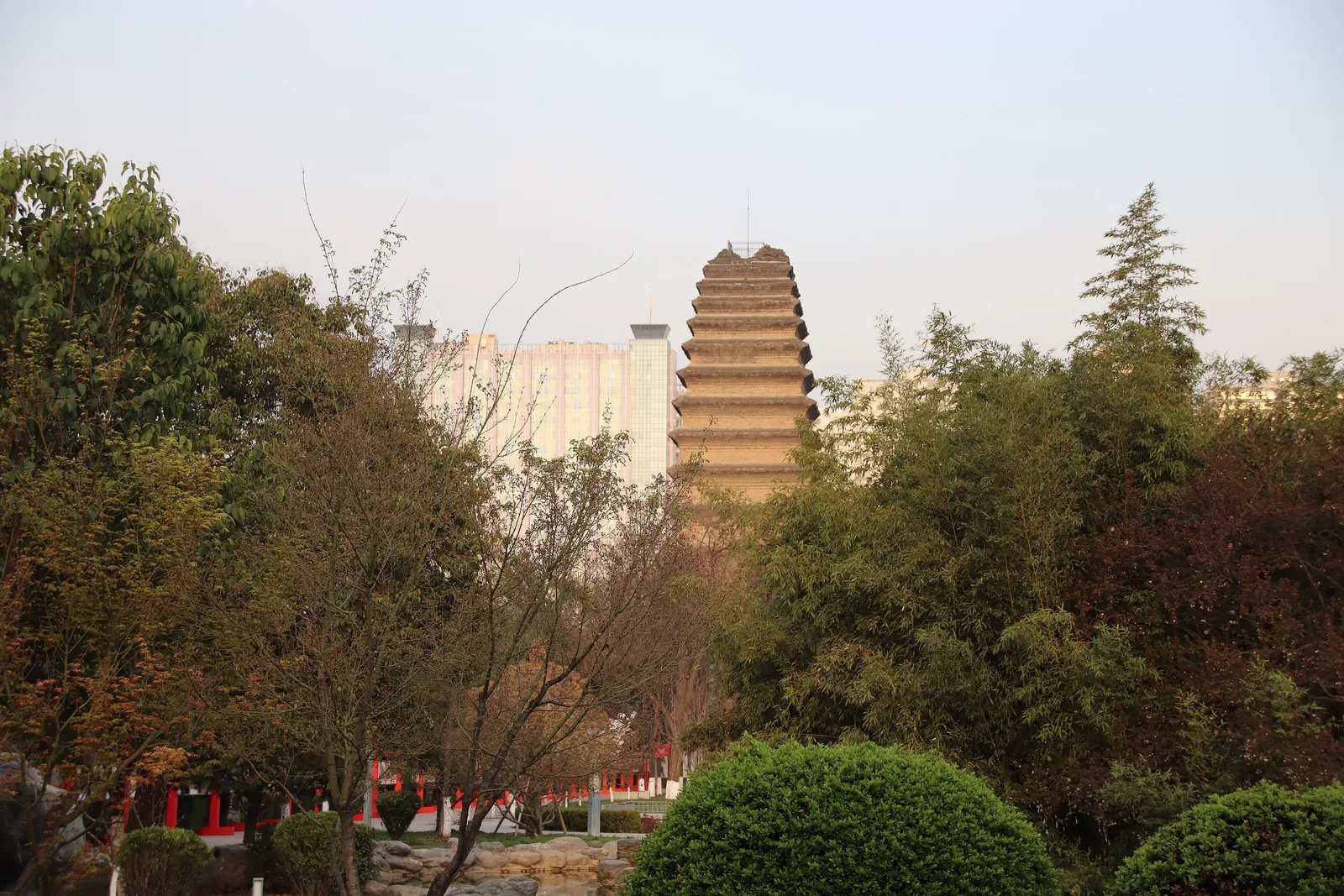
The pagoda that was said to heal itself
Photo: Gary Todd from Xinzheng, China · CC0
A Ming inscription claims an earthquake split Xi’an’s Small Wild Goose Pagoda and another closed it. The real rescue came in 1964.
Picture a street in Xi’an at the end of the 15th century. Above the rooftops rises a slim brick tower, already some 780 years old. And straight down the middle of it, from the top almost to the ground, runs a gap wide enough to let the sky through.
That, at least, is what a man named Wang He carved into the stone lintel of the Small Wild Goose Pagoda in 1551. His short text says that at the end of the Chenghua reign an earthquake struck Chang’an and the tower split from top to foot, a crack about a foot wide, as bright as a window, which passers-by often saw. Then, at the end of the Zhengde reign, the earth shook again, and in a single night the pagoda was whole, as if spirits had joined it back together.
Historians date those two earthquakes to about 1487 and 1521. The inscription is still there. So is the pagoda. The question is what really happened in between.
A tower for a traveller’s books
The story of the building starts with a monk who went to India by sea. Yijing was born in 635 and became a monk as a boy. In 671 he boarded a Persian ship in Guangzhou, spent six months in Srivijaya on Sumatra, and went on to the great monastery of Nalanda in India, where he studied for about ten years.
He came home in 695 with some 400 Buddhist texts. Empress Wu Zetian herself received him at Luoyang. For the rest of his life, until his death in 713, Yijing led teams of Indian and Chinese monks who translated 56 of those works. In his last years he worked at Jianfu Temple in Chang’an, the Tang capital that is now Xi’an. You can read more about him in our entry on Yijing.
The pagoda came soon after. Between 707 and 710 a separate pagoda courtyard was laid out just south of the temple, paid for by women of the imperial palace and supervised by a monk named Dao’an. It is often said the tower was meant to keep the texts and translations Yijing had brought back. Whatever its exact purpose, it belonged to the same world of scholars, scrolls and long journeys.
Later generations called it the Small Wild Goose Pagoda, to set it apart from the bigger and older Big Wild Goose Pagoda across town, which is tied to that other famous traveller, Xuanzang.
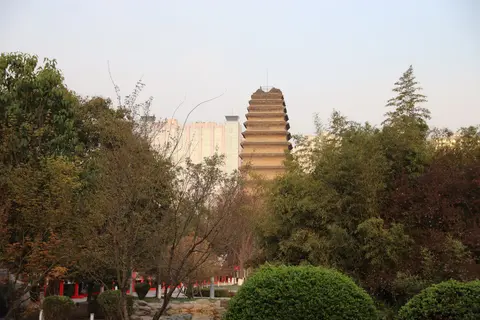 Sight in Xi'anXi’an Museum & Small Wild Goose Pagoda 西安博物院(小雁塔)A free city museum and the slender Tang pagoda of Jianfu Temple, where the monk Yijing translated texts he brought back from India.
How it was built
The Small Wild Goose Pagoda is a dense-eave pagoda. A tall ground storey carries a stack of tightly spaced roofs, each a little lower and narrower than the one below, so the whole outline curves gently inwards like a bullet. It was built with fifteen storeys, about 45 metres in all.
Inside, it is a hollow brick tube. On the north and south faces, small arched windows sit one above the other on every level. Those windows matter for our story: they line up into a vertical stripe of weaker masonry, like the perforation on a stamp.
Underneath lies a broad pad of rammed earth. According to studies of the foundation summarised by the architecture writers of the Wuyong Research Society, it spreads far beyond the base of the tower and is shaped like a shallow bowl, about 2.4 to 3.6 metres thick in the middle and thinner at the edges.
Legend and history
Now back to Wang He’s inscription. Was it simply invented? Probably not entirely. The cracks were real. What later tellers did was add to the pattern. One Qing-era local gazetteer says the tower split again in the great earthquake of 1556 and closed “without a trace” in a later tremor. Another writer recorded a split in 1691 and a closing in 1721. Together these became the tale of “three splits and three closings” that guides still tell today.
The museum that looks after the pagoda is clear about it. Speaking to CCTV in 2023, Li Yan, deputy director of the Xi’an Museum, said two major Ming earthquakes really did damage the tower, but it could not have cracked open and then closed itself. The first earthquake opened the cracks. The second knocked off its top.
Note that this pair is not the pair in the inscription. The first is the quake of about 1487. The second, the one that took the top, was almost certainly the catastrophic earthquake of early 1556, centred on Huaxian east of Xi’an, one of the deadliest in recorded history. It brought down the top two storeys of the pagoda. Since then it has had thirteen storeys and a blunt, flat top. A survey in 1989 measured it at 43.395 metres.
The real healing
So who closed the crack? People did. In 1964 the state paid for a full repair. Li Yan described it as a model of restoring an old building: the cracks were closed and the structure was made sound. It was possible, Li Yan said, because for all the shaking the tower had never shifted off its central axis.
The repair also told restorers about the tower’s past. They found that the upper bricks were laid in yellow mud, as Tang builders did, while the ground storey had been thickened later with lime-bonded brick: older patches over older wounds.
Why did the pagoda bend instead of falling? No one can say for certain. Some researchers point to the bowl-shaped foundation, which may have spread the shaking evenly. Others point to the thick, solid east and west walls. Those are reasonable ideas, not proven facts. What we know is that the tower cracked, survived, lost its top, and was saved by careful repair.
What you see today
The pagoda now stands in the grounds of the Xi’an Museum, among old trees and the halls of Jianfu Temple. Walk round it slowly before you go in.
From a distance, look at the top: that flat stop where the curve should continue is the 1556 earthquake, left as it is rather than rebuilt from guesswork.
Up close, look at the stone door frames on the north and south sides. They are covered with fine Tang line engravings of flying celestial musicians, a bird-bodied kalavinka, scrolling clouds and flowers, even a waist drum from Central Asia. Later visitors carved their own words over parts of them, and somewhere among those later lines is Wang He’s account of the crack.
In the temple grounds hangs a great bell. Its morning ringing, together with the tower, was counted among the Eight Views of Guanzhong, the old list of the region’s finest sights.
Then compare the pagoda with the Big Wild Goose Pagoda. One recalls Xuanzang’s overland road through Central Asia, the other the sea route that carried Yijing through Southeast Asia. And the small one carries a second lesson: it did not heal itself. Generations of builders, monks and restorers kept it standing.
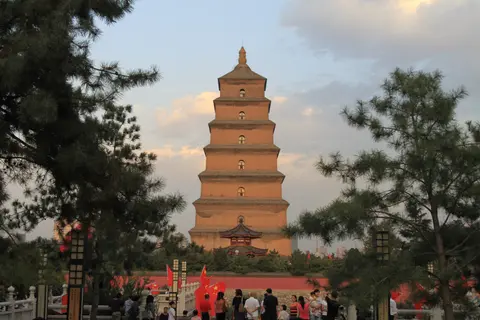 Sight in Xi'anBig Wild Goose Pagoda 大雁塔A Tang dynasty pagoda built for scriptures brought back from India, with a fountain show at night.
Places in this story
Sources
- Yijing (635–713) — Bibliothèque nationale de France, Patrimoines partagés France–Chine (heritage.bnf.fr)
- Xi’an Museum deputy director Li Yan on the Ming earthquakes and the 1964 repair — CCTV News via Hubei Daily (2023-08-01) (news.cnhubei.com)
- Small Wild Goose Pagoda: 1,300 years of a Chang’an pagoda (construction, Wang He inscription, foundation, 1960s repair) — Wuyong Research Society, The Paper (thepaper.cn)
- The 1556 Huaxian earthquake and its damage to Xi’an monuments — Gansu Earthquake Agency (gsdzj.gov.cn)
Legends are told as legends. Where historians disagree, we say so.
More stories
 HistoryThe well that found an armyIn 1974 farmers digging a well near Xi’an hit pieces of clay. They had found the First Emperor’s army, and the tomb it guards is still sealed.
 LegendsThe White Snake and Leifeng PagodaA snake spirit in love, a monk who stood in her way, and a real pagoda on West Lake that fell in 1924 and rose again.
 Travelers of the pastMarco Polo’s City of HeavenIn the 13th century a Venetian called Hangzhou the finest city in the world. What did he really see, and what is still there at West Lake?