
The scroll of a city on a spring day
Photo: Windmemories · CC BY-SA 4.0
A silk scroll traditionally said to show the Northern Song capital, now Kaifeng, is China’s best-known painting. Much about it is uncertain.
Unroll the scroll from right to left and you walk out of the countryside, follow a river past crowded wharves, squeeze across a busy bridge and pass under a city gate. It is about 25 centimetres high and more than 5 metres long, painted in ink and colour on silk. Along the River During the Qingming Festival (Qingming Shanghe Tu) is often called the most famous painting in China. It is attributed to Zhang Zeduan and is traditionally taken to show the capital of the Northern Song dynasty, Bianjing, today’s Kaifeng.
A painter we barely know
Almost everything about the painter is uncertain. His dates are usually given as 1085 to 1145, and many written records were destroyed when the Jin dynasty overthrew the Northern Song in 1127. The earliest attribution to Zhang Zeduan is an inscription dated 1186 added to the scroll by the Jin scholar Zhang Zhu, who cites an earlier catalogue. According to it, he was a native of Dongwu who went to the capital to study, then learned painting, and mastered jiehua, the ruled-line style used for buildings, with a special pleasure in boats, carts, markets, bridges, city walls and streets.
A capital of a million people
Bianjing was the Northern Song capital from 960 to 1127. It had three walled enclosures, for the palace, the inner city and the outer city, and the outer wall ran about 27 kilometres. The Bian River linked it to the Yellow River and the Grand Canal, bringing goods from north and south. Trade spilled out of the old walled markets into the streets, and the population is estimated at around a million.
We have a second witness. Meng Yuanlao left the city around its fall and later wrote the Dongjing Meng Hua Lu, “Dreams of Splendour of the Eastern Capital”, with a preface dated 1147. It records festivals, street entertainers and more than a hundred dishes and snacks, and its spring chapters are often read alongside the scroll.
What the scroll shows
At the right-hand end are fields, a country path and farmers and herders. The path widens into a road, the river bends, and the city gradually takes over. At the centre is a great arched wooden bridge, the Rainbow Bridge. A boat with its mast not fully lowered seems about to strike it; people shout and point, and someone lets down a rope to the crew. Around it are shops selling wine, grain, lanterns and medicine, inns, a tax office, and peddlers, jugglers, fortune tellers, doctors, teachers and monks. One count finds 814 people, 28 boats, 60 animals and 170 trees, and only about twenty women.
What nobody can be sure of
Scholars have studied the painting closely and still disagree on basic points. Even the title is uncertain, because “Qingming” can mean the festival, or it can mean “peace and order”. Some now question three things long taken for granted: that the city is Kaifeng, that the work was painted before 1127, and that it shows the festival. They suggest an idealised city, a date after the fall of the dynasty, and an early-autumn scene. Other scholars accept that it is Kaifeng but think it shows a day in the Qingming solar term rather than the festival itself.
One proposed reading is that the painting is a quiet warning to the emperor. Kaifeng depended on grain from the far south, yet the docks and gate show only a few guards who look inattentive, and “Qingming” would then be an ironic echo of a phrase meaning a bright and enlightened age.
Copies complicate things further. Artists made hundreds of copies and reinterpretations over the centuries. A Ming version attributed to Qiu Ying replaces the wooden bridge with a stone one, and a Qing court version presented in 1737 shows over 4,000 people. Treat no detail as a photograph.
Where the scroll is
The Song-dynasty scroll is kept at the Palace Museum in Beijing. Silk this old is fragile, so it is shown only rarely and for short periods, and exhibitions have drawn queues of several hours. Copies and later versions are held in museums across Asia, Europe and North America. Do not plan a trip around seeing the original; check the museum’s own announcements first.
Kaifeng today
Most of the Song city lies underground. The Yellow River flooded Kaifeng again and again, notably in 1642 and 1841, and the silt buried streets and buildings under later ones. Excavations have found Song city walls and traces of the Bian River, and the Ming and Qing walls often follow Song and Jin foundations. So the old capital survives as layers, with a few buildings above ground.
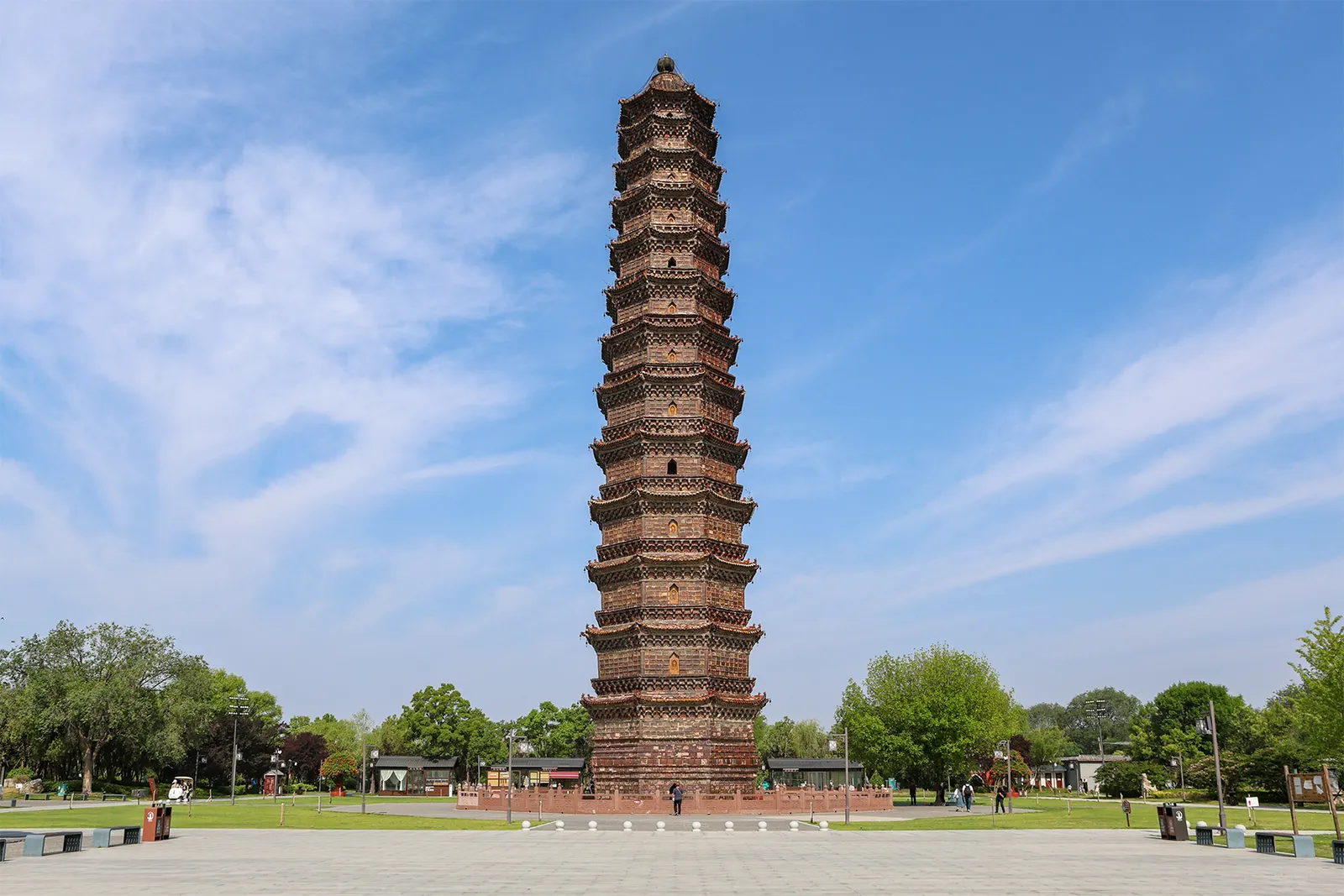
The Iron Pagoda, finished in 1049 after lightning burned an earlier wooden pagoda, is about 55 metres tall, with 13 storeys of glazed brick whose colour resembles iron. It has outlasted floods and earthquakes.
 Sight in KaifengIron Pagoda 铁塔公园A slender 13-storey pagoda from 1049, about 55 m tall, faced with brown glazed tiles that look like iron and decorated with hundreds of moulded Buddhas, dragons and musicians; it has survived floods and earthquakes for almost a thousand years.
Daxiangguo Temple, founded in 555, was a royal temple in the Song. A Yellow River flood destroyed it in the late Ming, and the present halls were rebuilt under the Qing.
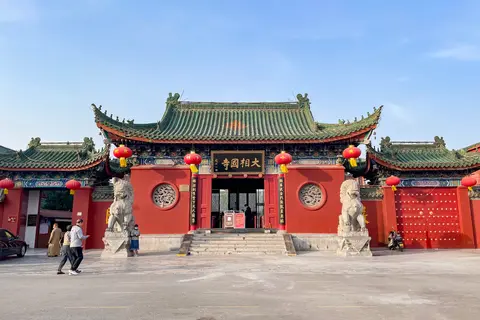 Sight in KaifengDaxiangguo Temple 大相国寺A Buddhist temple founded in 555 that was the state temple of the Northern Song; the present halls are mostly Qing, and the octagonal Glazed Hall holds a four-faced, thousand-armed Guanyin said to be carved from a single ginkgo tree.
Kaifeng Museum covers the city’s long history as a capital.
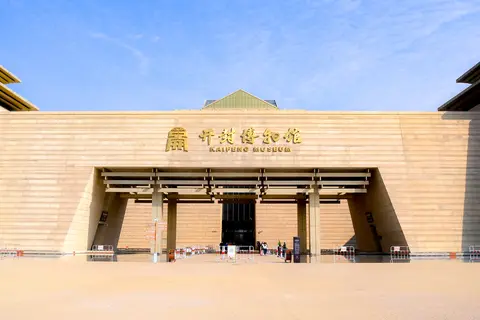 Sight in KaifengKaifeng Museum 开封市博物馆The city museum’s large new building in the western new district, with galleries on Kaifeng as capital of seven dynasties, Song-dynasty finds and the layers of cities buried under the present one by Yellow River floods.
Kaifeng’s Qing-dynasty city wall stands on older foundations and can be walked in part.
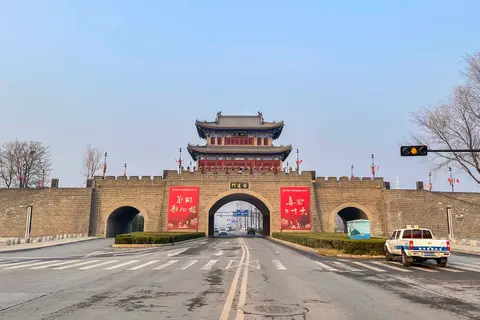 Sight in KaifengKaifeng City Wall 开封城墙About 14 km of Qing-dynasty wall, rebuilt after the Yellow River flood of 1841 on top of older walls, and one of the most complete city walls in China; a walkable section runs along the west and north sides from Daliang Gate.
Qingming Riverside Park is a modern recreation inspired by the scroll, with a roughly 70-minute water show called Dongjing Menghua, named after the memoir. It is a theme park, not a Song survival.
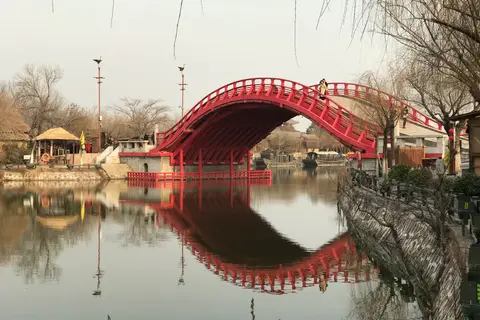 Sight in KaifengQingming Riverside Park (Millennium City Park) 清明上河园A large theme park that rebuilds the Song-dynasty scroll “Along the River During the Qingming Festival”: canals, a rainbow bridge, shops and costumed street shows by day, and the big outdoor night show “Dongjing Menghua” on the water.
For the wider city, see [[city:kaifeng]].
Places in this story
Sources
- Wikipedia: Along the River During the Qingming Festival (en.wikipedia.org)
- Wikipedia: Zhang Zeduan (en.wikipedia.org)
- Wikipedia: Bianjing (en.wikipedia.org)
- Wikipedia: Dongjing Meng Hua Lu (en.wikipedia.org)
- Wikipedia: Kaifeng (en.wikipedia.org)
- Wikipedia: Iron Pagoda (en.wikipedia.org)
- Wikipedia: Daxiangguo Temple (en.wikipedia.org)
- Wikipedia: Kaifeng Museum (en.wikipedia.org)
Legends are told as legends. Where historians disagree, we say so.
More stories
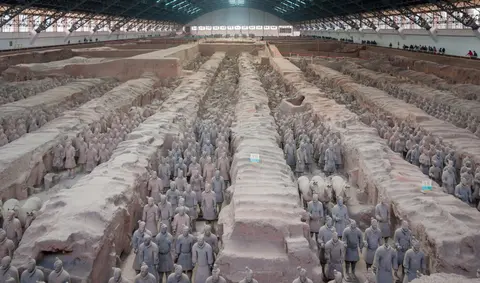 HistoryThe well that found an armyIn 1974 farmers digging a well near Xi’an hit pieces of clay. They had found the First Emperor’s army, and the tomb it guards is still sealed.
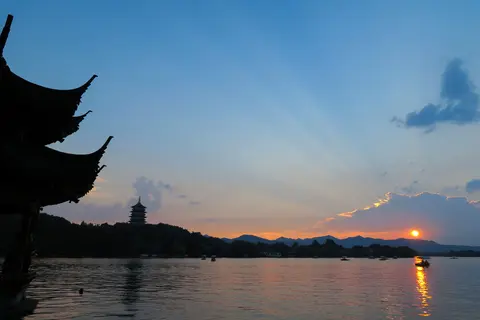 LegendsThe White Snake and Leifeng PagodaA snake spirit in love, a monk who stood in her way, and a real pagoda on West Lake that fell in 1924 and rose again.
 Travelers of the pastMarco Polo’s City of HeavenIn the 13th century a Venetian called Hangzhou the finest city in the world. What did he really see, and what is still there at West Lake?