
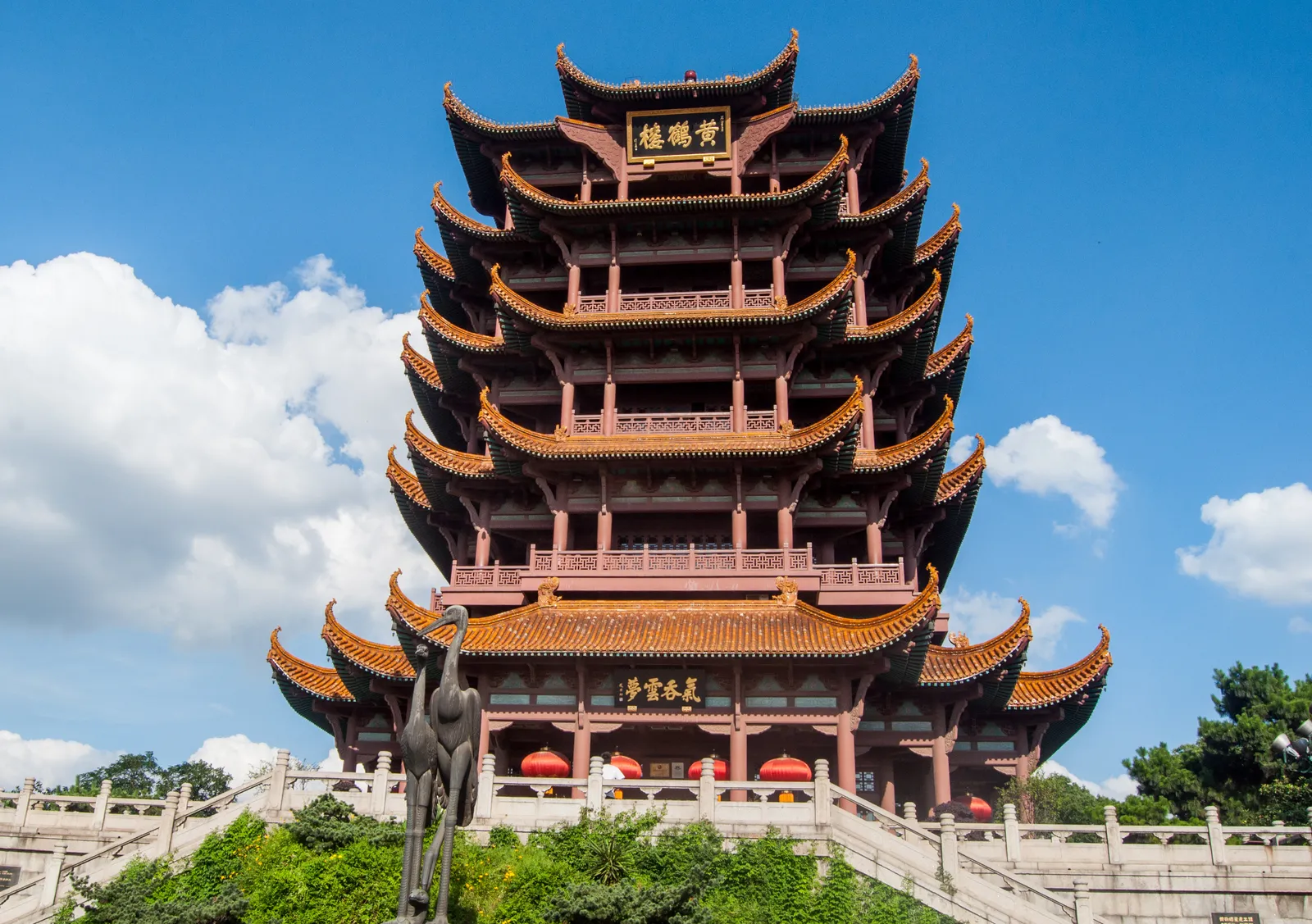
The Poem That Silenced Li Bai
Photo: Meraj Chhaya · CC BY 2.0
China's most famous poet is said to have read one poem at Yellow Crane Tower and put down his brush. The anecdote is doubtful. The poem is not.
There is a famous story about Yellow Crane Tower (黄鹤楼, Huánghè Lóu) in Wuhan. Li Bai, the most celebrated poet of the Tang dynasty, climbed the tower, read a poem already written there by a lesser-known man, Cui Hao, and gave up, because he could think of nothing better. Many guides tell it as fact. It is an anecdote, written down long afterwards, and scholars doubt it. What is certain is that the poem exists, and that Li Bai seems to have kept thinking about it.
The poem
Cui Hao lived from about 704 to 754 and passed the imperial examination in 723. His poem has eight lines:
昔人已乘黄鹤去,此地空余黄鹤楼。
黄鹤一去不复返,白云千载空悠悠。
晴川历历汉阳树,芳草萋萋鹦鹉洲。
日暮乡关何处是?烟波江上使人愁。
In plain English: The man of old has gone, riding a yellow crane, and only Yellow Crane Tower is left here. The crane, once gone, does not return; white clouds drift on, empty, for a thousand years. Across the clear river the trees of Hanyang stand sharp; fragrant grass grows thick on Parrot Island. Evening comes. Where is my home? Mist on the river's waves makes me sad.
The "man of old" comes from a legend behind the tower's name. Legend says an immortal flew away from this hill on a yellow crane. One version names him Wang Zi'an, another Fei Yi.
Even the first line is disputed. Tang and Song anthologies, including Dunhuang manuscripts, often read "white clouds" (白云) rather than "yellow crane", and many scholars consider that the older reading. The familiar version became standard later, and writers still argue about when.
The anecdote
The story turns on a couplet supposedly spoken by Li Bai:
眼前有景道不得,崔颢题诗在上头。
"There is a scene before my eyes that I cannot put into words: Cui Hao's poem is written up above."
The trail can be followed. The remark is credited to a lost early Song book, Gaiwen Lu by Li Tian, known through quotations in later Song collections such as Hu Zi's Tiaoxi Yuyin Conghua. That is some two and a half centuries after Li Bai's death in 762. It became best known through the Yuan dynasty writer Xin Wenfang, whose Tang Caizi Zhuan tells it in Cui Hao's entry. The scholar Cai Yijiang, writing on the poem, says the story may be a later invention and need not have happened.
A coarser sequel is less trustworthy still. Some verses have Li Bai threatening to smash the tower to pieces in frustration. The writer Ma Boyong, in an essay carried by People's Digest, says those lines were forged in the Song dynasty and later wrongly included under Li Bai's name.
What Li Bai really wrote
Whatever happened on the tower, Li Bai was not silenced. He wrote one of the best-known farewell poems in Chinese about this very spot, "Seeing Off Meng Haoran for Guangling at Yellow Crane Tower".
Two of his other poems sound like answers to Cui Hao. "Parrot Island" follows the opening pattern closely. "Climbing Phoenix Terrace in Jinling" begins with the same kind of repeated name: 凤凰台上凤凰游 ("On Phoenix Terrace, phoenixes once roamed"). Song writers said Li Bai wrote it to compete with Cui Hao, and the scholar Zhou Xunchu, in a 1985 study, thought that claim seems credible. This is the best evidence that the admiration was real, even if the famous remark was not.
Later critics made the rivalry official. The Song critic Yan Yu ranked Cui Hao's poem first among all Tang seven-character regulated verses. Others proposed different winners, and some have pointed out how freely its opening lines treat the rules of the form. The argument ran for centuries, which is part of why the poem stays famous.
The tower itself
The tower is older than the poem and also much younger. A Tang geography says a tower stood on this shore after Sun Quan built the fort of Xiakou in 223. War and fire destroyed it again and again. The last old tower on the original site was lost in 1884, and in 1957 a trestle of the Wuhan Yangtze River Bridge was built there. The present tower, begun in 1981 and finished in 1985, stands on Snake Hill about a kilometre away and rises 51.4 metres.
So Cui Hao never saw the building you will climb. The view is what links you to him: from the top you look across the Yangtze towards Hanyang, the bank he named in his fifth line. Practical details are on the Yellow Crane Tower page.
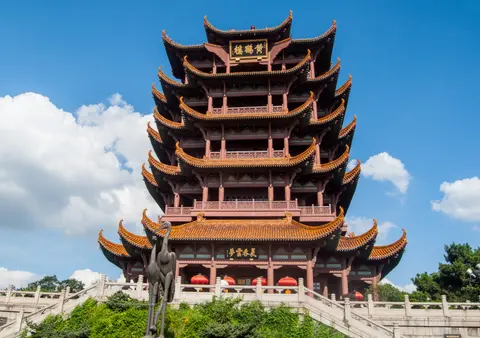 Sight in WuhanYellow Crane Tower 黄鹤楼A five-storey tower on Snake Hill, rebuilt in 1985 after a famous Tang poem; the top floor looks over the Yangtze and its first bridge.
Places in this story
Sources
- Wikisource: Cui Hao, Yellow Crane Tower (Chinese text) (zh.wikisource.org)
- Cai Yijiang: appreciation of Yellow Crane Tower (Chinese) (aisixiang.com)
- Zhou Xunchu, Literary Review 1985: the debate over the best Tang regulated verse (Chinese) (aisixiang.com)
- Luo Man: the text history of Yellow Crane Tower (Chinese) (chinawriter.com.cn)
- People's Digest, Ma Boyong: misread Tang poems (Chinese) (paper.people.com.cn)
- Wikipedia: Yellow Crane Tower (secondary) (en.wikipedia.org)
- Wikipedia: Cui Hao (secondary) (en.wikipedia.org)
Legends are told as legends. Where historians disagree, we say so.
More stories
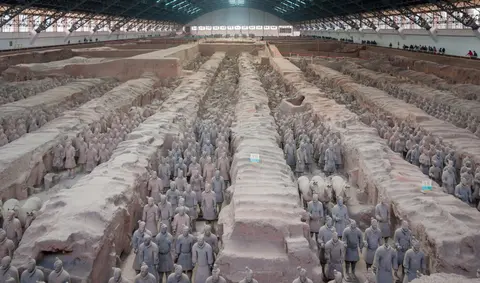 HistoryThe well that found an armyIn 1974 farmers digging a well near Xi’an hit pieces of clay. They had found the First Emperor’s army, and the tomb it guards is still sealed.
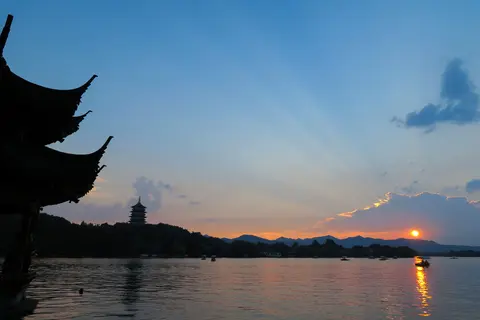 LegendsThe White Snake and Leifeng PagodaA snake spirit in love, a monk who stood in her way, and a real pagoda on West Lake that fell in 1924 and rose again.
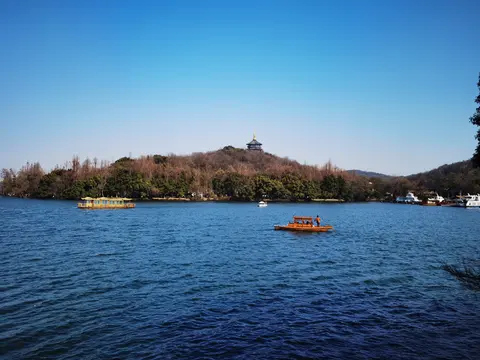 Travelers of the pastMarco Polo’s City of HeavenIn the 13th century a Venetian called Hangzhou the finest city in the world. What did he really see, and what is still there at West Lake?