

The Pockmarked Old Woman and Her Tofu
Photo: Colegota · CC BY-SA 2.5 ES
Mapo tofu is named after a real nickname and a small Chengdu eatery. The rest is tradition, and the versions do not fully agree.
Mapo tofu (麻婆豆腐, mápó dòufu) means, quite literally, "pockmarked old woman's tofu". Few famous dishes are named after a cook's skin. The short version of its history is this: tradition credits a Mrs. Chen, who cooked at a small eatery outside Chengdu's north gate in the late Qing dynasty. Later writers name the eatery, though no record from the 1860s survives. The details of how the dish came about are stories, and the people who tell them disagree.
The story people tell
Tradition places the beginning in 1862, the first year of the Tongzhi reign, at an eatery called Chen Xingsheng (陈兴盛饭铺) beside Wanfu Bridge (万福桥) in Chengdu's northern outskirts. A couple named Chen ran it. In many tellings the husband died early and his widow carried on alone.
The story says the customers were working men, porters carrying oil who crossed the bridge and stopped to eat. To save money, it goes on, they brought or bought their own tofu and beef, scooped a little oil from their loads, and asked the cook to make something good of it. In the telling, what she made was hot, numbing and cheap, and it spread by word of mouth.
Tradition says the name came from her face. "Ma" is short for mázi (麻子), pockmarks, and "po" means an old woman. People called her Chen Mapo, and the tofu took her name. It was a nickname, not a family name, and some retellings say it began as teasing.
One small coincidence helps diners remember it. The same character, 麻, also means the numbing tingle of Sichuan pepper, which is the dish's signature.
Where the versions disagree
Almost every detail has a rival.
- The date. Most Chinese accounts say 1862. Others say 1874.
- The people. Her husband appears as Chen Chunfu and as Chen Senfu. Chinese Wikipedia calls her Chen Liu shi, "Mrs. Chen, born Liu". One account has the husband alive and the wife at the stove; another has him dead.
- The meat. A Chinese report in The Paper says the first version used beef and rapeseed oil, that the shop switched to pork so that diners who avoided beef could order it, and that it later went back. Wikipedia's account, citing the writer Li Jieren, says the original was simple: chili, pork, tofu and Sichuan pepper. It adds that a chef named Xue Xiangshun moved the restaurant to beef and refined the recipe in the 1920s.
- The paste. Today's recipes rely on Pixian broad bean paste. Yet the 1950s recipe that Wikipedia calls the first published one used only fermented black beans.
These accounts cannot all be right, and we cannot tell you which is. None of the accounts we checked cites a document written in the 1860s.
What is on paper
The firmest evidence comes near the end of the Qing. Chengdu Tonglan, or Chengdu Records, a guide to the city published in 1909, lists the Chen Mapo tofu shop among the city's famous food businesses. The World of Chinese reports it as one of 23 famous restaurants. Old verses about the city also mention it, including a line from a Qing collection of Chengdu poems: "麻婆豆腐尚传名" ("Mapo tofu still carries its fame"). Another old book, Furong Huajiu Lu, is often cited too, though we could only find it quoted second-hand.
So by 1909 at the latest, Mrs. Chen's nickname was a brand. That is a remarkable thing to have happened to a woman whose own life is known only through later stories.
The dish goes abroad
The best-documented journey is to Japan. The chef Chen Kenmin (1912 to 1990), born in Yibin in Sichuan, opened his restaurant Shisen Hanten in Japan in the late 1950s and is credited with making Sichuan cooking and mapo tofu popular there. Sources give 1957 or 1958. Chen Mapo itself opened a branch in Japan in 2005. A Sichuan news report says the brand now belongs to Chengdu's municipal catering company and counts seven generations of cooks who have handed on the technique.
Trying it in Chengdu
Chen Mapo restaurants still trade in Chengdu, and a 2022 Sichuan news report says the brand was listed as a Bib Gourmand in the Michelin guide to the city. We could not confirm that anything of the first eatery at Wanfu Bridge survives, so check current branches and hours locally. Many kitchens in the city make the dish.
Show the characters 麻婆豆腐 when ordering. A good version, by the restaurant's own standard, is numbing, spicy, fresh and fragrant, with tender tofu that keeps its shape and a glossy red sauce. It usually contains minced meat, so if you do not eat meat, say so before you order. For more on eating here, see Chengdu.
 City guideChengdu 成都Giant pandas, Sichuan hot pot and slow afternoons in teahouses.
Places in this story
Sources
- The Paper: the history of mapo tofu (Chinese) (thepaper.cn)
- Sichuan Daily Chuanguan News: mapo tofu (Chinese) (cbgc.scol.com.cn)
- The World of Chinese: mapo tofu (theworldofchinese.com)
- Wikipedia: Mapo tofu (secondary) (en.wikipedia.org)
- Wikipedia (Chinese): Mapo tofu (secondary) (zh.wikipedia.org)
- Wikipedia: Chen Kenmin (secondary) (en.wikipedia.org)
Legends are told as legends. Where historians disagree, we say so.
More stories
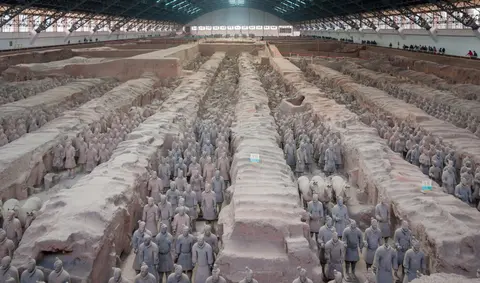 HistoryThe well that found an armyIn 1974 farmers digging a well near Xi’an hit pieces of clay. They had found the First Emperor’s army, and the tomb it guards is still sealed.
 LegendsThe White Snake and Leifeng PagodaA snake spirit in love, a monk who stood in her way, and a real pagoda on West Lake that fell in 1924 and rose again.
 Travelers of the pastMarco Polo’s City of HeavenIn the 13th century a Venetian called Hangzhou the finest city in the world. What did he really see, and what is still there at West Lake?