
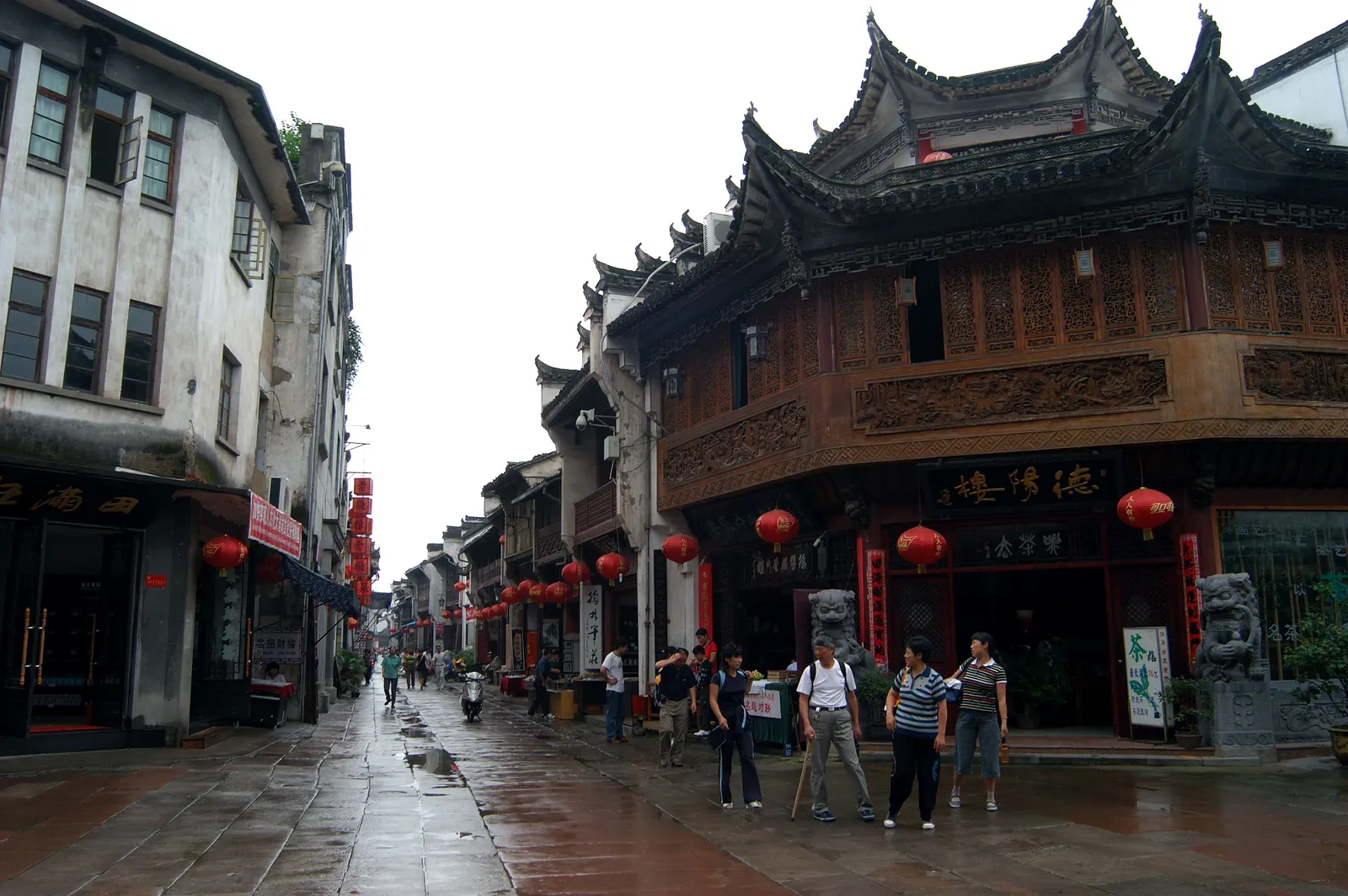
The plant hunter who came for tea
Photo: Emitchan · Public domain
In 1848 a Scottish gardener put on Chinese dress and went inland to collect tea plants for the East India Company.
Robert Fortune was a Scottish gardener who already knew China. From 1843 he had collected plants there for the Horticultural Society of London. In 1848 the East India Company gave him a stranger job. It wanted tea: living plants, seeds and people who knew how to make it, for government gardens in northern India, some of them in the Himalayan foothills. The botanist John Forbes Royle proposed the mission, and by mid-August Fortune was back in Hong Kong.
Most of what follows comes from Fortune himself, in A Journey to the Tea Countries of China (1852). It is one man’s account. He is the hero of his own book, and he wrote with the assumptions of his time.
Into the green tea country
The finest green tea, Fortune believed, came from the Huizhou district, which he spelled Hwuy-chow, more than 200 miles inland. Foreigners could not travel there freely, and he writes that boatmen had been punished for carrying them into the silk country on the way. He did not trust agents to do the job either, because he suspected they would gather plants near the coast and call them Huizhou plants.
So he hired two men from the district, one of them a servant and interpreter named Wang. On their advice he gave up English clothes for Chinese dress, shaved his head and added a braided tail. In October 1848 the party went by boat past Hangzhou and then upriver to Tun-che, today’s Tunxi (屯溪).
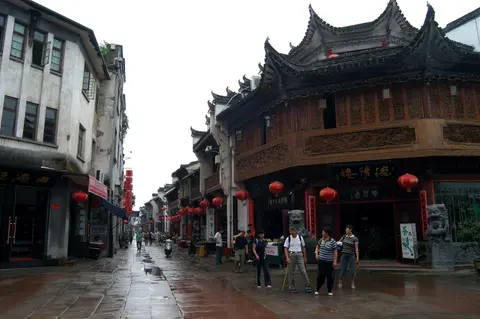 Sight in HuangshanTunxi Old Street 屯溪老街A 1 km stone-paved street of Song-to-Qing shopfronts in Huangshan city, selling tea, ink sticks, inkstones and snacks.
Their goal was Sung-lo-shan (松萝山), a hill that local tradition, as told to Fortune, named as the place where green tea was first made. He found it barren, with little tea left on it. The useful ground lay around it. Wang’s father, a farmer, lived in a smoky cottage within two miles of the foot of the hill, and from there Fortune collected seeds and young plants until he left on 20 November.
He also recorded something his readers would not have expected. Some green tea made for export was coloured. According to Fortune, workers scattered a powder of Prussian blue and gypsum over the leaves about five minutes before the end of the last roasting. By his sums, a drinker took in more than half a pound of it with every 100 pounds of dyed tea. The makers told him that foreigners seemed to like their tea looking uniform and pretty, that it sold for more, and that they did not drink it themselves.
One plant, two teas
Botanists in Europe then commonly treated green and black tea as two plants, *Thea viridis* and *Thea bohea*. Fortune concluded that the colour “depended upon manipulation, and upon that only”. Botanists today place Chinese and Assam tea in one species, *Camellia sinensis*.
The Wuyi hills
Next he went to the black tea country of the Wuyi hills (武夷山), his Woo-e-shan. This time another servant, Sing-Hoo, did the talking. At a hilltop temple the priests were told that Fortune came from a far country “beyond the great wall”. He saw tea growing everywhere, even on ledges, and pickers joking and singing as they worked. He repeated a story about chains and monkeys being used to reach leaves on the cliffs, and doubted that these methods supplied much tea.
He bought about 400 young plants from the farms, and an old Daoist priest added more after a small present. They travelled with their roots in damp moss, wrapped in oil-paper that kept off the sun and curious eyes.
Sight in WuyishanWuyi Tea Expo Park 中华武夷茶博园A landscaped riverside park about tea, with sculptures, carved tea poems and a small exhibition on how Wuyi rock tea is made; it doubles as the setting around the Impression Da Hong Pao theatre.Boxes of glass
Seeds sent to India in 1848 had largely failed. The answer was the Ward’s case, a sealed box of wood and glass invented by Nathaniel Ward. Fortune sowed seeds in the cases soon after gathering them, so they would sprout at sea, and split his shipments among several ships in case of accident. In India 12,838 plants were counted at Saharanpur, with more germinating, and about 12,000 more were raised from seed at Calcutta.
He left Shanghai on 16 February 1851, reaching Calcutta on 15 March. With him went Chinese tea makers engaged in Shanghai, men who had signed on through a local agent. His book mentions eight emigrants leaving together.
Did it work?
Not as simply as popular retellings suggest. Most of the Chinese plants in north-west India died, though a few survived in established gardens. Tea in Assam, the region that came to lead world production, grew from thick-leaved local plants that the Singpho people had long used. Darjeeling still grows Chinese strains. The skills Fortune’s recruits carried may have counted for as much as the plants, and writers disagree about how much credit he deserves.
“Stole” is the word popular books like. He paid for many plants and was given others, in a time long before modern biodiversity law, but he travelled in disguise beyond the limits set for foreigners. Scholars are still arguing over how to describe it.
Today
Tunxi’s tea shops sell Huangshan Maofeng green tea and Keemun black tea, and Wuyi is known for its rock tea. Our pages on the Wuyi Tea Expo Park and Tunxi Old Street have the practical details.
Places in this story
Sources
- Robert Fortune, A Journey to the Tea Countries of China (1852), full text at Kellscraft (kellscraft.com)
- Upton Tea Quarterly: Robert Fortune, the botanical explorer who changed the tea world (2021) (uptontea.com)
- Wikipedia: Robert Fortune (secondary) (en.wikipedia.org)
- Wikipedia: History of tea in India (secondary) (en.wikipedia.org)
Legends are told as legends. Where historians disagree, we say so.
More stories
 HistoryThe well that found an armyIn 1974 farmers digging a well near Xi’an hit pieces of clay. They had found the First Emperor’s army, and the tomb it guards is still sealed.
 LegendsThe White Snake and Leifeng PagodaA snake spirit in love, a monk who stood in her way, and a real pagoda on West Lake that fell in 1924 and rose again.
 Travelers of the pastMarco Polo’s City of HeavenIn the 13th century a Venetian called Hangzhou the finest city in the world. What did he really see, and what is still there at West Lake?