
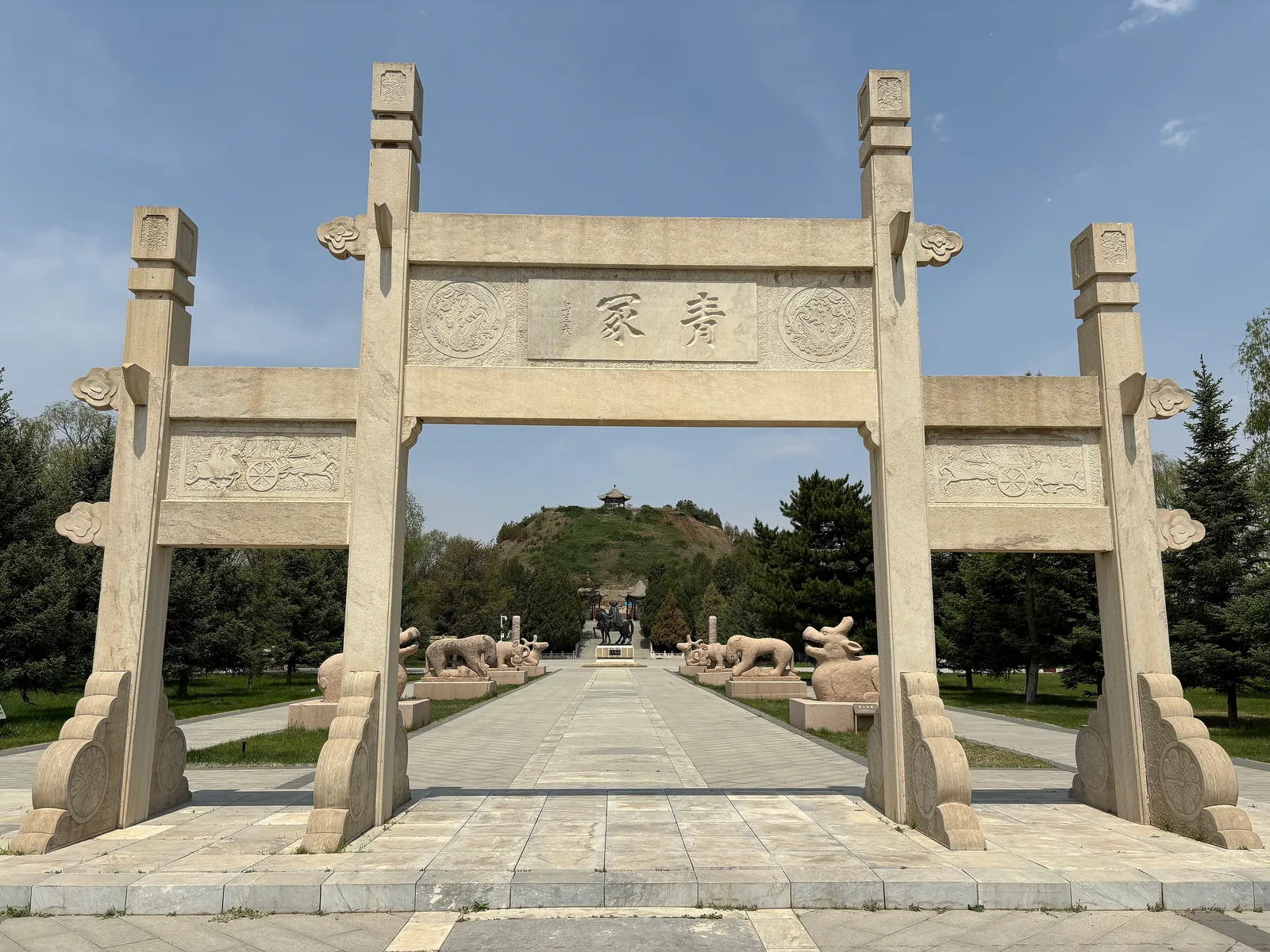
The palace woman who went north
Photo: Thebrainchamber1 · CC BY-SA 4.0
In 33 BC a Han court woman, Wang Zhaojun, married the Xiongnu ruler. The histories give her a few lines. The rest, painter included, came later.
South of Hohhot a grassy mound 33 metres high is known as the tomb of Wang Zhaojun. She is one of the most written-about women in Chinese history, with hundreds of poems, plays and stories to her name. The oldest record of her life, by contrast, could fit on a postcard. Her story is a good lesson in how a legend grows, so here it is in layers.
Layer one: the Book of Han
The earliest account is in the chapter on the Xiongnu in the Book of Han, written in the 1st century AD. In the first year of the Jingning era (33 BC), it says, Huhanye, the chanyu or ruler of the Xiongnu, came to the Han court again. He said he wished to become a son-in-law of the Han house, to bring the two closer. Emperor Yuan gave him "a woman of good family from the rear palace, Wang Qiang, courtesy name Zhaojun".
That is nearly all. The chanyu was delighted, the text says, and offered to guard the frontier from Shanggu west to Dunhuang, so that Han could stand down its garrisons. The emperor asked for opinions. An official who knew the frontier, Hou Ying, argued against the idea, and the garrisons stayed.
Marriage alliances of this kind, called heqin, had been part of Han and Xiongnu relations for generations. What marks this one is the timing, a period of peace on the frontier, and the fact that we have a name.
She received the title Ninghu Yanzhi and had a son. When Huhanye died in 31 BC, his son by another wife became ruler and, as the text puts it plainly, married her in turn. She had two daughters with him. The elder, Yun, later appears in the same chapter as a powerful figure among the Xiongnu who favoured friendly relations with China, and Zhaojun's nephew, Wang Xi (王歙), served as a court envoy to the Xiongnu. These later generations are the best evidence we have of the family's role.
The Book of Han does not tell us what she felt, or what she looked like, or where she was buried.
Layer two: the Book of the Later Han
Written in the 5th century, more than 400 years after the events, the Book of the Later Han adds a scene. Here Zhaojun has been in the palace for years without once seeing the emperor, and grief drives her to ask to go. At the farewell audience, five women are brought out. She appears so radiant that the emperor is startled and wants to keep her, but cannot break his word. It also says that after Huhanye's death she wrote asking to come home, and Emperor Cheng ordered her to follow Xiongnu custom.
This version gives her a will of her own and a sad choice. Historians cannot say where its details came from, and it differs from the Book of Han in small ways, such as giving her two sons.
Layer three: legend
Then the storytellers took over. The Miscellanies of the Western Capital, compiled some centuries after the event, gives us the painter. Emperor Yuan chose his women from portraits, it says, so they all bribed the court painters. Wang Qiang alone refused, so she was painted plain and never summoned. When the time came to send a woman north, the emperor picked her from the picture, saw her beauty too late, and had the painters executed, among them Mao Yanshou. This is a good story, and there is no support for it in the earlier histories.
Later ages added more. Legend says she played the pipa on horseback, and that geese forgot to fly and dropped from the sky, which is why she is counted among the Four Beauties of China. Du Fu wrote of the green tomb left facing the dusk. In the 13th century Ma Zhiyuan's play Autumn in the Han Palace made the whole affair a tragedy of love. Each version tells you as much about its own time as about her. Modern retellings keep doing the same, and they read her life in very different ways.
The tomb
The Book of Han names no burial place. The site south of Hohhot, known as Qingzhong (青冢), the Green Tomb, is the most famous, but mounds in Shanxi and Henan also carry her name. Treat the Hohhot mound as a memorial. It now sits in gardens with a museum (昭君博物院). Check hours and tickets on its page.
 Sight in HohhotZhaojun Tomb and Museum 昭君博物院(昭君墓)A 33-metre grassy mound honouring Wang Zhaojun, the Han court lady married to a Xiongnu chief in 33 BC, set in gardens with a museum on peace marriages along the steppe frontier.
Places in this story
Sources
- Ban Gu, Book of Han, chapter 94B: the Xiongnu (Chinese text) (zh.wikisource.org)
- Fan Ye, Book of the Later Han, chapter 89: the Southern Xiongnu (Chinese text) (zh.wikisource.org)
- Miscellanies of the Western Capital, volume 2 (Chinese text) (zh.wikisource.org)
- Wikipedia (Chinese): Wang Zhaojun, on tombs and later works (secondary) (zh.wikipedia.org)
- Wikipedia: Wang Zhaojun (secondary) (en.wikipedia.org)
Legends are told as legends. Where historians disagree, we say so.
More stories
 HistoryThe well that found an armyIn 1974 farmers digging a well near Xi’an hit pieces of clay. They had found the First Emperor’s army, and the tomb it guards is still sealed.
 LegendsThe White Snake and Leifeng PagodaA snake spirit in love, a monk who stood in her way, and a real pagoda on West Lake that fell in 1924 and rose again.
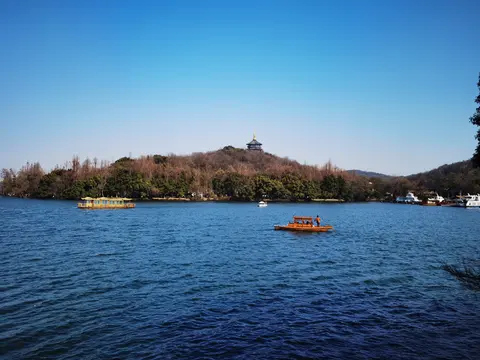 Travelers of the pastMarco Polo’s City of HeavenIn the 13th century a Venetian called Hangzhou the finest city in the world. What did he really see, and what is still there at West Lake?