
The man who walked China for thirty years
Xu Xiake spent three decades on the road in late Ming China and wrote it all down. You can still follow him up Huangshan and into Guilin's caves.
On the sixth day of a snowy month in 1616, a man on Huangshan took out his staff and began chopping holes in the ice. He cut one for his front foot, then another for his back foot, and his companions followed him up by the same method. He wrote it down that night, as he wrote everything down. His name was Xu Xiake (徐霞客).
The traveller
He was born Xu Hongzu in 1587 in Jiangyin, in today's Jiangsu. The family had money, though less than before. Xiake, "one in the sunset clouds", was a name given to him by a friend. Accounts of his life say that his mother encouraged him to travel, and that her weaving helped pay for his early trips.
His journeys began around 1607 and went on for more than thirty years, often on foot. In Guangxi he had a servant named Gu and a monk companion, Jingwen. He slept rough, ran out of food, and depended on the help of local scholars and abbots. In 1637, on the Xiang River, robbers struck his boat. He escaped by jumping into the water without his clothes, and had to borrow money from a friend to continue.
His surviving diaries begin with a trip to Mount Tiantai in 1613. A diary entry from that trip, dated 19 May by modern reckoning, is why that date is now China's Tourism Day.
Two climbs of Huangshan
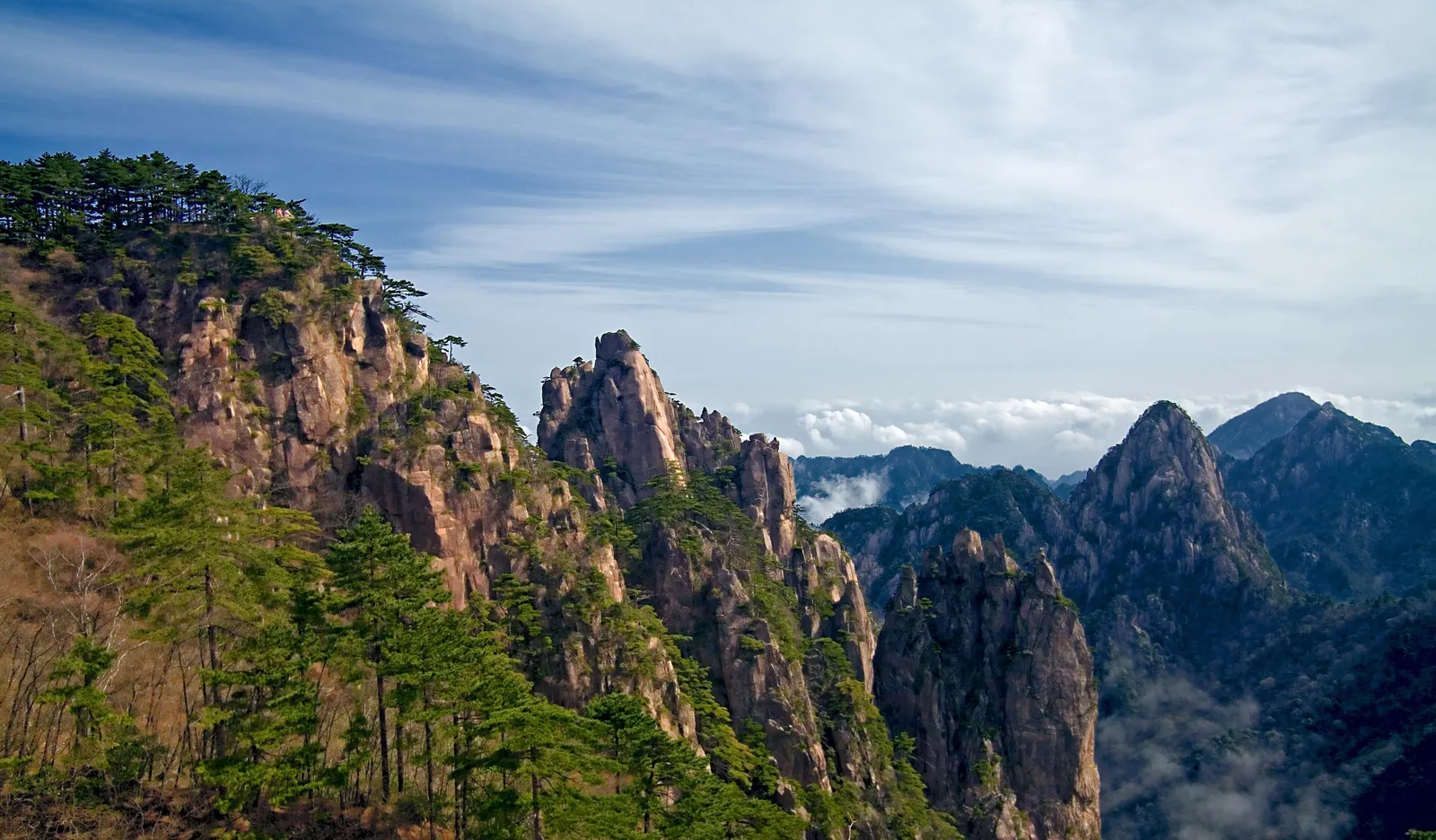
The first visit, in early 1616, was a fight against snow. He soaked in the hot springs at the foot of the mountain, and spent one whole day just sitting and listening to the snow fall. Monks told him the paths to the summit hermitages had been blocked for months. He went anyway, cutting his ice steps, and reached Guangmingding (光明顶), the Bright Summit. He noted that the pines were odd, with the smallest and shortest being the oldest and strangest.
He came back in the ninth lunar month of 1618, and this time the colours of autumn were on the slopes. A path he had not seen before led him towards Tiandu, the Heavenly Capital Peak, and he admits he felt both delight and shame for having missed it the first time. The monk at the hermitage told him there was no route up Tiandu and advised him to climb Lotus Peak the next day instead. He went anyway, with a travelling monk named Chengyuan, crawling up rock falls and hauling himself by grass and thorns. The monk climbed first at the worst places and reached down for him. On the way down they sat and slid.
The next day he climbed Lotus Peak, and judged it the highest point of the mountain, a finding the Chinese press still credits to him. At the top, he wrote, the colours in the morning light made you want to shout and dance.
A famous line says that after the Five Sacred Mountains you need see no others, and after Huangshan you need not see the Five. It is often pinned on him, but it does not appear in his two Huangshan diaries. A similar remark is credited to him in a later source, and the slogan itself seems to be a later summary.
The peak he never climbed
He reached Guilin in 1637, in the middle of his longest and final journey. He was delighted by Diecai Hill, walked the city, and took a guide into the Seven Star Cave with burning pine torches. He describes a stone carp hanging from a crack in the roof, so lifelike that no carver could do better.
One goal escaped him. Solitary Beauty Peak (独秀峰) stood inside the Ming princes' walled palace. To climb it, a monk there told him, he had to wait for the prince's permission, once a ceremony was over. A date was set, then moved, then moved again. He went off to Yangshuo and came back. In the summer heat, with rumours of bandits and the palace on alert, he gave up. His note is blunt: he had walked the foot of the hill on three sides, but not the east side or the top.
Anyone can climb it now, for a ticket and about 300 steep steps.
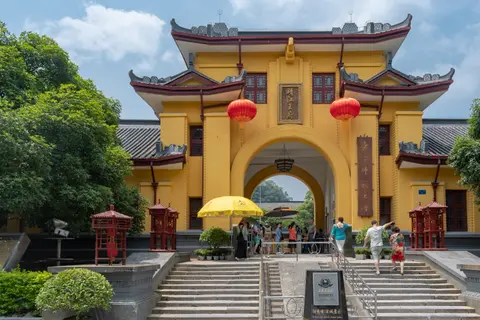 Sight in GuilinJingjiang Princes’ City and Solitary Beauty Peak 独秀峰·王城景区A walled Ming-dynasty princes’ palace in the city centre, with a steep peak inside and a museum on the old imperial exams.
After the road
In Yunnan his health failed. He could no longer walk, and a local official had him carried home by sedan chair. He died in Jiangyin in 1641.
His writing nearly died too. Much of the manuscript was burned in the wars at the end of the Ming, and his son Li Ji collected the surviving copies. What remains runs to hundreds of thousands of characters, and counts vary by edition. It contains careful notes on limestone caves, and a sustained argument that the Jinsha, not the Min, was the true upper Yangtze, contradicting the Tribute of Yu, a very old classic.
Following him
You can walk many of his routes, though on modern stone steps. Check conditions and opening hours on each page.
 Sight in HuangshanMount Huangshan (Yellow Mountain) 黄山风景区Granite peaks, twisted pines and seas of cloud: a UNESCO site walked on stone stairways, with hotels on the summit for sunrise.
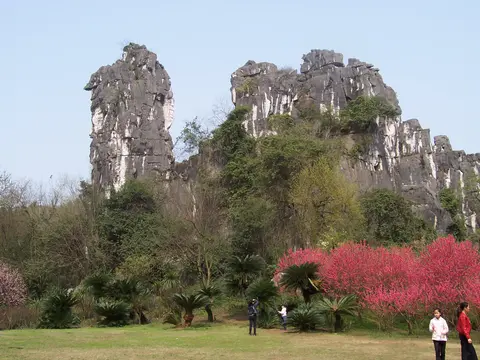 Sight in GuilinSeven Star Park 七星景区Guilin’s largest park, with karst hills, Camel Hill, old stone carvings and the Seven Star Cave.
Places in this story
Sources
- Xu Xiake, Diary of a Journey to Huangshan, 1616 (Chinese text) (zh.wikisource.org)
- Xu Xiake, Later Diary of Huangshan, 1618 (Chinese text) (zh.wikisource.org)
- Xu Xiake, Guangxi Diary, part 1, 1637 (Chinese text) (zh.wikisource.org)
- China News Service: on Xu Xiake, Huangshan and Tourism Day, 2024 (chinanews.com.cn)
- Wikipedia: Xu Xiake, on the Yangtze source and Tribute of Yu (secondary) (en.wikipedia.org)
- Wikipedia (Chinese): Xu Xiake (secondary) (zh.wikipedia.org)
Legends are told as legends. Where historians disagree, we say so.
More stories
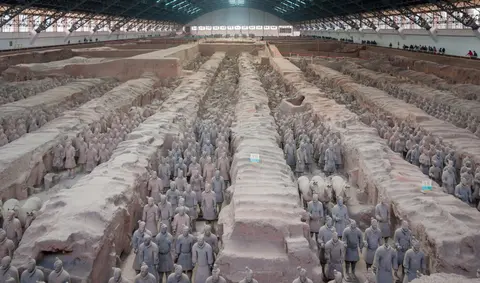 HistoryThe well that found an armyIn 1974 farmers digging a well near Xi’an hit pieces of clay. They had found the First Emperor’s army, and the tomb it guards is still sealed.
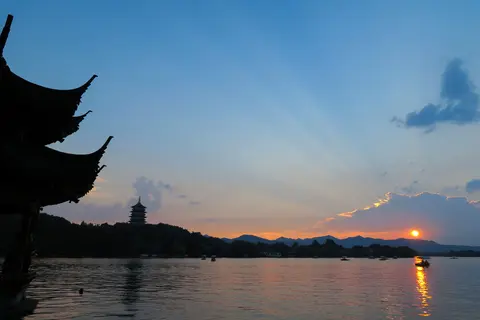 LegendsThe White Snake and Leifeng PagodaA snake spirit in love, a monk who stood in her way, and a real pagoda on West Lake that fell in 1924 and rose again.
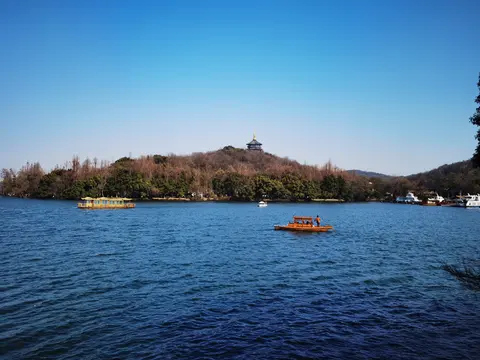 Travelers of the pastMarco Polo’s City of HeavenIn the 13th century a Venetian called Hangzhou the finest city in the world. What did he really see, and what is still there at West Lake?