
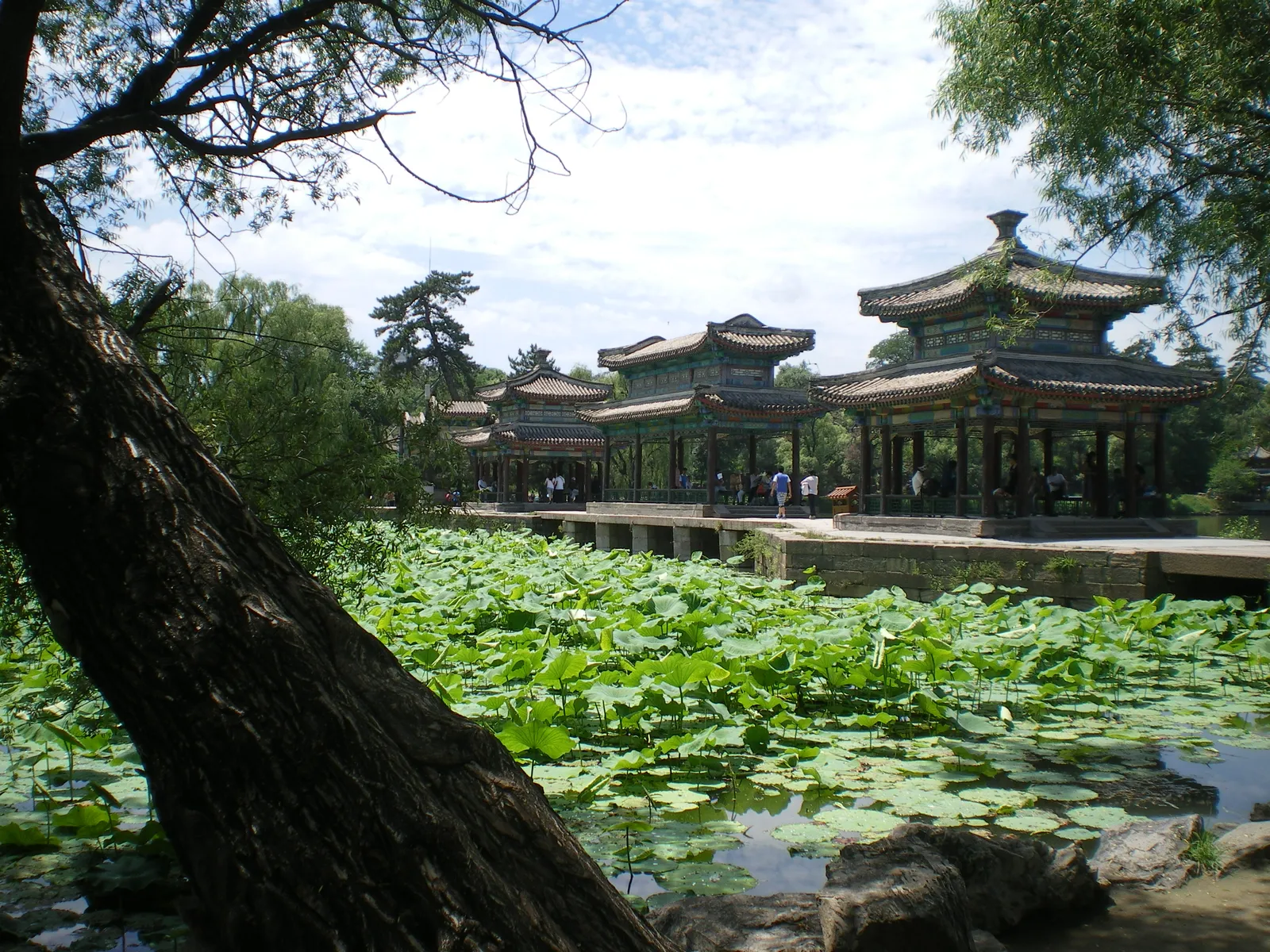
The British envoy at the emperor's tent
Photo: takwing.kwong · CC BY-SA 2.0
In September 1793 Lord Macartney met the Qianlong emperor at Chengde. What he did before the throne is still disputed.
Before dawn on 14 September 1793, a British lord in a palanquin was carried through the dark towards a huge yellow tent in the grounds of the emperor's summer retreat at Chengde. He had sailed from Portsmouth a year earlier. What he did when he reached the throne has been argued over ever since.
Why he came
George Macartney led the first British diplomatic mission to China. He left Portsmouth on 26 September 1792 with three ships. Trade with China then passed through Guangzhou (Canton) under strict rules, and the British wanted more: new ports, a permanent embassy in Beijing, a small island near the coast for traders, and relaxed rules at Guangzhou. He carried a letter from George III and a large collection of gifts, including instruments and a planetarium.
The emperor was at Chengde, known to the British as Jehol, north of the Great Wall. It was the usual season for the Qing court's autumn hunt, and the emperor's birthday was approaching. Leaving the planetarium and other gifts near Beijing, about seventy of the party set out on 2 September. They crossed the Great Wall at Gubeikou, where some men took bricks as souvenirs, and reached the outskirts of Chengde on 8 September.
The question of ceremony
The kowtow means kneeling on both knees and touching the forehead to the ground. The full form at court was three kneelings and nine prostrations. Macartney's instructions told him to accept any ceremony that did not compromise the honour of his king, and he had decided that he must show the emperor no more respect than he would show George III.
He made a written proposal: whatever he performed, a Chinese official of equal rank should perform the same before a portrait of his king. The Chinese officials objected. In their view, the emperor had no equal, and the embassy, like others, was bringing tribute.
A Qing edict offered a compromise: a reduced form of the ritual in place of the full nine prostrations. The British repeated their position, and for a few days the meeting looked uncertain. According to the British accounts, it was finally agreed that Macartney would go down on one knee, as he would before his own sovereign, without the usual kiss of the hand.
The audience
The British left their lodging at 3 a.m. and reached the encampment at 4. The emperor arrived at 7. The National Palace Museum in Taipei, citing the Qing record for the day, places the reception at the Wanshuyuan, the Garden of Ten Thousand Trees, and in the palace area of the resort. Thousands attended, including other foreign envoys and the emperor's son, the future Jiaqing emperor.
Macartney went up first, exchanged gifts with the emperor and handed over the king's letter. George Staunton, his deputy, followed. Then came Staunton's son Thomas, who had studied Chinese on the voyage and was invited to say a few words. A banquet followed, with the British seated on the emperor's left, a place of honour.
What did he actually do?
Here the accounts part ways, and it is fair to say the question is still open.
Macartney's own journal and the British accounts insist that he bent one knee and did not kowtow. An older study in English accepted that. Others read the evidence differently. Huang Yi-Long of Taiwan, writing in 2007, argues for a two-part compromise: first a modified Chinese form that left out the kowtow itself but included repeated kneeling and deep bows, then the British form of one knee for handing over the letter. He notes that Macartney later denied kneeling on both knees. Another summary of the negotiations says the one knee came in addition to a single prostration.
Historians have also asked how much it mattered. Henrietta Harrison, using a wider range of Qing archives, argues that the court was mainly concerned with the embassy as a security question, and that the fixation on ritual came largely from the British side. By this reading, the idea that the mission failed because of the kowtow is a later simplification. It is one reading, and others weigh the ritual more heavily.
The answer
The emperor's written reply refused the requests. Its best-known line says the empire "possesses all things in prolific abundance". The embassy left Chengde later that month. According to Harrison, that letter was little noticed until it was reprinted around 1900, when it took on a new meaning for later writers. The same archives show the emperor telling officials to prepare the coast, so a fuller reading is still being worked out.
In Chengde today
You can walk the Mountain Resort, including the area of the Wanshuyuan, though no tent or marker of that morning should be expected. Check tickets and opening hours on its page.
 Sight in ChengdeChengde Mountain Resort 避暑山庄The Qing emperors’ summer capital: a walled park of palaces, lakes, pavilions and wooded hills, the largest surviving imperial garden in China; a UNESCO World Heritage Site.
Places in this story
Sources
- National Palace Museum: The Chengde Summer Resort, Politics and Ritual (theme.npm.edu.tw)
- Huang Yi-Long, Impression vs. Reality: the Guest Ritual Controversy between Qing China and Britain, Bulletin of the IHP, 2007 (abstract) (www1.ihp.sinica.edu.tw)
- Henrietta Harrison, The Qianlong Emperor's Letter to George III, American Historical Review, 2017 (record and abstract) (ora.ox.ac.uk)
- James Carter, Lord Macartney, China, and the convenient lies of history, The China Project, 2020 (thechinaproject.com)
- The Kotow in the Macartney Embassy to China in 1793, Journal of Asian Studies (first page and notes) (cambridge.org)
- Wikipedia: Macartney Embassy (secondary) (en.wikipedia.org)
Legends are told as legends. Where historians disagree, we say so.
More stories
 HistoryThe well that found an armyIn 1974 farmers digging a well near Xi’an hit pieces of clay. They had found the First Emperor’s army, and the tomb it guards is still sealed.
 LegendsThe White Snake and Leifeng PagodaA snake spirit in love, a monk who stood in her way, and a real pagoda on West Lake that fell in 1924 and rose again.
 Travelers of the pastMarco Polo’s City of HeavenIn the 13th century a Venetian called Hangzhou the finest city in the world. What did he really see, and what is still there at West Lake?