
The bones in the medicine shop
A famous story says a sick scholar found China’s oldest writing in his medicine. It is a good tale, and there are good reasons to doubt it.
The story is told in many books and museums. In 1899 Wang Yirong (王懿荣), a senior Qing scholar in Beijing, fell ill with malaria. His prescription included “dragon bones” (龙骨, *lónggǔ*), an ingredient of traditional medicine. Before they were ground up he noticed marks scratched on them, and he recognised them as ancient writing. In some versions his friend Liu E (刘鹗) was visiting and saw them first.
It is a lovely way for China’s oldest known body of writing to come back into the world. It is also, as far as anyone can show, a legend.
What is solid
Some things are not in dispute. Wang Yirong (1845–1900), from Fushan in Shandong, was a real scholar and collector, and he served as director of the Imperial Academy (国子监) in Beijing. People near Anyang in Henan had been digging up old bones for a long time, sometimes reburying them, and in the 19th century they were sold and ground up as dragon bones. Most scholars accept 1899 as the year when the marks were first understood as writing.
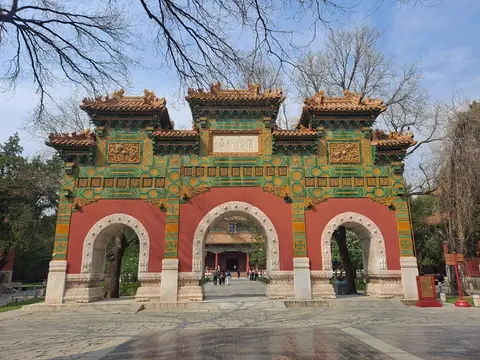 Sight in BeijingConfucius Temple and Imperial Academy 孔庙和国子监博物馆The imperial Confucian temple and the empire’s highest school side by side, with stone tablets naming centuries of exam graduates.
How Wang actually got them is a different matter. Most of the early evidence points to a dealer, not a pharmacy. According to these accounts, an antiques dealer from Shandong surnamed Fan, recorded under several names and often as Fan Weiqing (范维卿), collected inscribed pieces in Henan villages and took them to Beijing, where Wang bought them. One modern account says he acquired more than 1,500 pieces.
Wang had little time to study them. When foreign armies entered Beijing in 1900 he died by suicide, and his collection was sold. Liu E, a novelist and antiquarian, bought much of it and added more. In 1903 he published *Tieyun Canggui* (铁云藏龟), a book of 1,058 rubbings and the first of its kind.
The doubts
The clearest case against the medicine story comes from the researcher Ren Guangyu, in a 2018 journal article. He traces it to a short newspaper piece from 1931 and to hearsay in Liulichang, Beijing’s antiques quarter, in the early 20th century. He writes that Wang’s own descendants did not accept it. He relies instead on early field notes. Luo Zhenchang (罗振常) looked into the trade in spring 1911, in notes published in 1936 as *Huan Luo Fanggu Youji* (洹洛访古游记), and wrote that villagers sold their bones to Fan and that Fan sold only to Wang. James Menzies, a Canadian who investigated in 1914, also recorded Fan naming Wang alone as the first buyer.
The evidence is not all on one side. Menzies’s later book on oracle bones, as quoted by another scholar, has Fan saying that Wang bought dragon bones at a Beijing pharmacy and got an inscribed shell. Ren thinks that account was influenced by the Beijing hearsay. Even that line mentions no illness.
Ren argues that the tale should be taken out of academic history. He goes further and proposes a joint discovery: Wang as the collector who saw what the bones were, Liu E as the one who published the evidence.
Not everyone agrees. His is one researcher’s view, and historians still disagree about who should get the credit. Many still call Wang the father of oracle bone studies, some think the written evidence favours Liu E, and others have pointed to two Tianjin collectors, Wang Xiang and Meng Dingsheng. As the essayists at China Heritage put it, in effect, we cannot know whether Wang ever swallowed a single bone.
Finding the source
Dealers guarded their supply and said that the bones came from Tangyin, also in Henan. Reportedly it was the scholar Luo Zhenyu who traced them in 1908 to the Anyang area. By 1928 attention had settled on the village of Xiaotun (小屯), and from 1928 to 1937 archaeologists led by Li Ji dug there, recovering some 20,000 pieces. In 1936 one pit alone, known as YH127, held more than 17,000 inscribed pieces.
The site was Yin, the last capital of the Shang dynasty, from around the 13th century BC to about 1046 BC.
What the bones say
The Shang kings used these bones for divination. Workers prepared turtle shell or animal bone and drilled pits into it. Heat was applied until it cracked, and a diviner read the cracks. Nobody now knows how the cracks were interpreted. The questions and sometimes the results were often carved beside them.
Most inscribed pieces date to the reigns of the last nine Shang kings, and the dates of the earliest are still debated. Counts of the total vary widely, with some well above 100,000 pieces.
Where to see them
Oracle bones belong to Anyang (安阳), which has the Yinxu site (殷墟), a UNESCO World Heritage Site since 2006, with a new museum opened in 2024, and the National Museum of Chinese Writing (中国文字博物馆). We have no Anyang guide yet, so check their official notices.
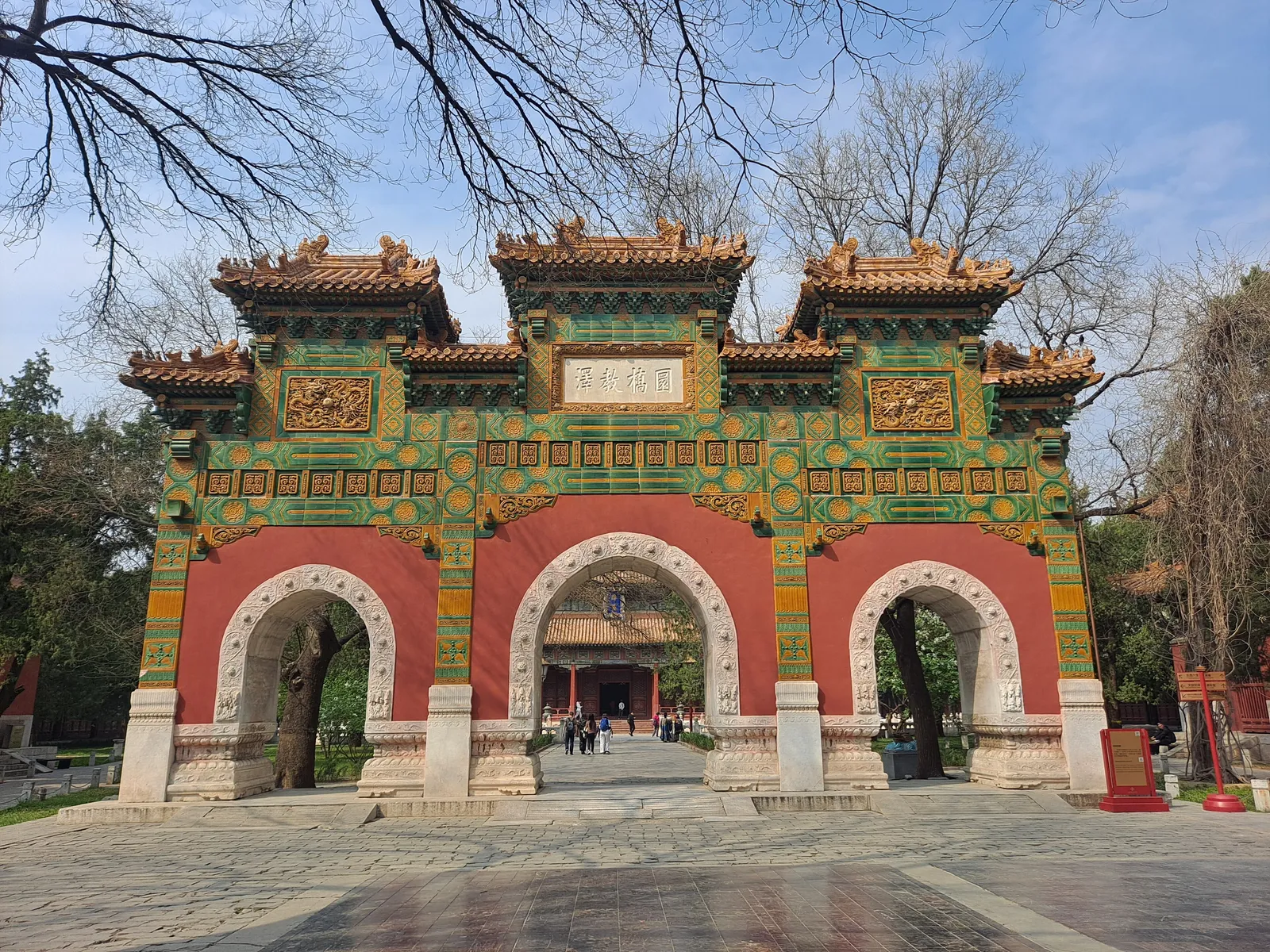
In Beijing, you can walk through the Imperial Academy where Wang served. The National Museum of China held a major oracle bone exhibition in 2019, with more than 100 inscribed pieces, but we could not confirm what is on show now, so check before you go.
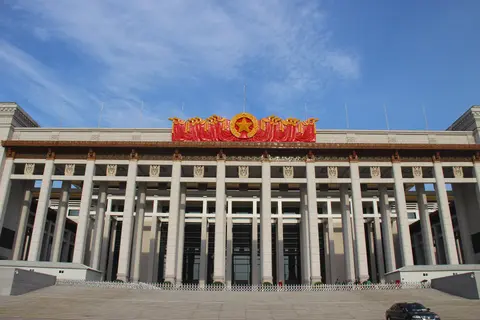 Sight in BeijingNational Museum of China 中国国家博物馆China’s national museum of history and art, on the east side of Tiananmen Square.
Places in this story
Sources
- Ren Guangyu, The joint discovery by Wang and Liu and new research on the discovery of oracle bone script, Journal of Guangxi Normal University, 2018 (Chinese, at Aisixiang) (aisixiang.com)
- Ren Guangyu, summary of the same argument (Chinese, at Aisixiang) (aisixiang.com)
- China Heritage: Oracle bones, that dangerous supplement (chinaheritage.net)
- The Paper: Wang Yirong (Chinese) (thepaper.cn)
- China Daily: Exhibition opens to mark discovery of inscribed oracle bones (2019) (chinadaily.com.cn)
- Wikipedia: Oracle bone (secondary) (en.wikipedia.org)
- Wikipedia: Yinxu (secondary) (en.wikipedia.org)
- Wikipedia: Liu E (writer) (secondary) (en.wikipedia.org)
Legends are told as legends. Where historians disagree, we say so.
More stories
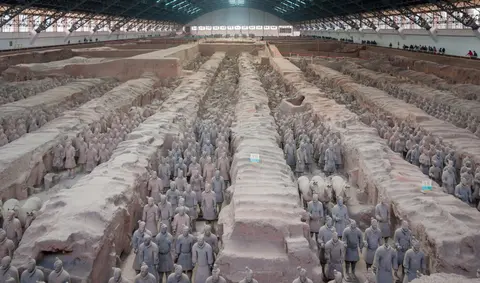 HistoryThe well that found an armyIn 1974 farmers digging a well near Xi’an hit pieces of clay. They had found the First Emperor’s army, and the tomb it guards is still sealed.
 LegendsThe White Snake and Leifeng PagodaA snake spirit in love, a monk who stood in her way, and a real pagoda on West Lake that fell in 1924 and rose again.
 Travelers of the pastMarco Polo’s City of HeavenIn the 13th century a Venetian called Hangzhou the finest city in the world. What did he really see, and what is still there at West Lake?