
The Immortal Who Left on a Crane
Photo: Meraj Chhaya · CC BY 2.0
Who flew away from Yellow Crane Tower? Old books name at least three people, and none of them can be proved. Here is how the legend grew.
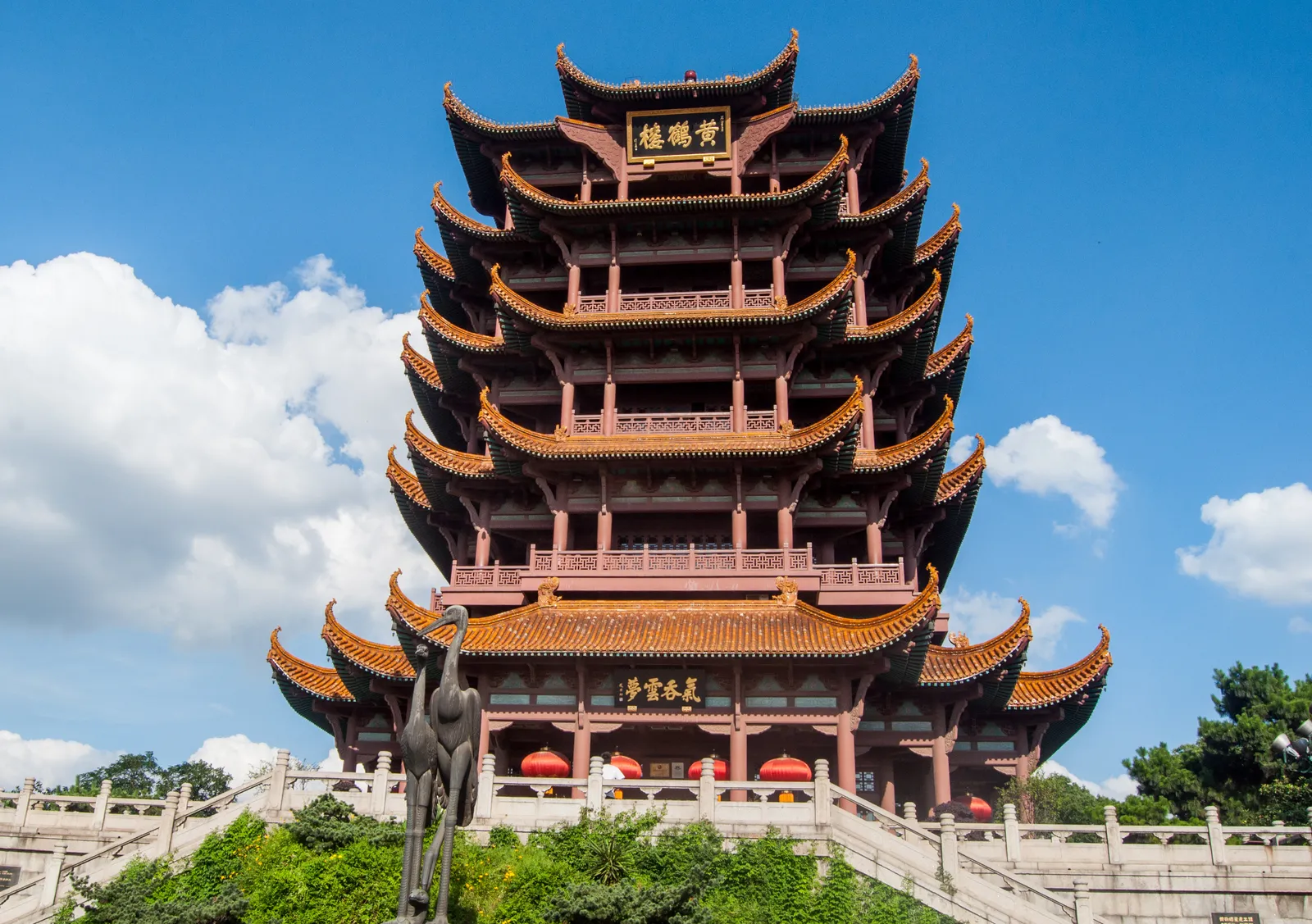
Legend says Yellow Crane Tower (黄鹤楼, Huánghè Lóu) is named after an immortal who flew away from this spot on a yellow crane. Who that immortal was depends on which book you open. China's national list of intangible heritage has included the Yellow Crane Tower legends since 2011 and says there are dozens of them. These are stories, not history, and the tower's oldest name may have a much plainer source.
An early line
China's heritage register says the first written version was in the *Shuyi ji*, a collection of strange tales by the 5th-century scholar Zu Chongzhi, and that this version is lost. An early account that survives is in the *Book of Qi*, a dynastic history from the 6th century. Its section on local government describes the walled town of Xiakou and adds one short remark:
In plain English: Xiakou stands on Huanghu Jetty, and people have long said that the immortal Zi'an passed over this place riding a yellow *hu*.
That is all. There is no tower in the sentence, and the bird is not quite a crane. *Hu* (鹄) is a word usually used for a swan. Later writers tell the story with *he* (鹤), crane, and that is the bird the world remembers.
Three candidates
Wang Zi'an. Later writers cite an old book, its title given in different forms, for the story that the immortal Wang Zi'an passed this hill on a yellow crane, that the hill took its name from the bird, and that people later built a tower there. This is the version closest to the *Book of Qi* line.
Fei Yi. A later local record, the *Ezhou Tujing*, gives the honour to Fei Yi. Another geography, the *Taiping Huanyu Ji*, also connects him with the hill. The odd thing about this one is that Fei Yi is a real person. He was a senior statesman of the Shu state in the Three Kingdoms period, and he died in 253. Nothing in his career suggests flight. The legend simply says he became an immortal and later stopped here to rest on his crane.
Lü Dongbin. In later centuries the story also attached itself to Lü Dongbin, one of the Eight Immortals of Daoist tradition, who is said to have risen to heaven from this site. He is the figure many visitors will hear about today.
Another tale credited to the *Shuyi ji* gives no name to the immortal at all. A man called Xun Gui (荀瓌), a lover of immortal arts, is on the tower when a figure comes down from the sky on a yellow crane. The two drink together, and the visitor flies off.
The crane drawn in orange peel
The tale that people enjoy most has no scholars or statesmen in it. The national list entry for the tower's legends mentions it under the title *Drawing a Crane with Orange Peel* (橘皮画鹤), and it is told in several ways.
Legend says a family named Xin kept a wine shop on the hill. A shabby Daoist drank there for a long time without paying, and nobody asked him for money. One day, to settle the debt, he took a piece of orange peel and drew a crane on the wall. When guests clapped and sang, the crane came off the wall and danced. Customers crowded in, and the shop grew rich.
About ten years later the Daoist came back. He played a flute, white clouds gathered, the yellow crane flew down, and he climbed on its back and rode into the sky. The grateful Xin family then built a tower on the spot and named it after the bird. The tale fits a pattern found in many Chinese stories: kindness to a stranger who turns out to be more than he seems.
What the records say
Now the plainer version. A geography of the Tang period, the *Yuanhe Maps and Records*, says the prefectural town was originally Xiakou, walled by the Wu state in 223, and that a tower called Yellow Crane Tower stood on the rock jetty at its south-west corner. It gives no date for the tower. Guides give 223 as the founding year, but that date is inferred from the town wall.
So the rock may have had the name first, and the immortals may have been called in to explain it. Nobody can settle this now, but the *Book of Qi* line already links rock and bird.
The tower itself has been lost and rebuilt many times. The last one on the old site went up in 1868 and burned in 1884. The old site now lies under an approach to the Wuhan Yangtze River Bridge, built in 1957. Today's tower, finished in 1985 about a kilometre away on Snake Hill, is a concrete building of five storeys and 51.4 metres.
Seeing it today
The legends are why the tower's most famous poem begins as it does: the man of old has gone, riding a yellow crane. We tell that part in The poem that silenced Li Bai. For tickets and how to get there, see Yellow Crane Tower.
 Sight in WuhanYellow Crane Tower 黄鹤楼A five-storey tower on Snake Hill, rebuilt in 1985 after a famous Tang poem; the top floor looks over the Yangtze and its first bridge.
Places in this story
Sources
- China Intangible Cultural Heritage Network: Yellow Crane Tower legends, national list entry (ihchina.cn)
- Book of Qi, chapter 15 (Chinese text) (zh.wikisource.org)
- Wikipedia: Yellow Crane Tower (secondary) (en.wikipedia.org)
- Wikipedia (Chinese): Yellow Crane Tower, with the Qixie zhi, Shuyi ji and Ezhou Tujing versions (secondary) (zh.wikipedia.org)
- Wikipedia: Fei Yi (secondary) (en.wikipedia.org)
- Limao Gushi: retelling of the Xin wine shop tale (Chinese, popular source) (limaogushi.com)
Legends are told as legends. Where historians disagree, we say so.
More stories
 HistoryThe well that found an armyIn 1974 farmers digging a well near Xi’an hit pieces of clay. They had found the First Emperor’s army, and the tomb it guards is still sealed.
 LegendsThe White Snake and Leifeng PagodaA snake spirit in love, a monk who stood in her way, and a real pagoda on West Lake that fell in 1924 and rose again.
 Travelers of the pastMarco Polo’s City of HeavenIn the 13th century a Venetian called Hangzhou the finest city in the world. What did he really see, and what is still there at West Lake?