
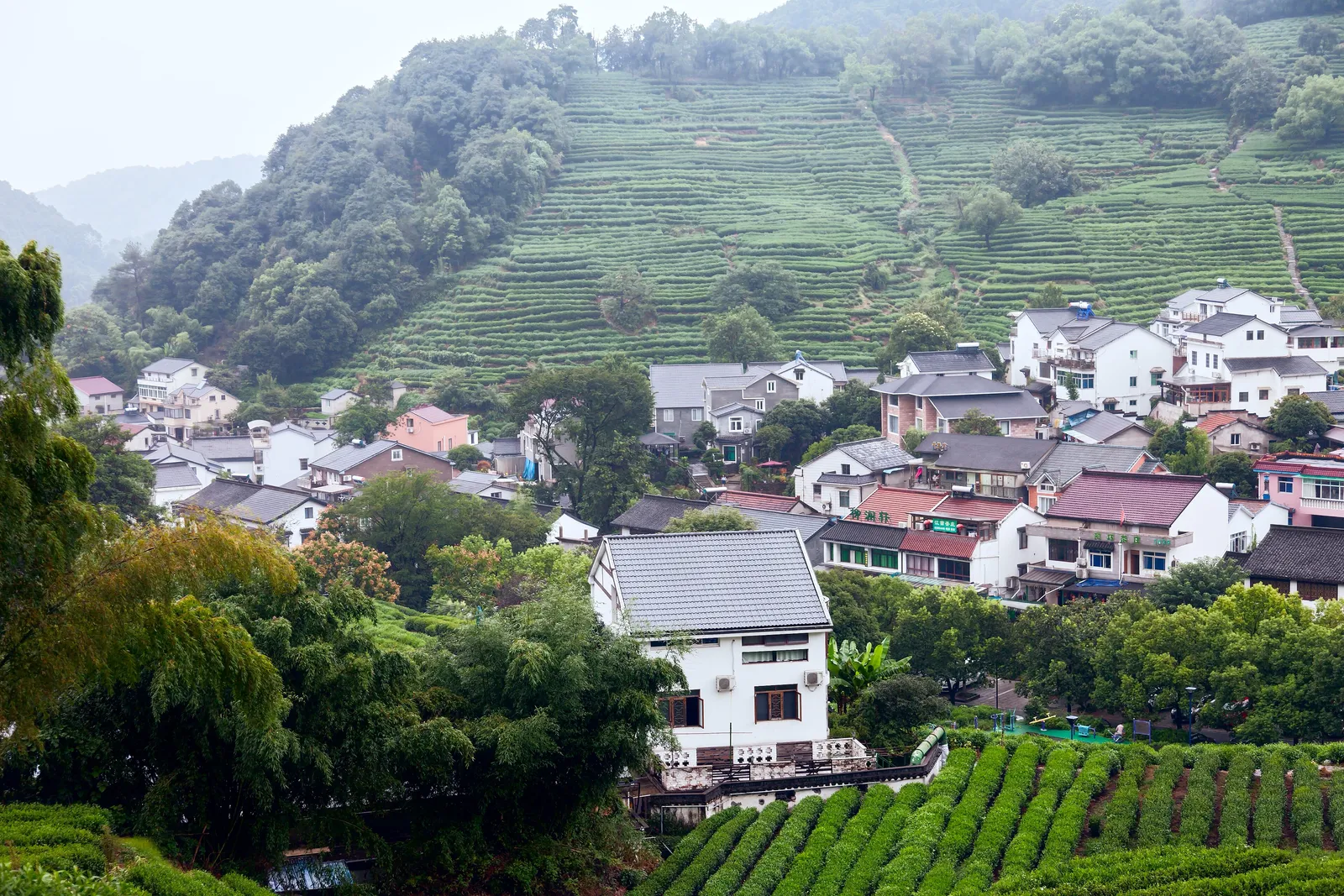
The Emperor's Eighteen Tea Bushes
Photo: Niklas Dougherty · CC BY-SA 4.0
Legend says Qianlong gave eighteen tea bushes in Hangzhou an imperial title. His visits and poems are on record. The decree is harder to find.
Every visitor to Hangzhou's tea hills hears about the eighteen bushes. Legend says the Qianlong Emperor gave them the title of imperial tea, and that they still grow at the foot of Lion Peak. The story is half history and half legend. Qianlong's visits, poems and love of Longjing (龙井, Lóngjǐng, "Dragon Well") are well recorded. The eighteen bushes are harder to pin down.
What the legend says
There are several versions. In the most common one, Qianlong came to Hangzhou on a southern tour and stopped at Hu Gong Temple (胡公庙) below Lion Peak (狮峰, Shī Fēng). The monks served him tea made from the bushes in front of the temple. He praised it and named those eighteen bushes yù chá (御茶), imperial tea, with caretakers appointed and new leaves sent to the palace each year.
A second legend gives the shape of the leaf a royal origin too. It says the emperor was picking tea himself when word came that his mother, the Empress Dowager, was ill. He stuffed the leaves into his sleeve and hurried back. In Beijing she noticed their scent, he brewed them for her, and she recovered. The flat shape of Longjing, the legend says, copies those leaves pressed in his sleeve.
A third version, told in the Hangzhou Daily, moves the bushes from the monks to a family: the Wang family's garden beside the temple, whose tea the emperor heard about before issuing a verbal order.
What is on record
Qianlong made six southern tours. Writers on tea commonly count four visits to the West Lake tea area, in 1751, 1757, 1762 and 1765. A detailed account in the Hangzhou Daily by Ding Yunchuan also traces visits on the tours of 1780 and 1784, drawing on the emperor's collected poems and court diaries.
The details are lively. In 1751 he watched tea being made and wrote "Song on Watching Tea Picking" (观采茶作歌), which that account calls his first mention of West Lake Longjing. In 1757, a day before the Grain Rain festival, farmers told him tea picked before the rain sold for more than tea picked after, and he wrote a poem on their honesty. In 1762 he named the Eight Scenes of Longjing, and he left the inscription "湖山第一佳", roughly "the finest of lake and hills". Of his roughly 43,600 poems, nearly 80 are about Longjing. One writer in the Beijing Evening News calls him the tea's spokesman, and his verses its advertising.
The eighteen bushes
Here the record thins out. Hangzhou accounts introduce the story with 据传 or 相传, "it is said". Ding Yunchuan himself treats the link between one of Qianlong's lines and the Wang family as an inference, and he cites no primary source for the decree.
The nearest thing to evidence is a line from the Qing dynasty West Lake Gazetteer (西湖志), quoted in a Hangzhou report: in front of Hu Gong Temple was a plot of less than one mu, about 670 square metres, that gave under one jin of tea a year and sent it as tribute. It speaks of a small tribute plot at this very spot. It does not mention the number eighteen or a title from the emperor.
The age of today's bushes is also unsettled. Some English-language sources say the original bushes are still alive. A Hangzhou news report says they have been replaced and replanted several times, while the garden itself has been kept. We found no dated study of the plants, so treat any claim of a 250-year-old bush with caution.
Longjing was not waiting for an emperor
The tea was already old. Lu Yu's Classic of Tea, from the 8th century, records tea at the Tianzhu and Lingyin temples of Qiantang, today's Hangzhou. In 1090 Su Dongpo wrote a poem on a trip to Longjing that shows crowds of carriages filling the valley. A book of 1591, Shiwu Ganzhu, lists more than 90 famous Chinese teas, with Longjing 21st. Ming writers praised it often. What Qianlong gave it was fame on the largest possible scale.
Visiting today
The tea grows in the hills west of the lake, and Longjing Village is the easiest place to see it. Spring, from late March to April, is picking season. The imperial garden at Lion Peak is open as a tourist site, so check its current fee locally. The name West Lake Longjing has been a protected certification mark since 2011, limited to registered producers inside a zone of about 168 square kilometres, which is worth remembering when someone offers you "imperial" tea.
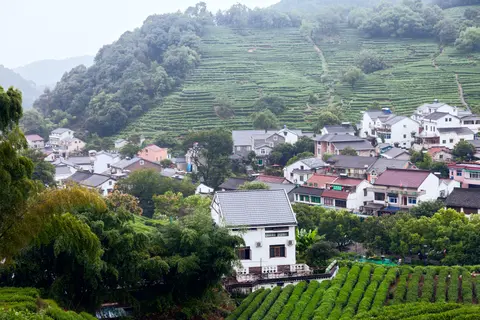 Sight in HangzhouLongjing tea village 龙井村Hillside tea terraces where Dragon Well (Longjing) green tea is grown, a short ride from the lake.
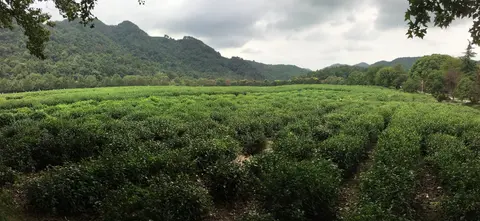 Sight in HangzhouChina National Tea Museum 中国茶叶博物馆China’s national museum of tea, set among tea bushes, ponds and pavilions west of West Lake, covering tea history, tea ware and how Longjing tea is made.
Places in this story
Sources
- Hangzhou Daily, Ding Yunchuan: Qianlong and Longjing (Chinese) (hznews.hangzhou.com.cn)
- Hangzhou News: the history of Longjing (Chinese) (hznews.hangzhou.com.cn)
- Hangzhou News: the imperial tea garden (Chinese) (hznews.hangzhou.com.cn)
- Beijing Evening News via China Writers, Yang Duojie: Longjing (Chinese) (chinawriter.com.cn)
- Our China Story: Qianlong and tea (Chinese) (ourchinastory.com)
- Wikipedia (Chinese): West Lake Longjing (secondary) (zh.wikipedia.org)
- Wikipedia: Longjing tea (secondary) (en.wikipedia.org)
Legends are told as legends. Where historians disagree, we say so.
More stories
 HistoryThe well that found an armyIn 1974 farmers digging a well near Xi’an hit pieces of clay. They had found the First Emperor’s army, and the tomb it guards is still sealed.
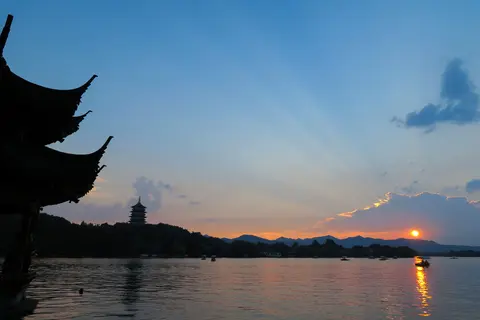 LegendsThe White Snake and Leifeng PagodaA snake spirit in love, a monk who stood in her way, and a real pagoda on West Lake that fell in 1924 and rose again.
 Travelers of the pastMarco Polo’s City of HeavenIn the 13th century a Venetian called Hangzhou the finest city in the world. What did he really see, and what is still there at West Lake?