
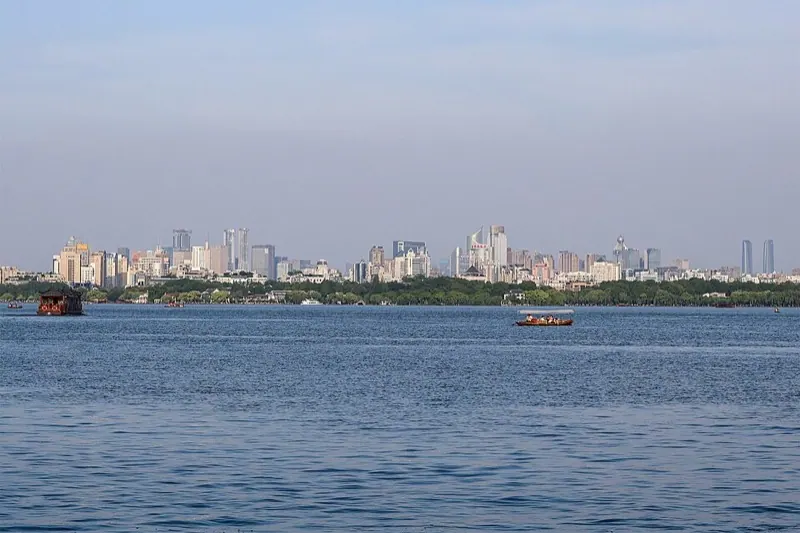
The commoner who baked his type in clay
Photo: Windmemories · CC BY-SA 4.0
Movable type rests on one witness: a scholar from Hangzhou who wrote down how a commoner named Bi Sheng did it, using fired clay and an iron plate.
Almost everything we know about the world's first recorded movable type comes from a single page. It was written by Shen Kuo, a scholar born in Hangzhou, and it describes the work of a man he calls only "a commoner": Bi Sheng.
The witness from Hangzhou
Shen Kuo was born in 1031 in Qiantang, today's Hangzhou. He had a long career under the Northern Song, including time as head of the Bureau of Astronomy, an envoy to the Liao and a military command, until a military setback in the early 1080s cost him his posts. In 1088 he retired to an estate on the edge of Zhenjiang that he called Dream Brook, and there he finished the notebooks known as the Dream Pool Essays. He died in 1095.
The book wanders from astronomy to fossils to music. Volume 18 has a short entry on printing.
What the page says
Shen starts with the background. Printing books from carved blocks, he says, was not common under the Tang. Then Feng Dao had the Confucian classics printed, and from then on books were made from blocks. In the Qingli era (1041 to 1048), he goes on, "a commoner, Bi Sheng" also made "movable blocks".
Then he gives the method, clearly enough to follow:
- Carve each character in sticky clay, as thin as the edge of a coin, one piece per character. Bake it hard in a fire.
- Coat an iron plate with a mixture of pine resin, wax and paper ash. Set an iron frame on the plate and pack the type tightly inside it.
- Warm the plate until the coating softens, then press a flat board on top so the faces become level as a whetstone.
- Ink and print. Afterwards, heat the plate again, brush with your hand, and the type falls off clean.
Two things show how carefully Shen or his informant watched. Bi kept two iron plates going at once: while one printed, the other was being set, so one was ready the moment the other finished. And he kept many copies of common characters. Words such as zhi and ye, Shen notes, had more than twenty pieces each, in case one page used them many times. Unused type was labelled with paper, sorted by rhyme group and stored in wooden cases. A rare character could be carved on the spot and baked over a grass fire.
Shen is also honest about the limits. For two or three copies, he says, the method was not simple. For dozens, hundreds or thousands, it was extremely fast.
He even explains why Bi did not use wood. Wood grain is uneven, it swells when wet so the faces end up at different heights, and it sticks to the coating. Baked clay does neither.
The entry ends with one sentence that explains why we know any of this: "When Sheng died, his type came into the hands of my younger relatives, and it is still kept to this day."
Who was Bi Sheng?
We do not really know. Shen gives him no hometown and no dates, and no other writer of the time mentions him. Later accounts vary. The surviving records do not say where he came from. Locally, a gravestone found in Yingshan County, Hubei, in 1990 is said to be his, and a park and museum now stand there. This is a local identification, not a settled one. Reference works give a death date of 1051 and a birth year of 972 or 990. Shen's page itself settles none of this.
What happened next
The method did not take over. In 1193 the official Zhou Bida printed a book with clay type, and called it Shen Kuo's method. Shen only recorded it: the method was Bi Sheng's. In 1298 the Yuan official Wang Zhen had more than 30,000 wooden types cut, and printed 100 copies of a local history of Jingde County with them. Hua Sui printed with bronze type around 1490.
Woodblocks still stayed the normal way of making books in China for centuries. The reason is debated, and the likely factors include the cost of making so many thousands of pieces for a script with so many characters, and how cheap copyists were. Metal type printing in Korea survives from 1377 in the book known as Jikji, and Gutenberg's press in Europe came some four centuries after Bi Sheng. Whether Chinese printing influenced Europe's is another open question, and this page has no evidence on it.
Seeing it today
Bi Sheng's type does not survive, and neither does the copy Shen's family kept. In Hangzhou you can walk the city Shen Kuo was born in. The movable type entry in the Dream Pool Essays is short enough to read in one sitting.
 City guideHangzhou 杭州West Lake, Longjing tea villages and a quick train from Shanghai.
Places in this story
Sources
- Shen Kuo, Dream Pool Essays, volume 18 (Chinese text) (zh.wikisource.org)
- Wikipedia: Bi Sheng (secondary) (en.wikipedia.org)
- Wikipedia (Chinese): Bi Sheng, on origin and the 1990 gravestone (secondary) (zh.wikipedia.org)
- Wikipedia: Shen Kuo (secondary) (en.wikipedia.org)
- Wikipedia: Movable type, on Wang Zhen, Hua Sui and Jikji (secondary) (en.wikipedia.org)
Legends are told as legends. Where historians disagree, we say so.
More stories
 HistoryThe well that found an armyIn 1974 farmers digging a well near Xi’an hit pieces of clay. They had found the First Emperor’s army, and the tomb it guards is still sealed.
 LegendsThe White Snake and Leifeng PagodaA snake spirit in love, a monk who stood in her way, and a real pagoda on West Lake that fell in 1924 and rose again.
 Travelers of the pastMarco Polo’s City of HeavenIn the 13th century a Venetian called Hangzhou the finest city in the world. What did he really see, and what is still there at West Lake?