
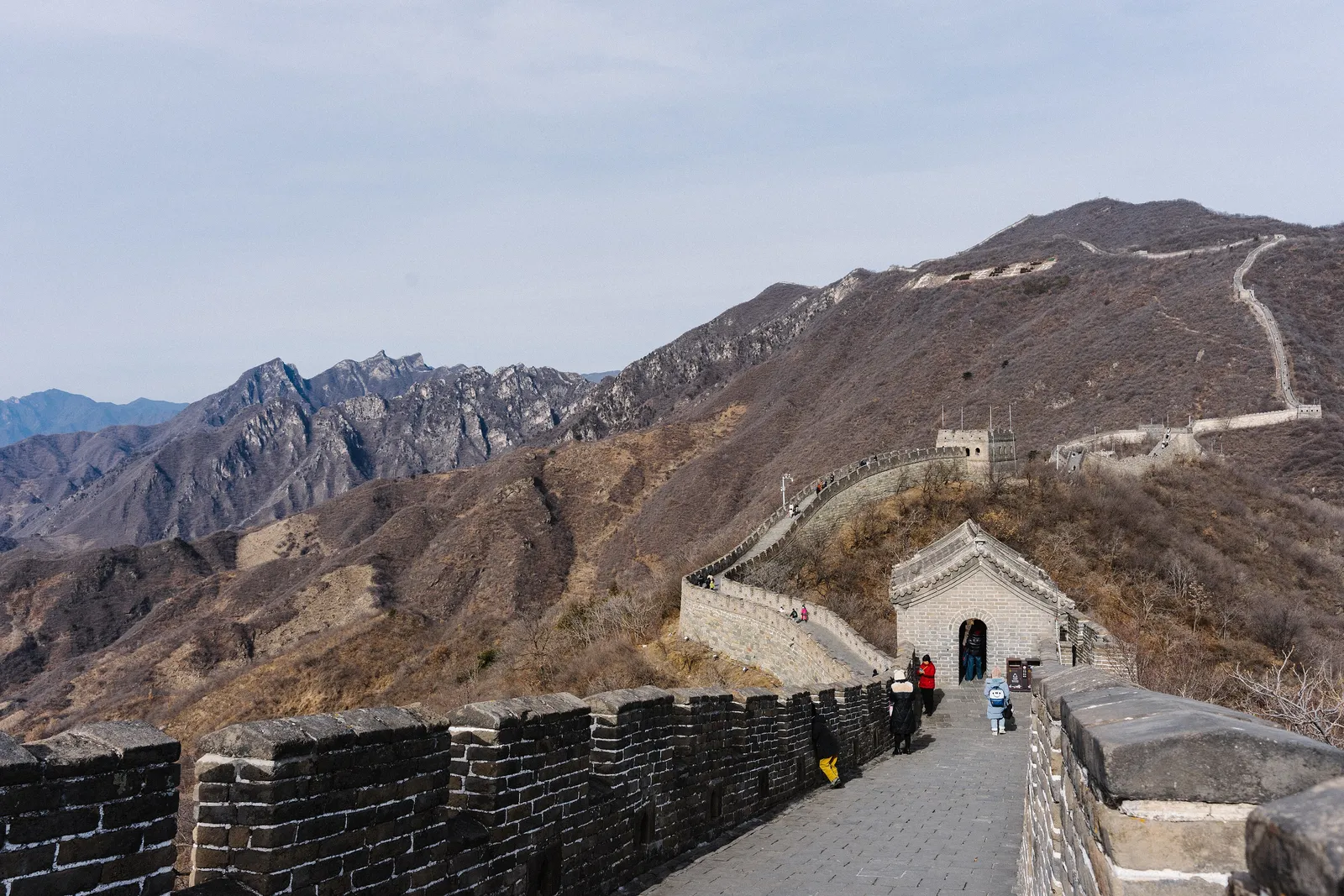
Mutianyu: the Great Wall that guards both ways
Photo: Lloyd Tudor · CC BY-SA 4.0
A stone found by wall workers names the Ming officials who rebuilt Mutianyu in 1569, down to the kiln managers. One famous general is missing.
Some years ago, workers from the office that looks after the Great Wall at Mutianyu were repairing a stretch of wall when they turned up a small stone tablet. It was only 85 centimetres tall, its border carved with scrolling flowers and three lively mythical beasts along the top. Its 301 characters were still sharp.
The date read: early autumn, third year of the Longqing reign. That is 1569. And the text was a list of names. At the top stood Tan Lun, supreme commander of the frontier armies around the capital. Below him came governors, inspectors and generals, and then, all the way down, the men who ran the quarries, the brick kilns, the lime kilns and the carpentry teams.
It was, in other words, a credit roll for a section of the Great Wall. But one name everyone expected was not there.
A wall worth guarding
Mutianyu lies in the hills of Huairou District, north of Beijing. Older stone walls already ran along these ridges when the Ming dynasty took power in 1368, but they were in poor shape.
The Ming had every reason to care. The Mongol rulers they had driven out were still a power on the steppe. In 1373 the founding emperor ordered his great general Xu Da to prepare the northern frontier, and garrisons were placed at 129 passes along more than 2,000 li of frontier running west from Yongping, near the coast. In 1381 Xu Da sent some 15,100 soldiers to repair 32 passes. And in 1404, under the Yongle Emperor, who later moved the capital to Beijing, Mutianyu was made an official pass.
Its position mattered. According to Beijing’s tourism authorities, the pass guarded one of the northern approaches to the capital, and it also covered the approaches to the Tianshou Mountains, where the Ming emperors were building their tombs. The Ming Tombs are about 39 kilometres to the south-west.
 Sight in BeijingMutianyu Great Wall 慕田峪长城A restored, forested stretch of the Ming wall with a cable car and toboggan, quieter than Badaling.
The general who was not on the stone
The wall you walk on today belongs mostly to a later, much bigger campaign. In 1567, with the backing of the senior minister Zhang Juzheng, two commanders who had made their names fighting pirates on the south-east coast were moved north. Tan Lun became supreme commander. Qi Jiguang was first put in charge of training the troops and then made commander of the Jizhou garrison, the most important stretch of frontier around Beijing. He stayed on this frontier until 1583.
Qi Jiguang is the name everyone links with this wall. Under his command the Ming strengthened the defences and built many new hollow brick watchtowers, where soldiers could shelter, store weapons and fight from above. A Kangxi-era gazetteer of Huairou even says that the frontier works here were “mostly Qi Jiguang’s legacy”.
So why is his name missing from the 1569 tablet? No one knows. The tablet lists Tan Lun as the man in charge, and Beijing’s tourism office simply calls the gap one of the mysteries of Mutianyu. The tablet itself is a reminder that a wall was never one man’s work. It needed officials and soldiers, but also quarrymen, brick-makers and lime-burners, and the stone remembered them.
Battlements on both sides
What makes Mutianyu look different from most other sections is easy to spot once you know. On most of the Great Wall, the crenellated parapet, the notched top edge behind which archers could shelter, faces outward, towards the north. At Mutianyu, both sides of the wall are crenellated.
Local historians explain it by the wall’s job: so close to the capital and the imperial tombs, it had to be able to fight in both directions. Whatever the exact reason, the effect is striking. The wall looks armoured on every side.
It also carries an unusual number of towers. On the main restored stretch there are 22 watchtowers in about 2.25 kilometres. And at the heart of it all is the Zhengguan Tai, the Main Pass Platform: three towers standing together on one platform, joined inside, with a stone plaque bearing its name. Its lower level is a connected hall said to hold around a hundred soldiers. Local writers call it unique on the whole Great Wall.
A legend on the side
Look south-east from the Big Corner Tower and you may notice a short spur of wall that runs off the main line for about a kilometre and then simply stops. Locals call it the Bald-Tail Wall, and they tell a story about it.
According to the legend, in the 1580s a general who had served under Qi Jiguang designed this spur to block enemies who might creep up through the side valleys. Officials of the Ministry of War demanded a bribe, and he refused. When the spur was finished, they accused him of building it in the wrong direction and had him executed. Years later, the story goes, a new commander saw that the spur was in exactly the right place, and set up a stone in the tower to clear the general’s name.
There is no record to confirm it. But it says something about how people here remember the wall: as the work of people, some honest, some not.
Built again in the 1980s
By the 20th century much of the wall at Mutianyu was crumbling. In 1983 China’s State Council approved its restoration. The site opened to its first visitors in 1986 and to everyone in 1988. In 1987 the Great Wall as a whole was inscribed on UNESCO’s World Heritage List.
Much of the brickwork you walk on was restored then, following the Ming line. That is worth knowing, not as a disappointment, but as the latest chapter in a long story of rebuilding: older walls, then Xu Da, then Tan Lun and Qi Jiguang, then the 1980s.
What you see today
Most visitors ride a cable car or chairlift up from the valley and walk the ridge between towers. In autumn the hills, more than 90 percent forest, turn red and gold. Some come down on a toboggan along a metal track.
Take time at the Zhengguan Tai, and count the towers along the ridge. Look at both parapets and imagine soldiers ready to face either way. Then look beyond the restored section, towards the west, where the wall continues unrestored towards Jiankou, broken and overgrown. Between the two you see the whole life of the Great Wall: built, rebuilt, ruined and rebuilt again.
Places in this story
Sources
- The history of the Mutianyu Great Wall: Xu Da, the 1404 pass and the 1569 builders’ stele — Visit Beijing (Beijing Municipal Bureau of Culture and Tourism), Huairou Tourism Commission (visitbeijing.com.cn)
- Mutianyu Great Wall: double-sided battlements and Qi Jiguang — Visit Beijing (visitbeijing.com.cn)
- Mutianyu, the finest of the Great Wall (Zhengguan Tai, Big Corner Tower, the Bald-Tail Wall legend) — Huairou Media via Beijing News (m.bjnews.com.cn)
- Mutianyu (restoration 1983–1988, towers, double parapets) — Wikipedia (en.wikipedia.org)
- The Great Wall — UNESCO World Heritage Centre (whc.unesco.org)
Legends are told as legends. Where historians disagree, we say so.
More stories
 HistoryThe well that found an armyIn 1974 farmers digging a well near Xi’an hit pieces of clay. They had found the First Emperor’s army, and the tomb it guards is still sealed.
 LegendsThe White Snake and Leifeng PagodaA snake spirit in love, a monk who stood in her way, and a real pagoda on West Lake that fell in 1924 and rose again.
 Travelers of the pastMarco Polo’s City of HeavenIn the 13th century a Venetian called Hangzhou the finest city in the world. What did he really see, and what is still there at West Lake?