
The Buddha carved to calm a river
A Tang monk set out to tame three wild rivers by cutting a 71-metre Buddha into the cliff above them. It took ninety years and three leaders.
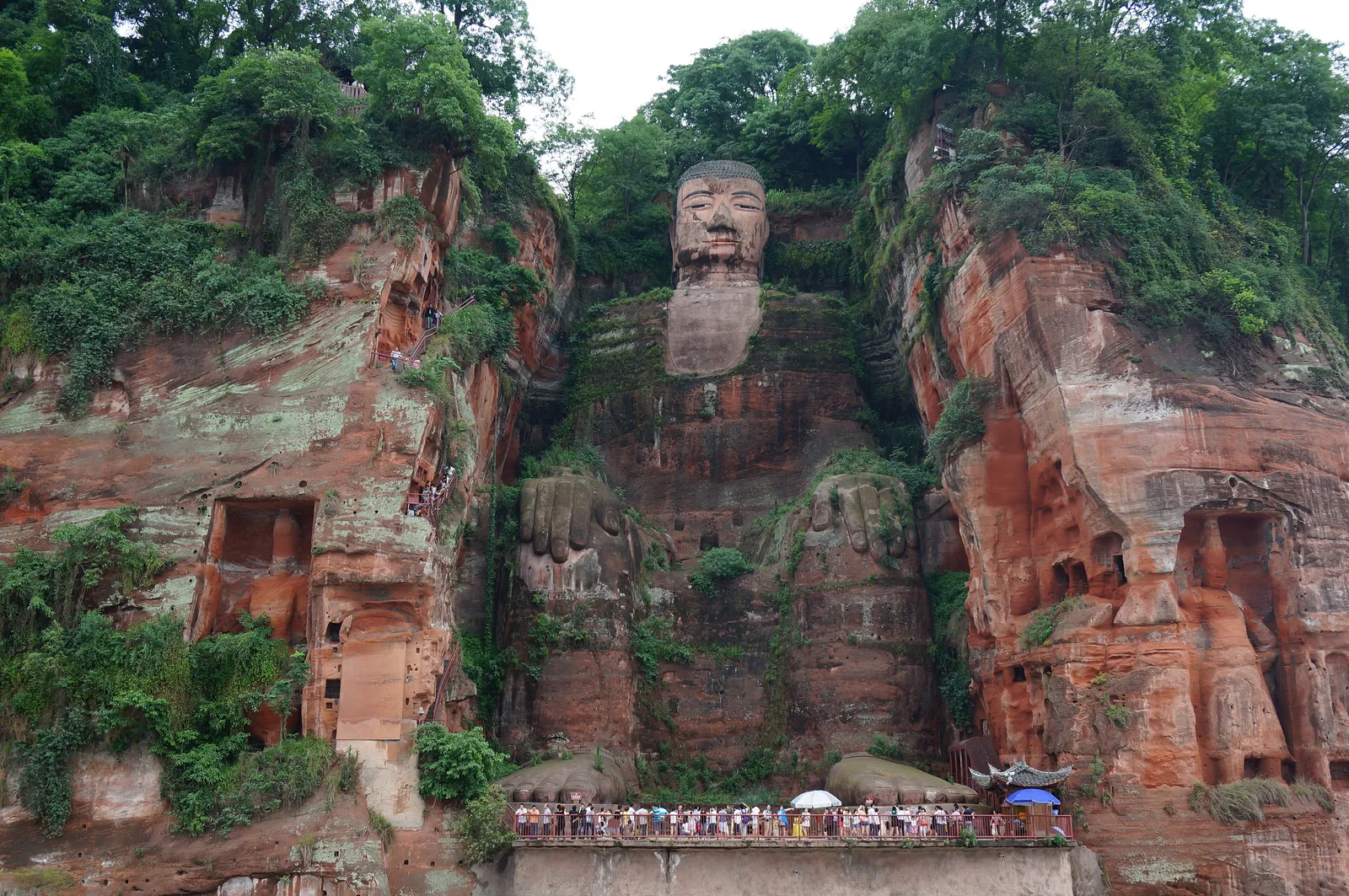
From the deck of the tourist boat you see the feet first. They rest on a ledge just above the brown water, each one broad enough for a crowd to stand on its toes. Then your eye climbs: the knees, the hands resting on them, the long folds of the robe, and finally, far above, a calm face framed by tight curls of hair. The figure is 71 metres tall, cut straight out of the red sandstone cliff.
The Leshan Giant Buddha has sat here, looking out over the water, for more than twelve centuries. It was not made only to be admired. According to a Tang inscription and local tradition, it was made to stop people drowning.
Three rivers, one cliff
Leshan, the old city of Jiazhou, stands where three rivers meet: the Min, the Dadu and the Qingyi. In flood season their currents slammed into the cliffs of Lingyun Hill, and the place was notorious for wrecks. Boats were smashed, and their crews were lost with them.
Most of what we know about the man who decided to do something about it comes from a single text, written ninety years after he began. Its author was Wei Gao, the military governor who finished the project, and it is usually called the Record of the Great Maitreya Stone Statue of Lingyun Temple in Jiazhou.
According to Wei Gao, a monk named Haitong, who lived at Lingyun Temple, felt pity for the boatmen. He reasoned that if the cliff were carved, the stone cut away would fall into the river and fill its deep places, and the water would grow calmer. He also believed that a great image of the Buddha would gather good karma and the help of many people. He chose Maitreya, the Buddha of the future, a figure widely worshipped in the decades before. Work began, Wei Gao says, early in the Kaiyuan era, which historians usually date to 713.
The monk and the official
Haitong had no fortune of his own. The money came from donations, and Wei Gao paints a vivid picture: people came from everywhere, valuable goods poured in, and skilled metal- and stoneworkers arrived.
He also tells the story everyone in Leshan still knows. A local official came to Haitong demanding a bribe. Haitong answered that the official could have his eyes before he could have the Buddha’s money. The official, angry, told him to go ahead. Haitong gouged out his own eye and presented it on a plate. The official fled in horror and begged forgiveness.
Is it true? We cannot check it. Wei Gao wrote it down only when the statue was finished, long after Haitong’s death, as part of a tribute to a man he admired, and later writers retold it again and again. Treat it as the story Leshan tells about its founder: a portrait of devotion, not a court record.
What is clearer is that Haitong did not live to see the statue finished. Accounts differ on how far the work had gone when he died: the Sichuan Local Chronicles Office says the head was done, others say it had reached the shoulders.
 Sight in LeshanLeshan Giant Buddha 乐山大佛A 71-metre seated Maitreya cut into a red sandstone cliff where three rivers meet. The monk Haitong began it in 713 to calm the dangerous water, and it took about 90 years. UNESCO listed it with Mount Emei in 1996.
Ninety years, three leaders
Two powerful officials took up the work. In the middle of the 8th century, the military governor of the region gave part of his salary and carried the carving on down to the knees. Then came Wei Gao, governor of western Sichuan from the 780s, gave his own salary, finished the statue from the knees to the lotus base, and added decoration. The work was complete in 803, ninety years after it began.
Wei Gao describes the building site in a few lines: ten thousand men straining, a thousand hammers striking together, great rocks crashing down like thunder. And the river? According to him, the dangerous currents were made smooth. Whether the falling rubble really tamed the confluence is hard to judge today. But the boats kept coming, and the Buddha stayed.
A Buddha with a roof and drains
For centuries the statue did not stand in the open. A tall wooden pavilion was built to cover it. When the Song-dynasty poet and official Fan Chengda sailed past in the 12th century, he wrote that the figure was 360 chi (old Chinese feet) tall, that its eyes were two zhang wide, that a thirteen-storey building covered it, and that its ears were still made of wood. The river at its feet, he added, was so violent that you could not stand and look at it straight.
The pavilion has long gone, and accounts differ on when it was destroyed. If you look carefully, you can still see marks of it in the cliff on both sides of the statue.
Less visible is something the Tang builders left inside. Lingyun Hill is soft red sandstone full of water, and moisture seeps through it all the time. So the carvers cut hidden drainage passages behind the ears, at the shoulders and behind the chest. Peng Xueyi of the scenic area’s grottoes research institute told Beijing News in 2020 that the passages are 50 centimetres to a metre wide and about three metres high, slope back into the hill and carry seepage away from the statue. The ear and shoulder passages are connected. The drainage grooves in the hair, he added, are a later addition.
The Buddha has needed all the help it can get. In August 2020, during a major flood, the river rose over the platform at its feet and reached its toes, for the first time in about seventy years. The water fell again within hours. The statue survived.
What you see today
Since 1996 the Leshan Giant Buddha has been part of a UNESCO World Heritage site, together with nearby Mount Emei. There are two ways to see it, and they feel completely different.
From the river, on one of the sightseeing boats, you see the whole figure at once, the way the boatmen of Jiazhou saw it, with Lingyun Hill and its temples above. It takes about half an hour.
On foot, you start at the top beside the head, level with an ear taller than a person. Then you go down a narrow stairway cut into the cliff, zigzagging past the shoulder and the robe to the feet. On busy days the queue for those stairs can take hours, but at the bottom you can stand at the Buddha’s feet and look up.
Somewhere on that climb, notice the water. It still darkens the stone in streaks, still runs through the channels the Tang carvers cut. The river is still there too, wide and fast, flowing past a Buddha that was built to watch over it.
Places in this story
Sources
- Wang Junhua, Haitong: the founder of the Leshan Giant Buddha (Wei Gao’s record, later governors, Fan Chengda’s description) — Sichuan Local Chronicles Office (Fangzhi Sichuan), The Paper (thepaper.cn)
- How much did the Leshan Buddha’s 1,000-year-old drainage system help in the flood? (Peng Xueyi, grottoes research institute) — Beijing News via Sina (news.sina.cn)
- Leshan Giant Buddha management committee on the statue’s history (713 start, Haitong, Wei Gao, Maitreya, 1996 UNESCO listing) — Sichuan Daily (Chuanguan News), 2026-03-11 (cbgc.scol.com.cn)
- Mount Emei Scenic Area, including Leshan Giant Buddha Scenic Area — UNESCO World Heritage Centre (whc.unesco.org)
Legends are told as legends. Where historians disagree, we say so.
More stories
 HistoryThe well that found an armyIn 1974 farmers digging a well near Xi’an hit pieces of clay. They had found the First Emperor’s army, and the tomb it guards is still sealed.
 LegendsThe White Snake and Leifeng PagodaA snake spirit in love, a monk who stood in her way, and a real pagoda on West Lake that fell in 1924 and rose again.
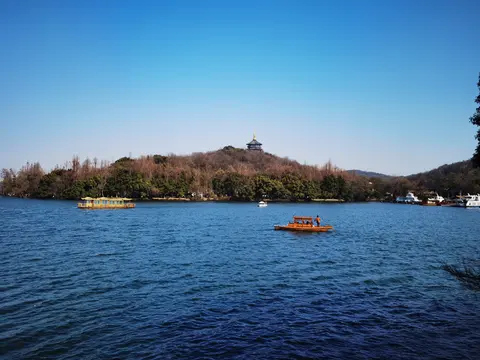 Travelers of the pastMarco Polo’s City of HeavenIn the 13th century a Venetian called Hangzhou the finest city in the world. What did he really see, and what is still there at West Lake?