
The bronze jar said to feel distant earthquakes
Photo: xiquinhosilva · CC BY 2.0
In AD 132 a Luoyang astronomer built an instrument to show where an earthquake came from. It is lost, and every model today is a guess.
In AD 132 a court astronomer in Luoyang presented something the old history says had no precedent in the records: a bronze vessel that was said to know when the earth had moved far away, and in which direction. His name was Zhang Heng. The instrument is gone. All we really have is one short passage in an old history, and that passage has kept engineers arguing for 150 years.
The man
Zhang Heng was born in AD 78 in Nanyang commandery, in today's Henan. Around 111 or 112 he was summoned to court at Luoyang, the Eastern Han capital, and served twice as Chief Astronomer, the second time from about 126 to 132. He was also a poet and a mathematician, and he built a water-driven armillary sphere. He died in Luoyang in 139.
What the record says
The description comes from Zhang's biography in the Book of the Later Han, compiled by Fan Ye in the 5th century, about three hundred years after the event. It is brief enough to retell almost in full.
In the first year of the Yangjia era, it says, Zhang made a "houfeng didong yi", an instrument for observing the winds and the movements of the earth. It was cast in fine bronze, eight chi across (roughly two metres), with a domed lid, and shaped like a wine vessel. Seal-script characters, mountains, turtles, birds and beasts decorated the outside.
Inside stood a central column, with eight channels leading off it and catches and triggers fitted to them. Outside were eight dragons, each holding a bronze ball in its mouth. Below each dragon sat a toad with its mouth open. All the working parts were hidden in the sealed vessel.
When the earth moved, the text says, the vessel shook, one dragon's mechanism let go, and its ball dropped into the toad with a ringing sound that alerted the attendant. One dragon had fired and the other seven had not moved, so you could read the direction of the quake.
Then comes the story that made it famous. Once a dragon released its ball, but nobody felt anything. Scholars in the capital mocked the instrument. Some days later a courier arrived with news of an earthquake in Longxi, in today's Gansu. After that, the text says, everyone accepted it, and historians were told to record the direction from which earthquakes came.
What we do not know
The passage is the whole of the evidence. No part of the instrument has ever been found, and no drawing from the time survives. The text does not explain how the column worked. It also gives no date for the Longxi quake, and modern writers disagree: a 2009 paper by the team behind the newest model argues for an event in 134, while the annals of Emperor Shun record a quake in 138 at the capital, Jincheng and Longxi. That entry lists the capital too, so it does not fit neatly with a quake nobody there felt.
Later attempts are mentioned too. Xindu Fang in the Northern Qi and Lin Xiaogong in the Sui are said to have made similar devices, and by about 1290 the writer Zhou Mi noted that the books describing them could no longer be found. A study of the lost instrument says it had already disappeared by the end of the Eastern Han.
Many reconstructions, no original
The dragon-and-toad jar you have probably seen in a museum, a stamp or a textbook is a modern reconstruction. Treat it as an educated guess.
Since 1875 about a dozen designs have been proposed. Most fall into two families, a hanging pendulum and a standing, inverted one, and writers differ on who proposed which and when. Wang Zhenduo, who titled his 1936 paper a "conjecture", produced in 1951 the exhibition model that became the familiar image. Imamura Akitsune in Japan published his own design in 1939.
Researchers have since been hard on the 1951 model. A 2009 paper in the Chinese journal Physics says it contained a fundamental mistake and that the earlier models were concepts which did not work as seismoscopes. A new study began in 2002, a replica was announced in 2005, and its authors say it works and fits the text and Han styling. Others are more cautious. Hong-sen Yan has written that modern replicas have not matched the accuracy and sensitivity the history describes. Hsiao Kuo-Hung and Yan, reviewing the field in 2009, sort the designs into several families and say the question stays open until new evidence turns up.
So the honest summary has two parts. It is documented that a 5th-century history credits Zhang Heng with this instrument and describes what it looked like. How it worked, and how well, remains conjecture.
Visiting today
Nothing of the instrument can be seen in Luoyang. The city is still the place to think about the Eastern Han capital where Zhang Heng worked. His tomb is in Nanyang, which needs a separate trip, where his tomb (张衡墓) is kept as a memorial site. Check opening details locally before you go.
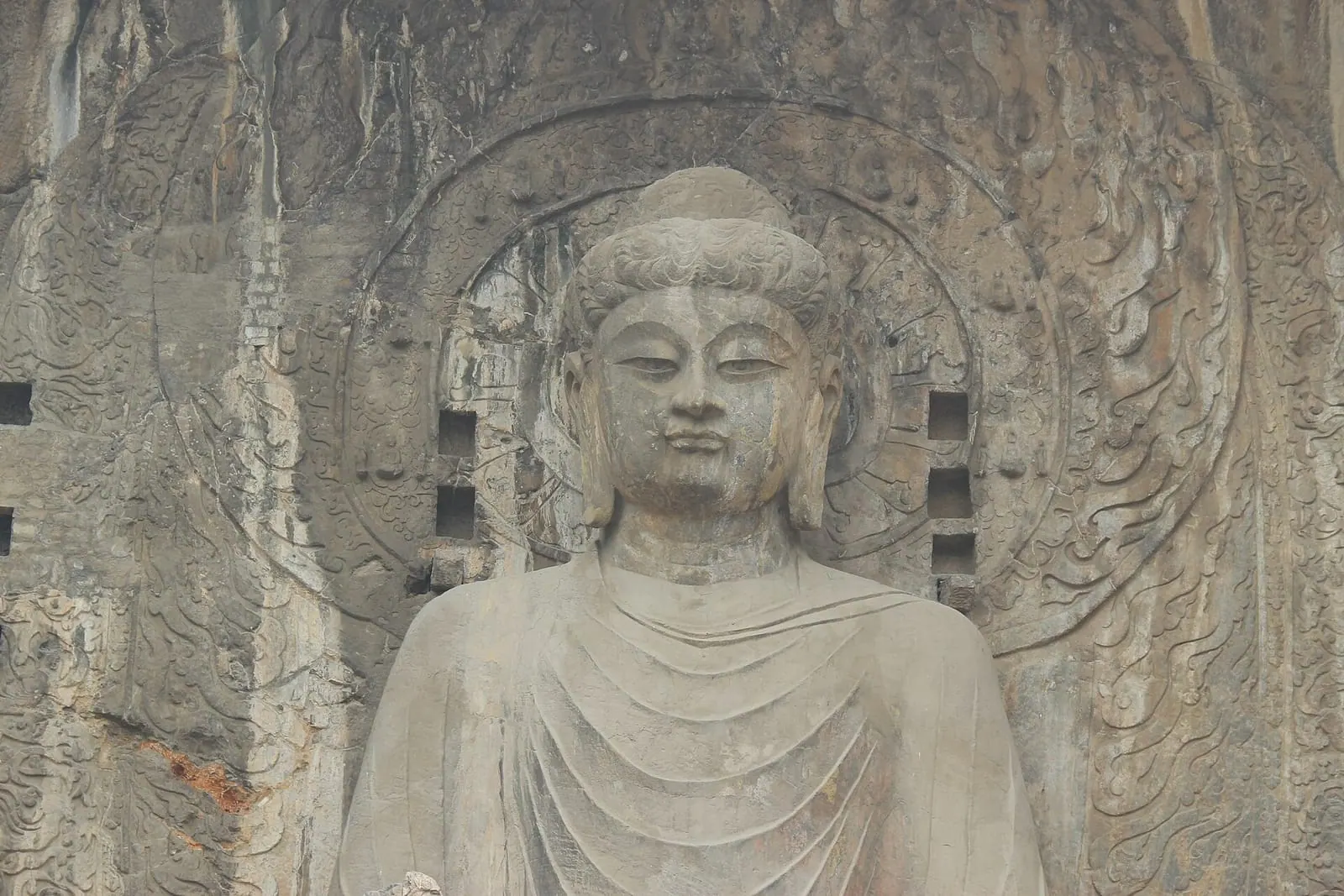 City guideLuoyang 洛阳The Longmen Grottoes, with Shaolin Temple within reach.
Places in this story
Sources
- Fan Ye, Book of the Later Han, chapter 59: biography of Zhang Heng (Chinese text) (zh.wikisource.org)
- Fan Ye, Book of the Later Han, chapter 6: annals of Emperor Shun, earthquake of 138 (Chinese text) (zh.wikisource.org)
- Hsiao and Yan, The Review of Reconstruction Designs of Zhang Heng's Seismoscope, Journal of JAEE, 2009 (jstage.jst.go.jp)
- Science brings back Zhang Heng's seismometer to life, Physics (Wuli), 2009 (wuli.iphy.ac.cn)
- Wikipedia: Zhang Heng (secondary) (en.wikipedia.org)
- Wikipedia (Chinese): Houfeng didong yi, on reconstructions (secondary) (zh.wikipedia.org)
- Wikipedia (Chinese): Zhang Heng, on the tomb in Nanyang (secondary) (zh.wikipedia.org)
Legends are told as legends. Where historians disagree, we say so.
More stories
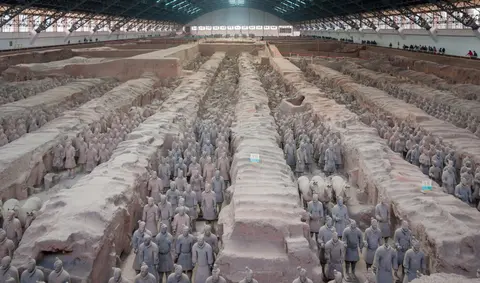 HistoryThe well that found an armyIn 1974 farmers digging a well near Xi’an hit pieces of clay. They had found the First Emperor’s army, and the tomb it guards is still sealed.
 LegendsThe White Snake and Leifeng PagodaA snake spirit in love, a monk who stood in her way, and a real pagoda on West Lake that fell in 1924 and rose again.
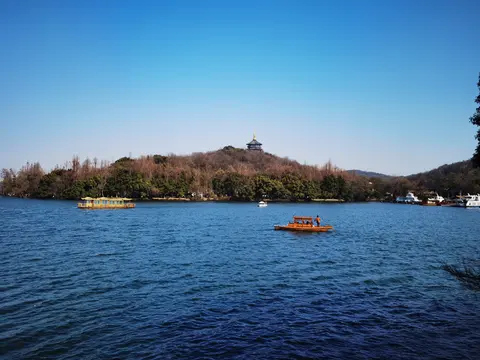 Travelers of the pastMarco Polo’s City of HeavenIn the 13th century a Venetian called Hangzhou the finest city in the world. What did he really see, and what is still there at West Lake?