
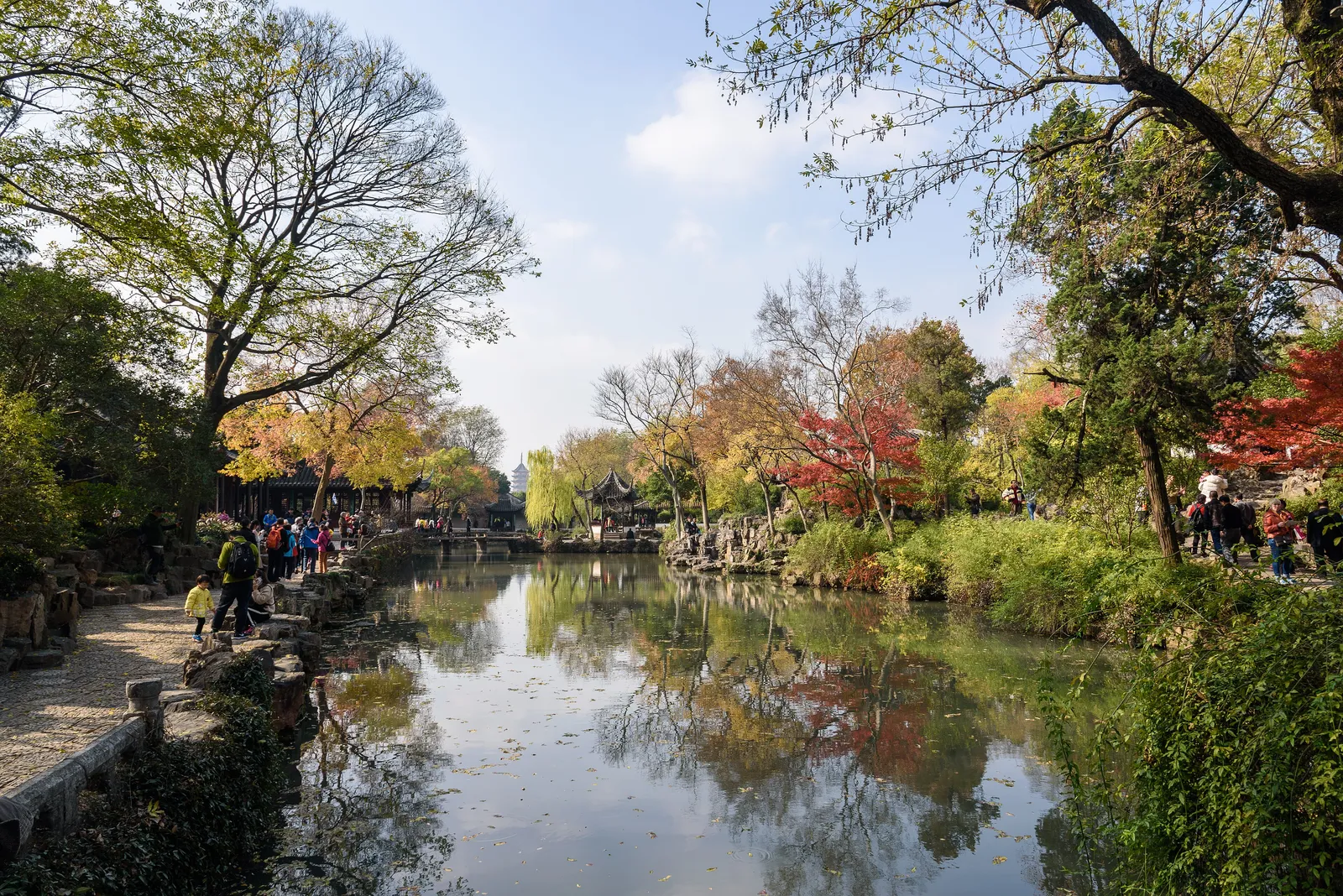
Why Suzhou’s gardens look small but feel endless
Photo: King of Hearts · CC BY-SA 4.0
Suzhou’s scholar gardens fit mountains, lakes and forests into a few city plots. The trick is not size but walls, windows and borrowed views.
Step through the gate of the Master of the Nets Garden and for a moment there is nothing to see. A narrow passage, a whitewashed wall, a turn. Then the wall opens, and in front of you lies a pond with rocks like small cliffs, a pavilion leaning over the water, a covered walkway climbing past old trees. You walk on, and it keeps going: another courtyard, another window, another view.
When you come out and look at a map, it is hard to believe. The whole garden covers about half a hectare, smaller than a football pitch.
That is the magic of the classical gardens of Suzhou. They were built inside a crowded city, on plots squeezed between houses, lanes and canals. Yet they were meant to hold a whole landscape. Nine of them are now a UNESCO World Heritage site, inscribed in 1997 and extended in 2000.
Gardens for retired officials
Most of these gardens were made by scholar-officials, men who had passed the imperial exams, served the state, and then come home. A garden was their answer to public life: a place to read, paint, write poems and receive friends, far from the court but still in town.
The Humble Administrator’s Garden is the classic example. In the early 16th century a censor named Wang Xianchen, back in his native Suzhou, built it on the site of an old temple. He took its name from a 3rd-century rhapsody by Pan Yue, On Living in Idleness, in which the writer says that tending his garden and growing his vegetables is the only kind of governing a humble man like him is fit for. The name is often read as a wry joke at his own expense, and a quiet comment on life at court.
His friend, the painter Wen Zhengming, knew the garden well. He painted it more than once. An album of eight views that he made in 1551, at the age of 81, is now in the Metropolitan Museum of Art in New York. The garden has been rebuilt so many times since that it is hard to match Wen’s scenes to what you see today, but the spirit is the same: a garden made to be looked at like a painting.
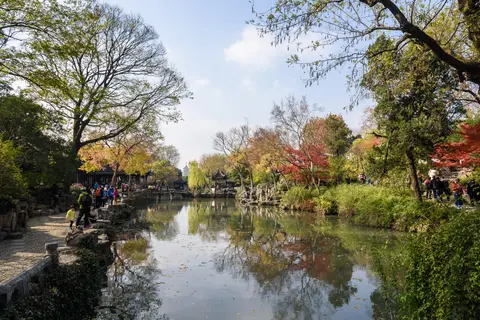 Sight in SuzhouHumble Administrator’s Garden 拙政园The largest and most famous of Suzhou’s classical gardens: ponds, pavilions and winding corridors from the Ming dynasty.
Trick one: hide the edges
The first rule is that you should never see the whole garden at once. Walls, corridors, rockeries and buildings break the space into a chain of smaller scenes. Paths bend. Corridors zigzag. Doorways are placed so that you only see what lies beyond when you reach them.
The Chinese have a phrase for the effect: the view changes with every step. A garden that would take two minutes to cross in a straight line takes an hour to explore, because there is no straight line.
Trick two: frame everything
The second rule is to turn views into pictures. Walls are pierced with round moon gates, vase-shaped doorways and lattice windows, each one placed to frame something: a single banana plant, a twisted pine, a rock against a white wall. In Suzhou, a white wall is not a dead end. It is a sheet of paper, and the plants in front of it, and their shadows, are the painting.
Names do the same work in words. Halls and pavilions are named after lines of poetry. In the Humble Administrator’s Garden, the main hall of the central garden, the Distant Fragrance Hall, takes its name from a famous line by the Song thinker Zhou Dunyi in praise of the lotus, and it looks out over a pond of lotuses.
Trick three: borrow the view
The third rule is the boldest: use what lies outside the garden. In 1631 a garden designer named Ji Cheng wrote the Yuanye, or The Craft of Gardens, the great Ming handbook on the subject. Its final chapter is about borrowed scenery: bringing a distant hill, a temple roof or a tree in a neighbour’s yard into your own composition.
The most famous example in Suzhou is in the Humble Administrator’s Garden. From a small pavilion at the entrance to the central garden, the Pavilion Leaning against the Rainbow, you can see the North Temple Pagoda rising beyond the trees, outside the garden walls. It belongs to another place entirely, but from here it looks like part of the design.
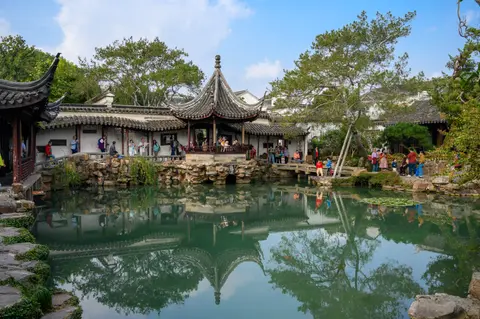 Sight in SuzhouMaster of the Nets Garden 网师园A small, perfectly proportioned garden around one pond, with evening music and opera shows in the warm months.
Trick four: mountains made of stone
The last ingredient is rock. Suzhou’s gardeners prized limestone from nearby Lake Tai, worn by water into holes, ridges and hollows. Piled into rockeries, these stones become mountains with caves and paths. Set up alone, a fine stone is treated almost like a sculpture.
The Lingering Garden is home to one of the most admired: the Cloud-Capped Peak, a tall, slender Lake Tai rock that was moved to its current place when the garden was rebuilt in the 1870s. Stand in front of it and it is easy to see why people called such stones mountains in miniature.
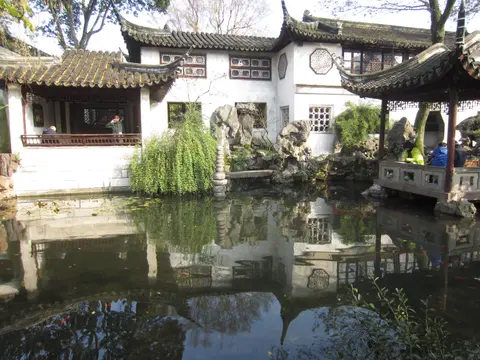 Sight in SuzhouLingering Garden 留园A grand garden of halls, courtyards and a 700-metre covered walkway, home to the famous Cloud-Capped Peak rock.
A Suzhou courtyard in New York
The Master of the Nets Garden traces its history back to a Southern Song official, Shi Zhengzhi, who admired the simple, solitary life of a fisherman. In the 18th century a retired official named Song Zongyuan rebuilt it and gave it its present name, another nod to that fisherman’s life.
In one corner lies a small courtyard called the Late Spring Studio, named after a line by the Song poet Su Dongpo. Around 1980, that courtyard became the model for the Astor Court in the Metropolitan Museum of Art. A team of craftsmen from Suzhou’s garden administration went to New York and built it by hand, using traditional methods, Lake Tai rocks and hand-made tiles. It was completed in 1981. If you have stood in the Astor Court, you have already stood, in a sense, in Suzhou.
What you see today
Go early. Suzhou’s gardens are among China’s most visited sights, and the effect of hidden, unfolding space disappears when every path is full. The Humble Administrator’s Garden is the largest; the Master of the Nets Garden is one of the smallest and often the most moving; the Lingering Garden is famous for its corridors and its rocks.
Do not try to see everything. Sit for ten minutes in one pavilion and look at what it frames. Walk a corridor slowly and watch the views change in the windows. Look for the borrowed pagoda. Then go back out into the street and notice how small the garden walls look from the outside. That is the whole trick: a small space, arranged so that you never reach its end.
Places in this story
Sources
- Classical Gardens of Suzhou — UNESCO World Heritage Centre (whc.unesco.org)
- Wen Zhengming, Garden of the Inept Administrator (album, 1551) — The Metropolitan Museum of Art (metmuseum.org)
- Humble Administrator’s Garden (Wang Xianchen, Pan Yue, Distant Fragrance Hall, borrowed view of North Temple Pagoda) — Wikipedia (en.wikipedia.org)
- Master of the Nets Garden (Shi Zhengzhi, Song Zongyuan, Late Spring Studio) — Wikipedia (en.wikipedia.org)
- Astor Court, Metropolitan Museum of Art (Suzhou craftsmen, completed 1981) — Wikipedia (en.wikipedia.org)
- The Craft of Gardens (Yuanye, Ji Cheng, 1631; chapter on borrowed scenery) — Wikipedia (en.wikipedia.org)
- Lingering Garden (Cloud-Capped Peak moved in the 1870s rebuild) — Wikipedia (en.wikipedia.org)
Legends are told as legends. Where historians disagree, we say so.
More stories
 HistoryThe well that found an armyIn 1974 farmers digging a well near Xi’an hit pieces of clay. They had found the First Emperor’s army, and the tomb it guards is still sealed.
 LegendsThe White Snake and Leifeng PagodaA snake spirit in love, a monk who stood in her way, and a real pagoda on West Lake that fell in 1924 and rose again.
 Travelers of the pastMarco Polo’s City of HeavenIn the 13th century a Venetian called Hangzhou the finest city in the world. What did he really see, and what is still there at West Lake?