

Nü'er Hong: The Wine Buried for a Daughter
Photo: Windmemories · CC BY-SA 4.0
Brew at her birth, dig it up on her wedding day. Shaoxing's best-loved custom is real, though its age is uncertain.
Nü'er hong (女儿红, nǚ'ér hóng), "daughter's red", is a Shaoxing rice wine named after a family custom: brew a jar when a daughter is born, bury it, and open it when she marries. The custom is real, and it is still performed at some Shaoxing weddings. Its origin story is a legend, and an often-cited ancient source turns out to describe somewhere else. On a shelf today, the name is mostly a label.
The custom
Shaoxing is the home of *huangjiu* (黄酒), yellow wine, brewed from glutinous rice. Traditional brewing is done through the cold months, ending around the Beginning of Spring in February, though exact dates vary, and the finished wine is aged in jars for three years or more. The craft joined China's first national list of intangible heritage in 2006. The list entry says it began in the Spring and Autumn period, which is best read as a traditional claim, not a settled date.
Long ageing is what the custom depends on. In the usual telling, a father brewed or set aside wine at his daughter's birth, sealed the jar with clay and buried it, sometimes under the ground in the courtyard, sometimes in a wall. On her wedding day it came up. One account has the jar loaded onto the bridal sedan chair as part of her dowry. Others have it poured for the guests. A son might get a jar too, called *zhuangyuan hong* (状元红), "top scholar's red", meant to celebrate his success in the imperial exams. Since very few men ever came first in the exams, tradition says it was often opened at his wedding instead.
The jars are part of the story. Traditional accounts say the finest were carved or painted with flowers, and that this gave rise to the name *huadiao* (花雕), "carved flowers". Today that word covers a whole type of aged Shaoxing wine.
The legend
The local origin story is a folk tale. Legend says a wealthy man in Dongguan, in Shaoxing, longed for a child. When his wife at last became pregnant, he happily brewed more than twenty jars of wine. A daughter was born, and he held a banquet when she was one month old. Afterward, some jars were left unopened. It seemed a pity to waste them, so he buried them under an osmanthus tree in the garden and forgot them.
Eighteen years later the girl married. At the feast the wine began to run short, and the old man suddenly remembered the jars. His servants dug them up and knocked off the clay seals. The fragrance filled the hall, and the guests were amazed. Neighbours began to do the same, the tale ends, and the custom spread.
What the old books say
Encyclopedias and brand histories often cite an ancient source: the *Nanfang Caomu Zhuang* (《南方草木状》), a botanical work attributed to Ji Han of the Jin dynasty, around 304. The passage is real:
In plain English: when southerners have a daughter a few years old, they brew a great deal of wine. In winter, when the ponds dry out, they seal the wine in jars and bury them in the pond bed. In spring the water returns and covers them. When the girl is about to marry, they open the pond and take out the wine for the guests. It is called *nü jiu*, daughter's wine, and it tastes wonderful.
It is a lovely detail, but look at the context. This book is about the plants of the far south, and the passage comes right after a recipe from the South Sea region. It describes "southerners", with no mention of Shaoxing or its yellow wine. So it shows that a similar custom existed in ancient China. It does not show that nü'er hong is 1,700 years old. We found no early record that ties the custom to Shaoxing itself.
The label
Nü'er hong is also a name on wine labels. Several producers use it, and others sell similar aged wine as huadiao.
Most bottles you can buy were not buried for anyone's daughter. If you have the real custom in mind, ask rather than assume. The custom itself has not disappeared: some traditional weddings in Shaoxing still have the bride's father unseal a jar buried at her birth, following the local practice of "brew at birth, open at marriage".
Tasting it
Start at the China Yellow Wine Museum in Shaoxing. Check its page for hours before you go. To order, ask for 女儿红 or 花雕. If you plan to drive afterward, don't: this is alcohol, however mild it seems.
Sight in ShaoxingChina Yellow Wine Museum 中国黄酒博物馆A museum of huangjiu, the rice wine this city gave its name to, on the north side of the old town near Guangxiang Bridge.Places in this story
Sources
- China Intangible Cultural Heritage Network: Shaoxing yellow wine craft, national list entry (Chinese) (ihchina.cn)
- Nanfang Caomu Zhuang, volume 1 (Chinese text) (zh.wikisource.org)
- The China Project (2021): Nü Er Hong, how a rice winemaker created a legendary Chinese brand (thechinaproject.com)
- Zhejiang government news: Shaoxing courtyard wedding (2025) (regional.chinadaily.com.cn)
- Wikipedia (Chinese): Huadiao, with the Dongguan tale (secondary) (zh.wikipedia.org)
- Wikipedia: Shaoxing wine (secondary) (en.wikipedia.org)
Legends are told as legends. Where historians disagree, we say so.
More stories
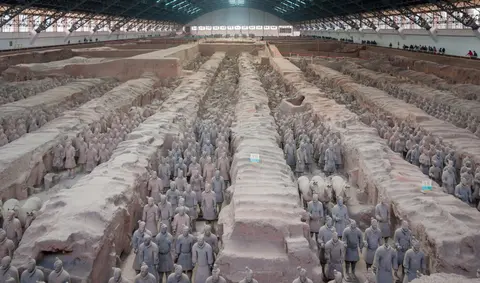 HistoryThe well that found an armyIn 1974 farmers digging a well near Xi’an hit pieces of clay. They had found the First Emperor’s army, and the tomb it guards is still sealed.
 LegendsThe White Snake and Leifeng PagodaA snake spirit in love, a monk who stood in her way, and a real pagoda on West Lake that fell in 1924 and rose again.
 Travelers of the pastMarco Polo’s City of HeavenIn the 13th century a Venetian called Hangzhou the finest city in the world. What did he really see, and what is still there at West Lake?