
The water-driven clock tower of Kaifeng
Photo: Windmemories · CC BY-SA 4.0
Around 1090 a Song official built a Kaifeng tower that turned a star globe and sounded the hours by water power. Only his book survives.
Around 1090, in the Song capital that is now Kaifeng, a tall tower stood. At the top, a bronze instrument for sighting the stars turned slowly. Below it, a star globe turned too. On a five-storey front, small figures came out of doors to show the hour, ring bells and beat a drum. All of it was driven by a waterwheel. It ran for only a few decades, and nothing of it survives but a book.
The official
Su Song (苏颂, 1020 to 1101) came from near Quanzhou, in Fujian. He was a career official: he served as Minister of Justice and later as a chief minister. He was also a scholar with wide interests, who oversaw a large illustrated work on medicinal plants and compiled early printed star maps.
In the 1070s he travelled as an envoy to the Liao state in the north, and the visit raised a question about whose calendar was right. According to one account, the Liao calendar proved slightly better, which embarrassed the Song court. In 1086 the emperor told him to build a new armillary clock. One historian, Liu Heping, sees a link and argues the emperor wanted to compete with the Liao in science.
The tower
Su worked with a mathematician and official named Han Gonglian. A small wooden model came first, finished in 1088. The bronze parts were cast by 1090, and by one account the whole was finished by 1094. Sources give its height as about 12 metres (40 feet).
It had three levels of use. On top was the armillary sphere, a set of bronze rings for measuring the positions of stars. In the middle was the celestial globe, showing the constellations as they moved. Below was the clock, a pagoda-like front with tiers of figures. According to the Taichung museum's study of the text, figures rang a bell on some hours and struck a gong on others, while one in the middle beat a drum for each quarter hour. Others held up signs for each hour and quarter. At night a figure struck a gong through the watches.
The driving power was a waterwheel about 11 feet across, carrying 36 scoops. Water poured steadily into one scoop at a time. A set of levers and balances held the wheel still until a scoop was full, then let it turn by one step, then stopped it again. That stop-and-go action is why historians call it an escapement, the part of a clock that divides time into even steps. Su had predecessors, and he named them: earlier water-powered spheres back to Zhang Heng, and Zhang Sixun's device of 976. A long chain, the "celestial ladder", carried power up to the top. It is often called the oldest known endless power-transmitting chain.
Su explained his idea in a memorial to the emperor. The heavens move without ceasing, he wrote, and so does water, and if the water is made to pour evenly, machine and sky will agree, "for the unresting follows the unceasing".
Whether to call this the first true mechanical clock is a matter of definition. Joseph Needham argued for its place in the line of clockwork, and a Chinese science paper notes that it came about 200 years before mechanical clocks in Europe. Others stress that its timekeeping depended on flowing water, and that it was a one-off state project, not the beginning of an industry.
What happened to it
Kaifeng fell to the Jin in 1127. The tower was taken apart, and the pieces went north towards today's Beijing. Accounts differ on the details, but it was never put back together. The Song court, now in the south, asked Su's son Su Xie to rebuild it from his father's writings. He could not. Su Xie apparently believed some vital details had been left out on purpose.
What survived was the book. Su's Xinyi Xiangfayao (新仪象法要, New Design for an Armillary Sphere and Celestial Globe) dates from about 1092 to 1096. It holds dozens of technical drawings and star maps. It was printed in the south in 1172, and that text allowed the modern work.
Seeing it now
Nothing of the tower can be seen in Kaifeng, and no site is marked on our pages. To see what it may have looked like, you will need a reconstruction. Wang Zhenduo made one in 1958. The Science Museum in London holds a 1:48 model made in 1965. A larger working one is at the National Museum of Natural Science in Taichung, which calls it the first true-to-scale working model in the world. All of these are interpretations of the book.
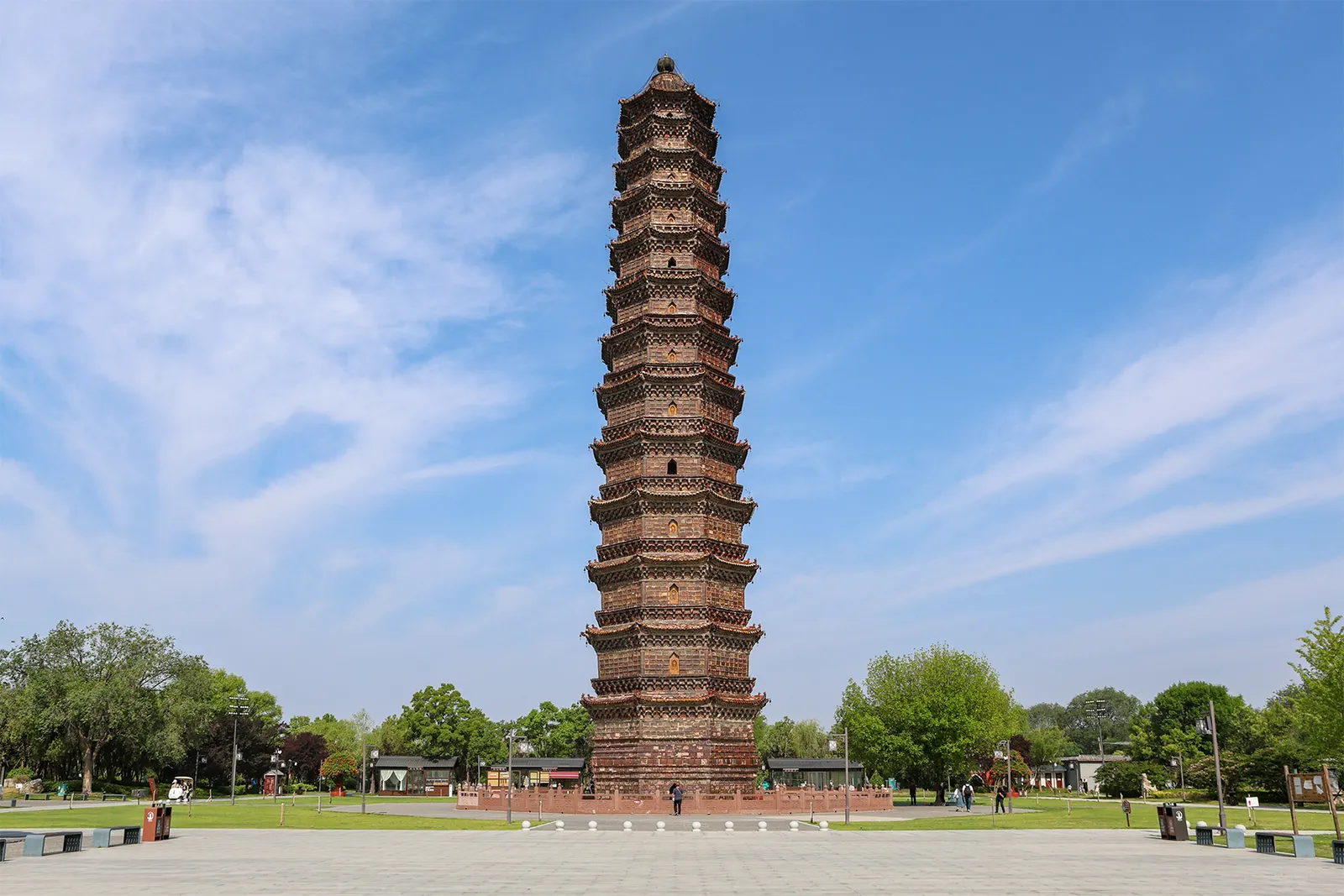
In Kaifeng itself, the Iron Pagoda of 1049 is a Northern Song structure that Su Song's contemporaries would have known.
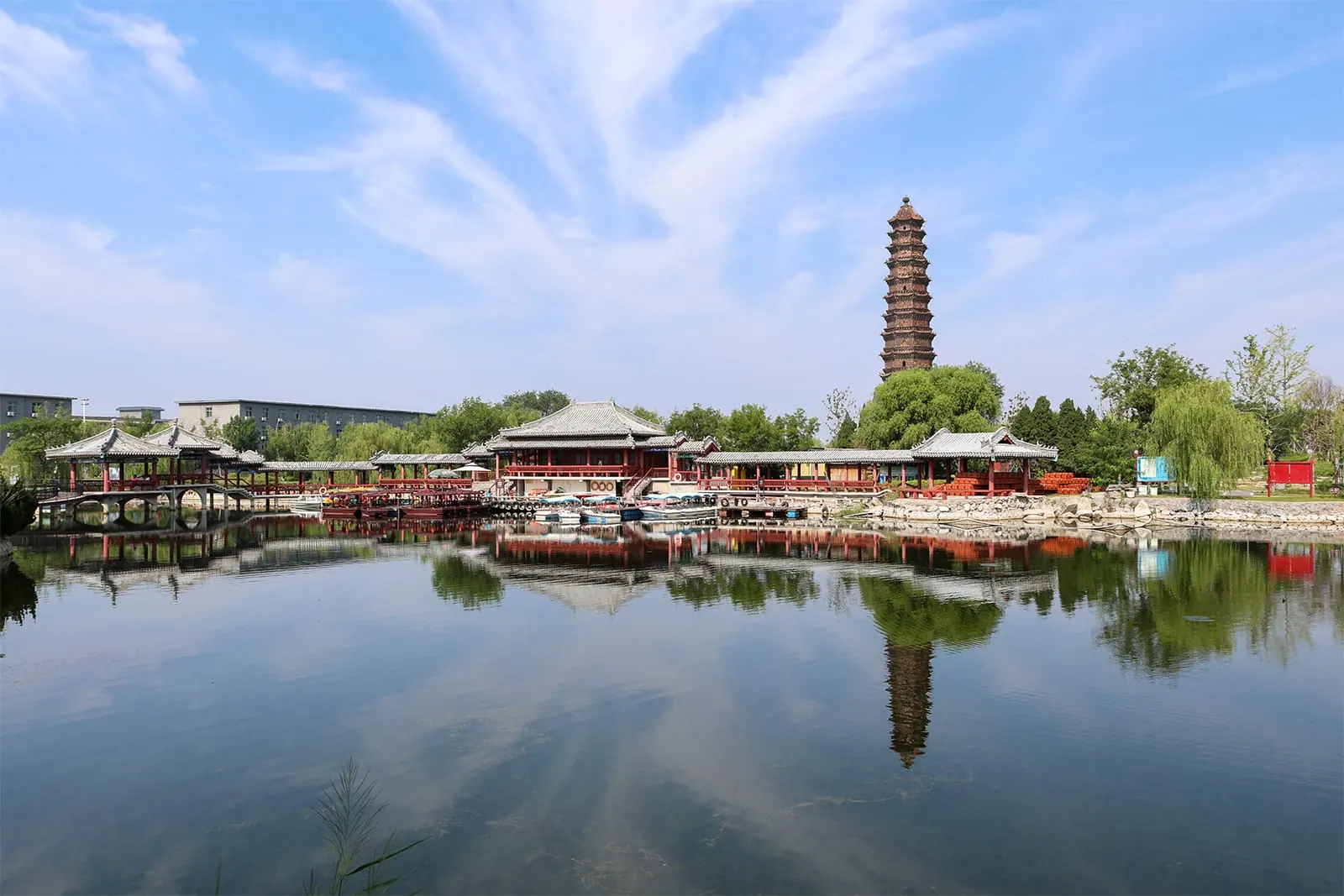 City guideKaifeng 开封The Northern Song capital: the Iron Pagoda, a living version of the Qingming scroll and one of China’s best night markets.
 Sight in KaifengIron Pagoda 铁塔公园A slender 13-storey pagoda from 1049, about 55 m tall, faced with brown glazed tiles that look like iron and decorated with hundreds of moulded Buddhas, dragons and musicians; it has survived floods and earthquakes for almost a thousand years.
Places in this story
Sources
- National Museum of Natural Science (Taichung): Water-powered Armillary Sphere and Celestial Globe Tower (nmns.edu.tw)
- Science Museum Group: Model of a Chinese Astronomical Clock-Tower, 1965 (collection.sciencemuseumgroup.org.uk)
- Science and Technology Daily (China), 15 February 2025 (digitalpaper.stdaily.com)
- Wikipedia: Su Song (secondary) (en.wikipedia.org)
- Wikipedia (Chinese): Su Song (secondary) (zh.wikipedia.org)
Legends are told as legends. Where historians disagree, we say so.
More stories
 HistoryThe well that found an armyIn 1974 farmers digging a well near Xi’an hit pieces of clay. They had found the First Emperor’s army, and the tomb it guards is still sealed.
 LegendsThe White Snake and Leifeng PagodaA snake spirit in love, a monk who stood in her way, and a real pagoda on West Lake that fell in 1924 and rose again.
 Travelers of the pastMarco Polo’s City of HeavenIn the 13th century a Venetian called Hangzhou the finest city in the world. What did he really see, and what is still there at West Lake?