
The engineer who tamed a river
Some 2,300 years ago a Qin governor split the wild Min River in two without building a dam. His work still waters the Chengdu Plain.
Where the Min River leaves the mountains of western Sichuan, it drops onto a wide, flat plain. In spring and summer, snowmelt and rain turn it into a torrent full of gravel. For the farmers of ancient Shu, around today’s Chengdu, that meant floods in the wet season and drought in the dry one.
The state of Qin conquered Shu in 316 BC, and some decades later, in the 3rd century BC, it sent a governor there named Li Bing. We know almost nothing about him as a person. What we have is his work, and it is still running.
A few lines in the old books
The oldest record is short. In the Records of the Grand Historian, written around 100 BC, Sima Qian says that Bing, governor of Shu, cut through the Lidui, ended the damage done by the Mo River and opened two channels through Chengdu. Boats could travel on them, he adds, and the surplus water was used to irrigate the fields, to the people’s great benefit. The Lidui is traditionally identified with the rock beside the channel you can see today, though some historians place it elsewhere.
Some 450 years later the Chronicles of Huayang, a history of the southwest, add more. They say Li Bing built a weir across the river, led the two channels past the city and turned the plain into farmland so reliable that people said flood and drought now obeyed human will and famine was unknown. That is where Sichuan’s old nickname comes from: Tianfu, the Land of Abundance. The traditional date for the project is 256 BC; the ancient sources do not pin it to a single year.
Split the river, don’t block it
The clever part is that Dujiangyan has no big dam. It works with the river, in three pieces.
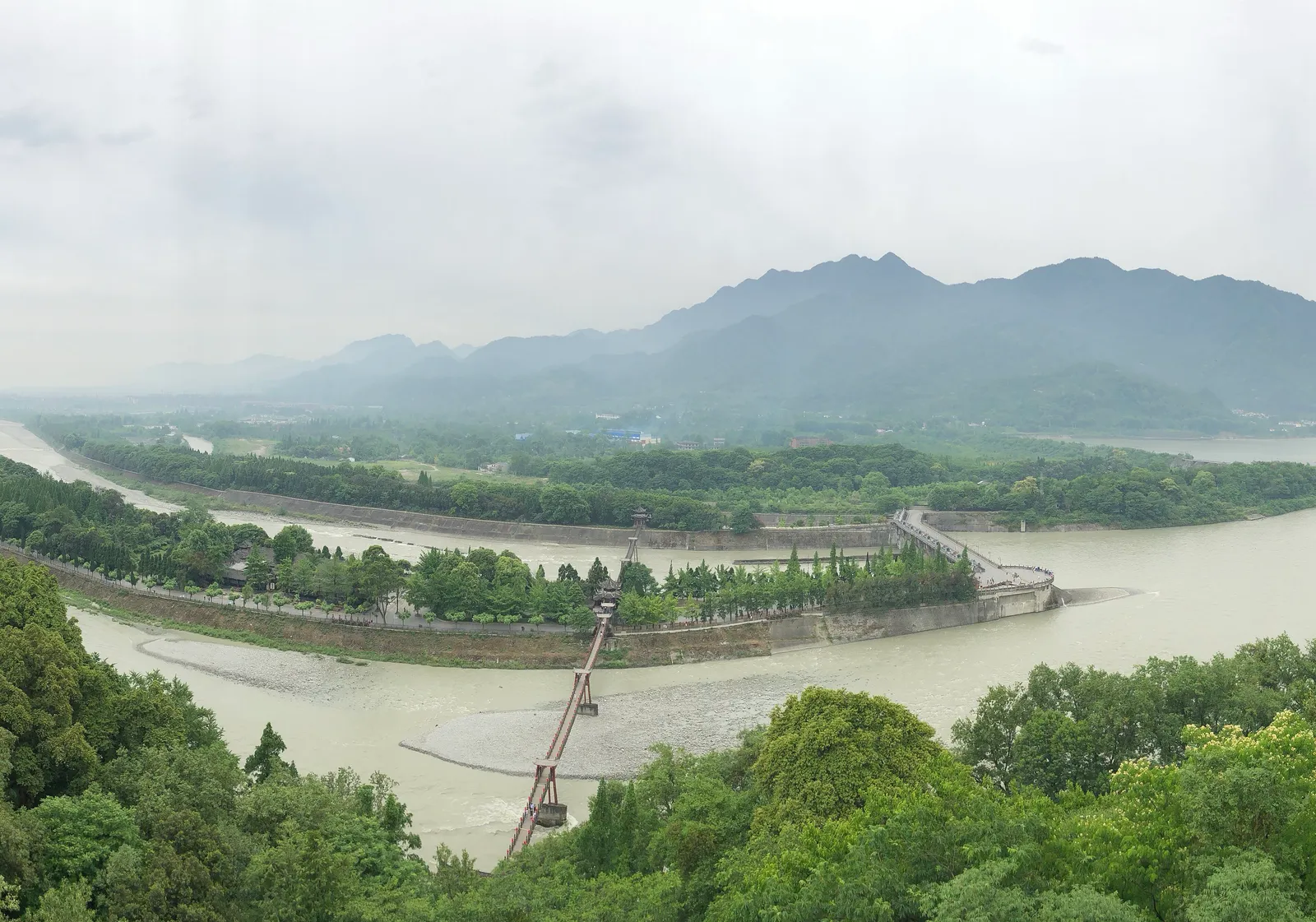
First comes the Fish Mouth, a long levee whose pointed head sits in the middle of the current and splits it in two: an inner river that heads for the plain and an outer river that carries on in the old bed. Because the river bends here, the split changes with the seasons: engineers usually say roughly 60 percent goes into the inner channel in the dry season, while in flood the proportions reverse.
Next is the Flying Sand weir, a low spillway along the inner channel. When the water is high it pours over the top and back into the outer river, taking much of the sand and gravel with it.
Last is the Bottle-Neck, a narrow gap cut through the rock of a hill called Yulei. It is the only way in, so it acts like a throat: however high the river rises, only so much can pass. From there, canals fan out across the fields by gravity alone.
For most of its history the weirs were long baskets of woven bamboo filled with river stones. The baskets wore out and were repaired every winter when the channels were dredged, while wooden tripods, called macha, held back the water during the work. The rule of thumb for that work, dig the bed deep and keep the weir low, is attributed to Li Bing by tradition, though it was written down much later.
 Sight in ChengduDujiangyan and Mount Qingcheng 都江堰与青城山A 2,000-year-old irrigation system and a forested Taoist mountain, both UNESCO sites.
History and legend
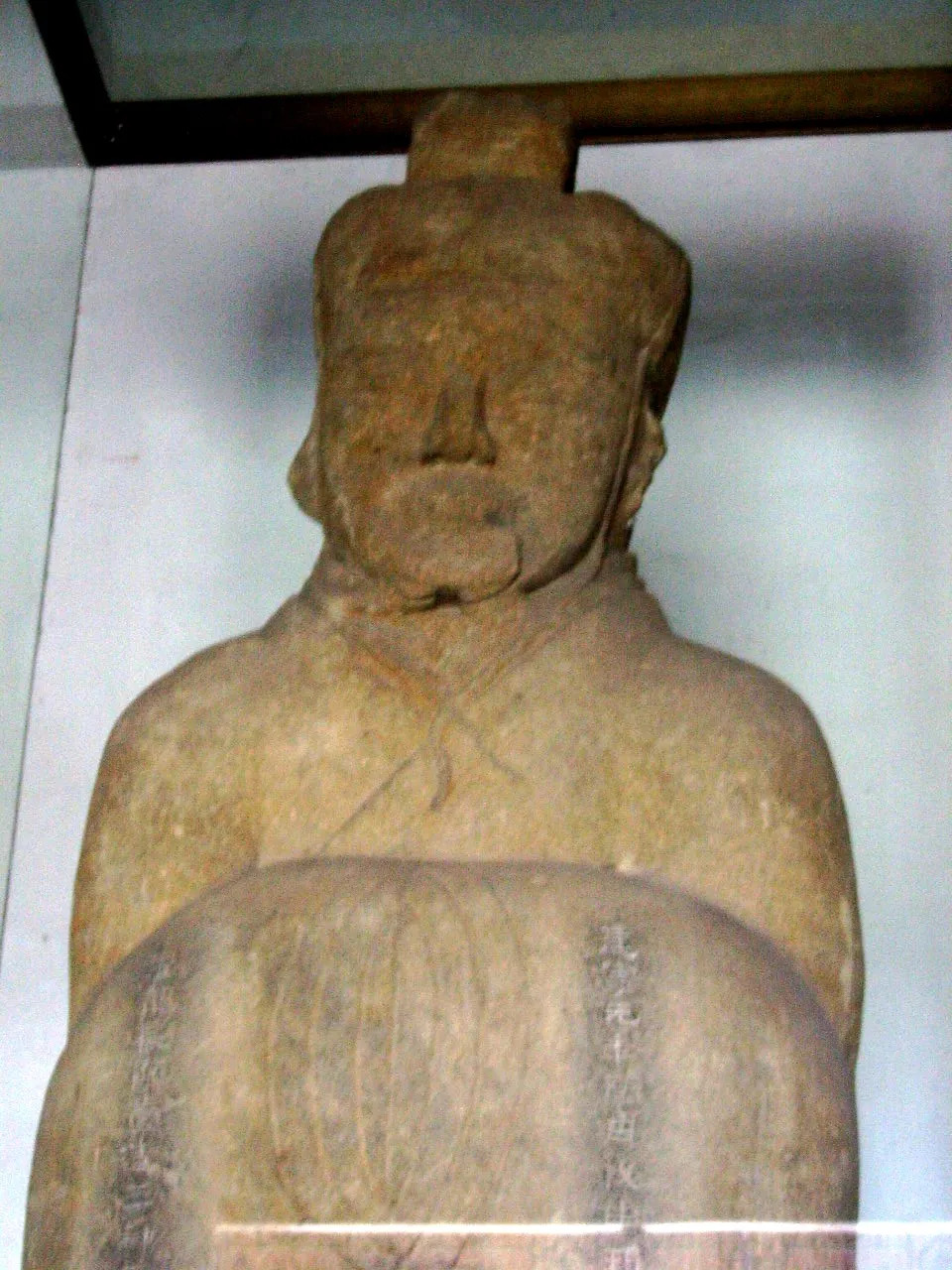
The Chronicles of Huayang also say Li Bing set three stone men in the water as gauges: in a dry year the water should not fall below their feet, in flood it should not rise above their shoulders. In 1974 a stone statue almost three metres tall was lifted out of the riverbed. Its inscription names Li Bing, is dated AD 168, and says the water officials made three stone men to keep the water in check. It seems to have been one of a later set of gauges, carved four centuries after him in his name. It now stands in the Fulong Temple.
Legends grew around him early. The same Chronicles report that “some say” when Li Bing was cutting the cliffs the water god grew angry, and Li Bing went into the river with a blade to fight it. Tradition also says the Bottle-Neck was opened by heating the rock with fire and cracking it with cold water; the Chronicles describe him burning firewood against a cliff on another river, but nothing firm ties the method to this gap.
And the son? Stories of Li Bing’s son, often called Erlang, who helped his father and chained a dragon, spread from around the Song dynasty, a thousand years later; he is absent from the early records. Local people honoured father and son together all the same, in the Erwang Temple above the river.
What is not legend is the result. Dujiangyan has been rebuilt and extended many times, later with iron, stone and concrete, yet it still follows the old layout and still waters the Chengdu Plain. UNESCO listed it with nearby Mount Qingcheng as a World Heritage site in 2000.
Visiting today
You can walk out along the Fish Mouth, cross on a swaying cable bridge and watch the Min squeeze through the Bottle-Neck. The Erwang and Fulong temples are both inside the scenic area, and each year at the Qingming festival in early April the town holds a water-releasing ceremony. See Dujiangyan and Mount Qingcheng for tickets and transport.
Places in this story
Sources
- Sima Qian, Records of the Grand Historian, chapter 29: Treatise on Rivers and Canals (Chinese text) (zh.wikisource.org)
- Chang Qu, Chronicles of Huayang, volume 3: Records of Shu (Chinese text with commentary) (zh.wikisource.org)
- UNESCO: Dujiangyan Water-Releasing Festival was Successfully Held (2024) (unesco.org)
- UNESCO Multimedia Archives: Mount Qingcheng and the Dujiangyan Irrigation System (unesco.org)
- Wikipedia: Dujiangyan (secondary) (en.wikipedia.org)
- Wikipedia (Chinese): Li Bing, on the AD 168 statue inscription (secondary) (zh.wikipedia.org)
Legends are told as legends. Where historians disagree, we say so.
More stories
 HistoryThe well that found an armyIn 1974 farmers digging a well near Xi’an hit pieces of clay. They had found the First Emperor’s army, and the tomb it guards is still sealed.
 LegendsThe White Snake and Leifeng PagodaA snake spirit in love, a monk who stood in her way, and a real pagoda on West Lake that fell in 1924 and rose again.
 Travelers of the pastMarco Polo’s City of HeavenIn the 13th century a Venetian called Hangzhou the finest city in the world. What did he really see, and what is still there at West Lake?