
Power plugs and adapters in China: sockets, voltage and power banks
China uses 220 V and plug types A, C and I. Which adapter to bring from your country, when you need a converter, and the power bank rules.
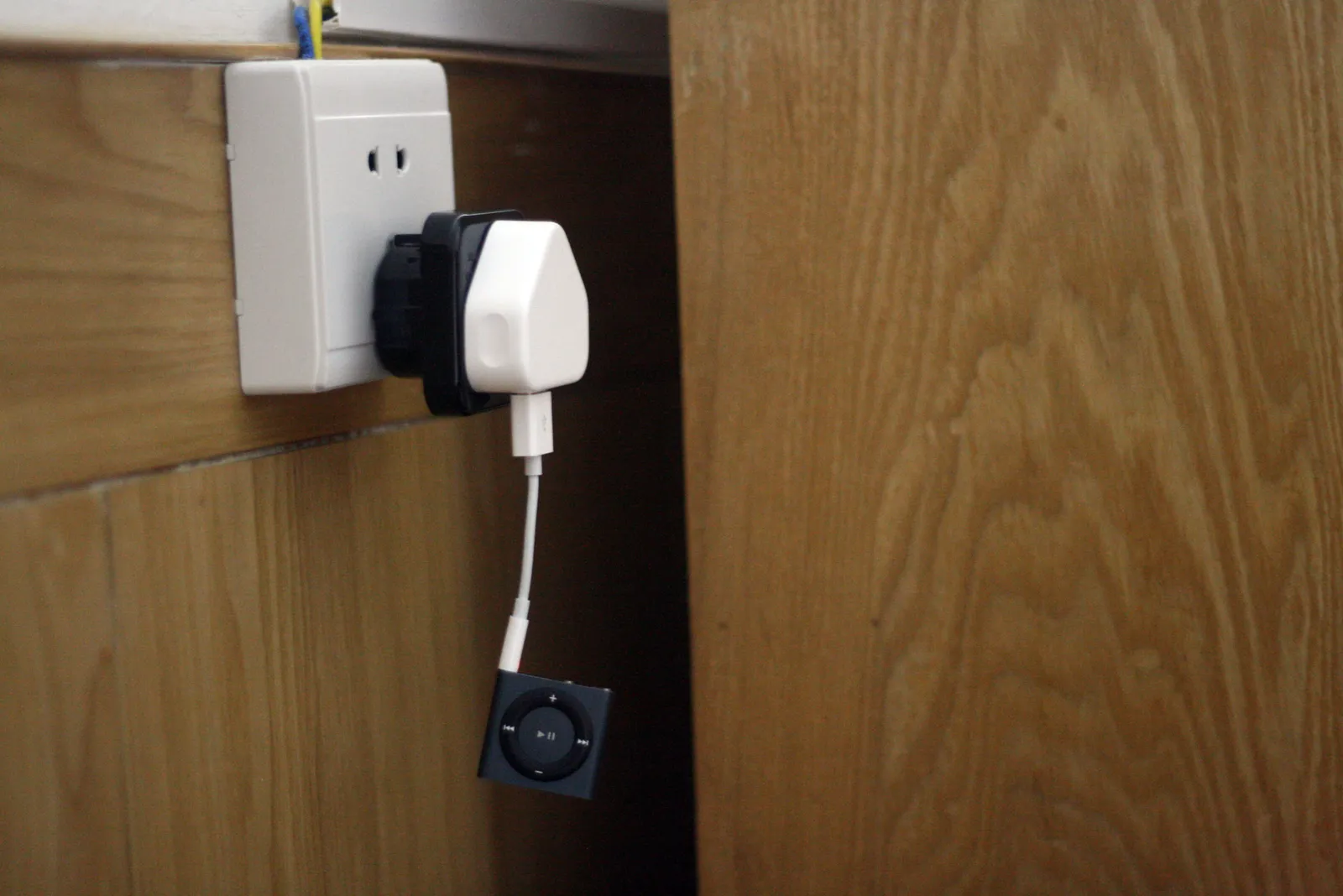
Your phone is your map, wallet, ticket and translator in China, so keeping it charged matters more than on most trips. The good news: sockets are easy to use with the right adapter, and phone chargers work everywhere. The part that catches people out is power banks at airport security.
Voltage and plug types
Mainland China uses 220 V at 50 Hz. Sockets take three plug types:
- Type A: two flat parallel pins, as in the US, Canada and Japan.
- Type C: two thin round pins, the Europlug.
- Type I: two flat pins in a V shape plus a flat earth pin, as in Australia and New Zealand.
A typical Chinese wall outlet, in hotels and homes alike, has two parts: a two-hole slot on top that takes A and C plugs, and a three-hole slot below for type I. Newer hotels often add USB ports by the bed or desk, and some rooms have “universal” sockets that also accept other shapes, but do not count on it.
Hong Kong and Macau are different: they mainly use the British-style type G, so if your trip starts there, bring an adapter for that too. See Hong Kong and Macau to mainland China.
Which adapter to bring
- United Kingdom and Ireland (type G): your plugs do not fit. Bring an adapter to type I or type A/C.
- Continental Europe (types C, E and F): flat, thin two-pin Europlugs (C) fit the two-hole slot. The thicker round plugs with earth contacts (E and F, “Schuko”), common on laptops, kettles and hair dryers, do not fit Chinese sockets. Bring an adapter. The same applies to Korea and Russia, which use C and F.
- Italy (type L) and Switzerland (type J): the three-pin versions do not fit; slim two-pin plugs usually do.
- US, Canada and Japan (types A and B): two-pin type A plugs fit. Three-pin type B plugs, with the round earth pin, do not; you need an adapter.
- Australia and New Zealand (type I): your plugs fit the Chinese three-hole slot. The Chinese version differs slightly (pins about 1 mm longer, earth pin on top), so a fit can be loose or tight, but it works.
The simplest option for everyone is a small universal travel adapter that covers A, C and I, ideally with two or three USB ports so you can charge a phone, a watch and a power bank overnight from one socket. Adapters are also cheap in Chinese supermarkets and convenience stores, and many hotels lend them at reception.
Do you need a voltage converter?
Look at the small print on each charger or appliance. If it says INPUT 100–240 V ~ 50/60 Hz, it works in China with only a plug adapter. This covers almost all phone, tablet, laptop and camera chargers.
Appliances from the UK, Europe or Australia made for 220–240 V also work directly. Appliances made only for 110–120 V (common in the US, Canada and Japan), such as some hair dryers, straighteners, curling irons and electric shavers, will be damaged or can overheat if plugged straight into 220 V. Either bring a proper voltage converter rated for the appliance’s wattage, or leave it at home. Almost every hotel room has a hair dryer.
Power banks on flights
You will want a power bank, but check it before flying inside China. The Civil Aviation Administration of China (CAAC) rules are:
- Since 28 June 2025, power banks with no 3C (CCC) mark, an unclear mark, or from a recalled model or batch are banned on domestic flights. The 3C mark is a small oval logo with three Cs, printed on the power bank. Most power banks sold abroad do not have it, and security will take them.
- Power banks go in hand luggage or your pocket, never in checked bags.
- Up to 100 Wh is fine. 100 to 160 Wh needs airline approval, maximum two per person. Over 160 Wh is banned.
- The capacity (Wh, or mAh with voltage) must be printed and readable.
- You may not use a power bank to charge devices during the flight, and one with a power switch must be kept off.
A 20,000 mAh power bank is about 74 Wh, well under the limit. More details, including what happens at security, are in our domestic flights guide. International airlines set their own rules, so check with yours.
Power banks on trains
China Railway’s list of restricted items allows power banks and lithium batteries with clear markings of up to 100 Wh each in your hand luggage. Railway staff have said they check the capacity, not the 3C mark. Power banks over 100 Wh may be stopped at the station scanner. G and D high-speed trains have sockets at most seats, usually under the seat or between seats. See the high-speed train guide.
Renting a shared power bank
Restaurants, cafés, malls, stations and airports have machines renting out power banks with built-in cables. Scan the QR code with Alipay or WeChat, take a battery, and return it to any machine of the same brand, often in another part of town. You pay by the hour, with a daily cap. Some may ask for a deposit or credit check that foreign accounts do not pass; if so, try the other app. Set up your wallet first: how to pay in China.
Quick checklist
- A universal adapter for A, C and I, with USB ports.
- Check every charger for 100–240 V; leave 110 V-only appliances at home.
- A power bank with a 3C mark, 100 Wh or less, in hand luggage.
- Your phone cable, plus a spare.
For the rest of your bag, see what to pack for China.
Sources
- Electrical Safety First: travel adaptor for China (electricalsafetyfirst.org.uk)
- CAAC: rules on carrying power banks on flights (Chinese) (caac.gov.cn)
- CAAC: ban on power banks without CCC marks on domestic flights (caac.gov.cn)
- China Railway 12306: list of items banned or restricted on trains (Chinese) (12306.cn)
- Beijing Municipal Administration for Market Regulation: power banks on flights (Chinese) (scjgj.beijing.gov.cn)
Checked against these sources on 2026-09-27. Rules change often, so confirm on the official site before you go.
Read next
More on Practical tips
 30 basic Chinese phrases for travelers, with pinyinThirty essential Mandarin phrases in characters and pinyin: greetings, numbers, directions, ordering food, paying and asking for help, plus tones in brief.
 Hotels in China for foreigners: booking, check-in and registrationWhich hotels take foreign passports, how check-in and deposits work, where to book, and how to register with police within 24 hours if you stay privately.
 China etiquette tips: tipping, chopsticks, temples and morePractical etiquette for China: no tipping, chopstick manners, queues, what not to photograph, temples, gifts, bargaining and topics to handle with care.