
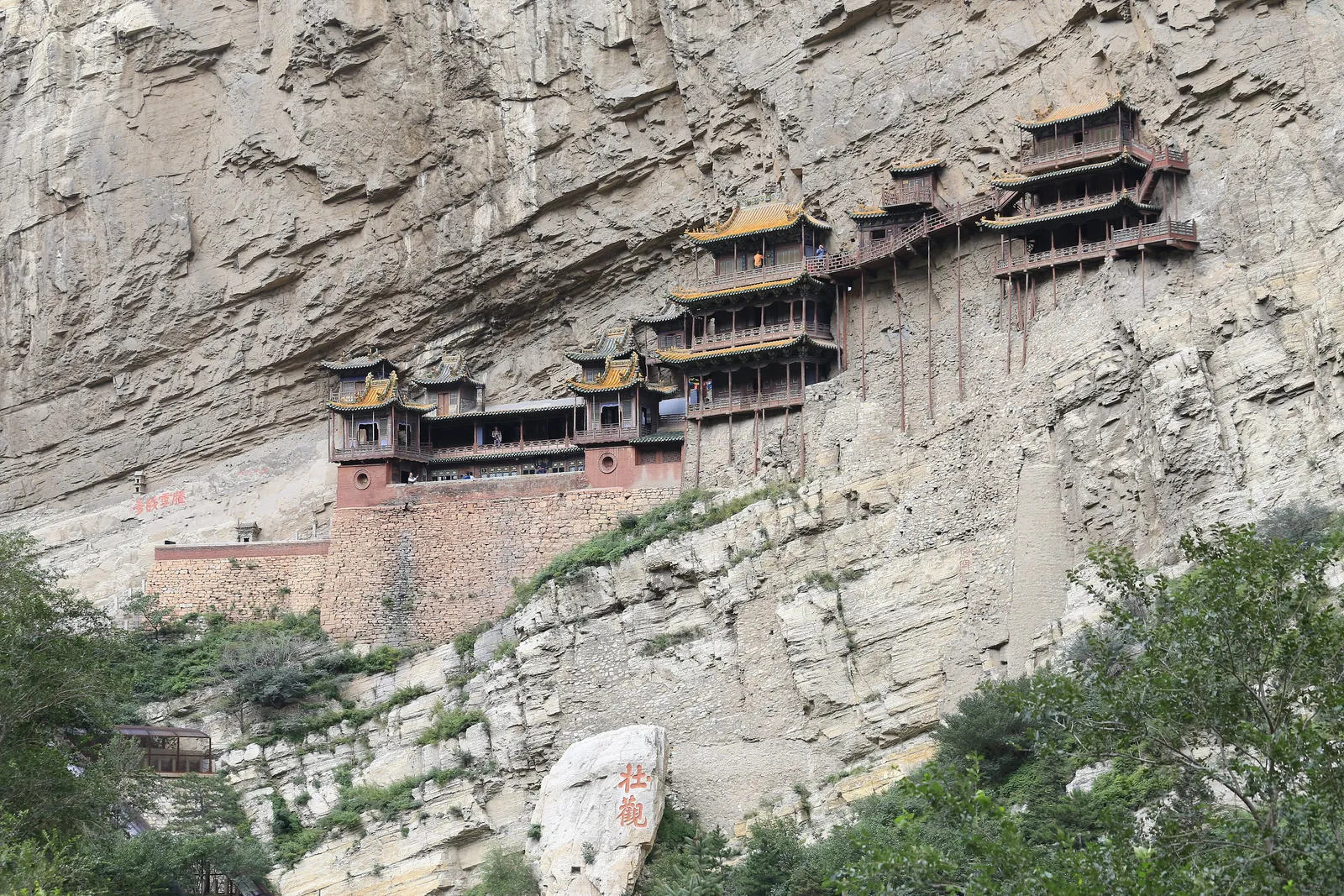
The Monastery Hanging on a Cliff
Photo: Zhangzhugang · CC BY-SA 3.0
Forty rooms of timber on a sheer rock face. What keeps the Hanging Temple up, what is documented, and which famous claims are still contested.
The Hanging Temple (悬空寺, Xuánkōng Sì) looks as if it should not be there: a cluster of wooden halls fixed to a cliff in the Jinlong Gorge of Mount Heng, in Hunyuan County near Datong. The short answer to how it stands is that its weight goes mainly into the rock, through timber beams set deep in the cliff. The slim red posts under it get the attention, but what they do is argued over. So are its age and even its height. Here is what can be said with confidence, and what cannot.
How old is it?
The date on almost every sign and guide is 491, the 15th year of the Taihe era of the Northern Wei. That is a tradition rather than a settled fact, and the explanations behind it do not agree.
One story says a monk named Liaoran began the building. Another, told by Shanxi's culture and tourism department, links it to the Daoist Kou Qianzhi, who is said to have left a dying wish for a temple in the air. Kou died in 448, more than 40 years before the date given. Other accounts connect its beginnings to an army's road through Mount Heng in 398, and one proposes a much later origin in the Southern Song, without solid evidence.
What is agreed is more modest. According to the Hengshan Gazetteer, as cited by the Shanxi account, it was repaired in the Jin, Ming and Qing periods, and most of what stands today dates from the Ming and Qing. So "1,500 years old" describes the site's tradition, not the wood in front of you.
How it stays up
The structure is pure timber, built against the rock, with mortise-and-tenon joints holding beams, ties and posts together.
- The beams. Accounts usually count 27 main horizontal beams, about 50 cm across, of local hemlock (铁杉) soaked in tung oil against decay and insects.
- The sockets. According to the official Shanxi account, builders cut holes in the rock with small mouths and wide interiors, then fixed the beams inside, a method it compares to modern expansion bolts. Boards, posts and frames were built up from there.
- The cliff. An overhang above acts like an umbrella against rain and sun. A trench cut in the rock above carries water and falling stones away.
- The frame. Because everything is linked, the frame can flex a little, which is often given as the reason it has come through earthquakes. Sources state this more confidently than they prove it.
The contested posts
Do the posts hold the temple up? Sources disagree.
Some travel writers say the posts were added later and exist mainly to reassure visitors. Others say they bear load. The Shanxi account takes a middle line: some carry weight, some even out heights, and some take extra load when needed. A 2025 seismic study in a Nature Portfolio heritage journal, by Zhuoxin Yang and colleagues, used a computer model of the temple and found that the bottom columns and the cantilever beams respond most strongly in an earthquake. That suggests the columns are working parts, not decoration. It does not settle how much they carry in everyday use.
The contested numbers
Sources give very different heights above the ground: about 58 metres from Shanxi's culture and tourism department, about 75 metres on English Wikipedia, and over 90 metres on Chinese Wikipedia, with nearly 100 metres from the highest point to the valley floor elsewhere. The Shanxi account adds that experts estimate the drop was nearly 100 metres when it was new. We cannot reconcile these, so treat any single figure with care.
Other numbers are steadier. There are 40 halls and rooms, on a floor area of about 152.5 square metres.
The words 壮观 ("magnificent") carved below the temple are traditionally credited to Li Bai, but this is only "said to be", and we found no proof. The present carving was cut in 1991 from a Qing rubbing. Datong's visitor guide also says the Ming traveller Xu Xiake called the place 天下巨观, a grand sight under heaven.
Keeping it standing
The temple became a Shanxi protected site in 1957 and a national one in 1982. A major restoration in 1978 replaced several main beams and exposed hidden joints. Reinforcement followed in 1990, and after falling rocks damaged a roof ornament it closed in 2015 and reopened in 2016.
The structure is still delicate. The site's managers have warned that pulling on or loading any beam can disturb the balance of the frame.
Visiting
The walkways are narrow, so keep your hands off the timber. For transport, hours and visitor limits, see the Hanging Temple page and check again before you go, since these change.
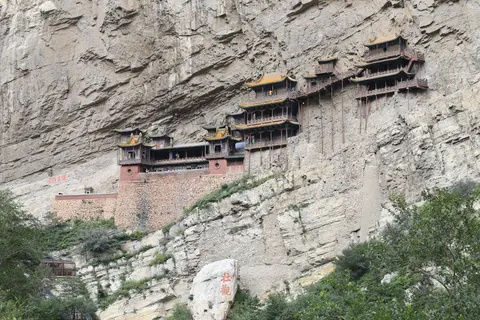 Sight in DatongHanging Temple 悬空寺A 1,500-year-old temple clinging to a sheer cliff on wooden stilts, shared by Buddhism, Taoism and Confucianism.
Places in this story
Sources
- Shanxi Department of Culture and Tourism via The Paper: the Hanging Temple (Chinese) (m.thepaper.cn)
- CCTV News via Chuanguan: Hengshan Scenic Area notice, October 2026 (Chinese) (cbgc.scol.com.cn)
- Yang et al. 2025: Seismic vulnerability assessment of historical timber temples (record read at sciety.org; abstract excerpt only) (doi.org)
- Datong Foreign Affairs Office: city services guide (dt.gov.cn)
- Travel of China: the claim that the pillars are for reassurance (travel writing) (travelofchina.com)
- Our China Story: the Hanging Temple (ourchinastory.com)
- Wikipedia (Chinese): Hanging Temple (secondary) (zh.wikipedia.org)
- Wikipedia: Hanging Temple (secondary) (en.wikipedia.org)
Legends are told as legends. Where historians disagree, we say so.
More stories
 HistoryThe well that found an armyIn 1974 farmers digging a well near Xi’an hit pieces of clay. They had found the First Emperor’s army, and the tomb it guards is still sealed.
 LegendsThe White Snake and Leifeng PagodaA snake spirit in love, a monk who stood in her way, and a real pagoda on West Lake that fell in 1924 and rose again.
 Travelers of the pastMarco Polo’s City of HeavenIn the 13th century a Venetian called Hangzhou the finest city in the world. What did he really see, and what is still there at West Lake?