
The Elephant That Would Not Go Home
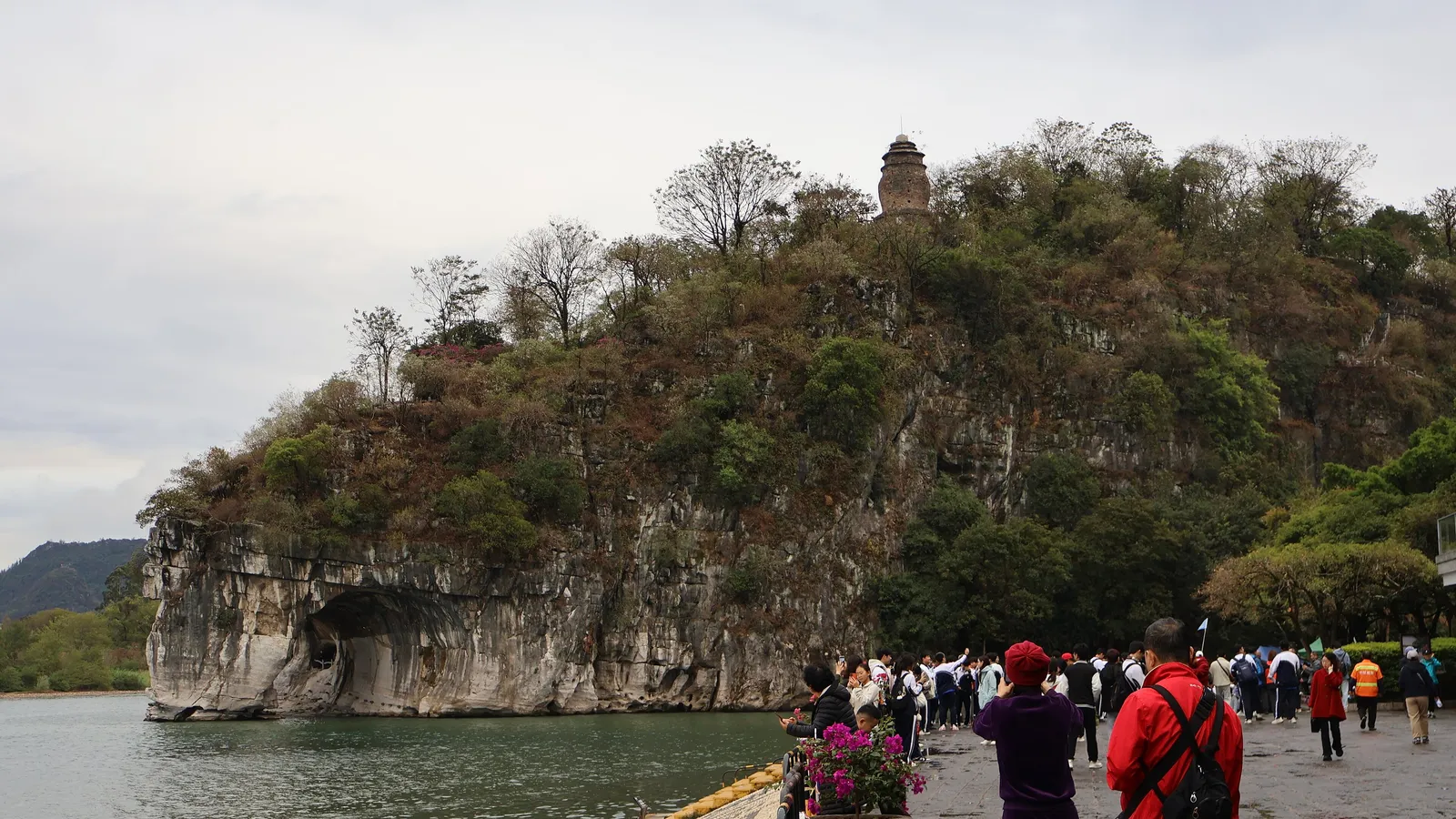
Guilin's emblem is a hill shaped like an elephant drinking from the river. Legend says it is one: a heavenly elephant that refused to leave.
Elephant Trunk Hill (象鼻山, Xiàngbí Shān) stands where the Taohua River meets the Li River in the middle of Guilin, and it does look like an elephant with its trunk in the water. Legend says that is because it was once a real one, an elephant from heaven who loved this place too much to leave. Geology has a different answer, and the hill's written history, with its old quarrel over a name, is as entertaining as the legend.
The legend
There are many versions. In the one most often told, the elephant belongs to the Jade Emperor, the ruler of heaven in Chinese popular tradition, and is his mount. One day he rode it down to the human world. When it was time to go back, the elephant had fallen in love with the mountains and rivers of Guilin and refused to return. It walked to the Li River to drink.
The Jade Emperor was furious. He drew the sword at his waist and thrust it into the elephant's back. The elephant turned to stone where it stood, its trunk still in the river. The sword is still there too, legend says: the hilt is the small pagoda on top of the hill.
A second version is gentler. Here the elephant was badly hurt or fell ill on the journey to earth, and poor Guilin farmers nursed it back to health. In gratitude it stayed to help them and watch over the place, and it never went home.
Both stories end with the elephant here for good. No one has dated them, and we found no old written source for either, so treat them as folk tales.
What it is really made of
The hill is pure limestone laid down on a sea floor about 360 million years ago, and it rises some 55 metres above the water. Acidic water wore away the rock, as it did with all the karst hills around Guilin.
The "trunk" exists because of a hole. Between trunk and leg is a round opening, Water-Moon Cave (水月洞, Shuǐyuè Dòng), through which the river flows. It is about 17 metres long and 12 metres high. Above it, two more openings run through the hill at the point where an elephant's eyes would be. Those are older, part of an ancient underground river.
The quarrel over a cave
The hill's written history is mostly about that cave. Song dynasty writers came here to see the arch and its reflection make a full circle, like a moon floating on the water. One Song poem, by a writer known as the recluse of Jibei, goes:
In plain English: at the bottom of the water there is a bright moon, and above the water a bright moon floats. The water flows and the moon does not leave. The moon leaves and the water still flows.
Then came a dispute between two senior officials. In 1166 the poet and official Zhang Xiaoxiang visited, stayed until late and came back soon after. Because the cave's mouth faces east, he renamed the cave and its pavilion Chaoyang, "Facing the Morning Sun", and had his reasons carved into the north wall. Fan Chengda, who later held the same post, thought this was wrong. He restored the old name and had his own *Inscription on Restoring Water-Moon Cave* carved on the south wall. So the two men still face each other across the water. Water-Moon is the name that stuck.
More than 50 inscriptions survive inside the cave, including a poem manuscript by Lu You, one of the most famous Song poets, copied in stone.
The sword hilt
The pagoda on top is the Puxian Pagoda (普贤塔, Pǔxián Tǎ), a brick structure about 13.6 metres high, usually dated to the Ming dynasty. From a distance it does look like a sword hilt, and it is also called the Sword Hilt Pagoda and the Vase Pagoda for its shape. Its proper name honours Puxian, the bodhisattva Samantabhadra, who in Buddhist art rides on an elephant.
The hill is now the city's symbol.
Seeing it
The classic view is from across the river, and no ticket is needed. To walk to the cave and climb to the pagoda, you enter the park. Look on the cave walls for the inscriptions. See Elephant Trunk Hill for hours and prices, and check them before you go.
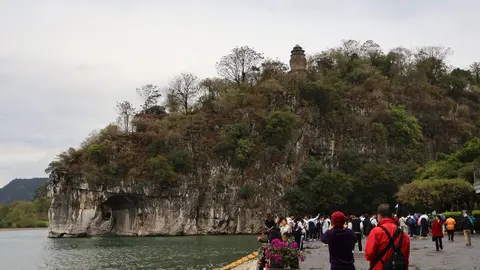 Sight in GuilinElephant Trunk Hill 象鼻山Guilin’s symbol: a hill shaped like an elephant drinking from the river.
Places in this story
Sources
- China Weather Network: Elephant Hill park, with the cave and inscriptions (Chinese) (weather.com.cn)
- Bendibao: Elephant Trunk Hill, geology and city emblem (Chinese) (m.bendibao.com)
- CLI: Elephant Trunk Hill guide, with both legend versions (studycli.org)
- China Xian Tour: Elephant Trunk Hill, on the Puxian Pagoda (chinaxiantour.com)
- Wikipedia (Chinese): Elephant Trunk Hill (secondary) (zh.wikipedia.org)
Legends are told as legends. Where historians disagree, we say so.
More stories
 HistoryThe well that found an armyIn 1974 farmers digging a well near Xi’an hit pieces of clay. They had found the First Emperor’s army, and the tomb it guards is still sealed.
 LegendsThe White Snake and Leifeng PagodaA snake spirit in love, a monk who stood in her way, and a real pagoda on West Lake that fell in 1924 and rose again.
 Travelers of the pastMarco Polo’s City of HeavenIn the 13th century a Venetian called Hangzhou the finest city in the world. What did he really see, and what is still there at West Lake?