
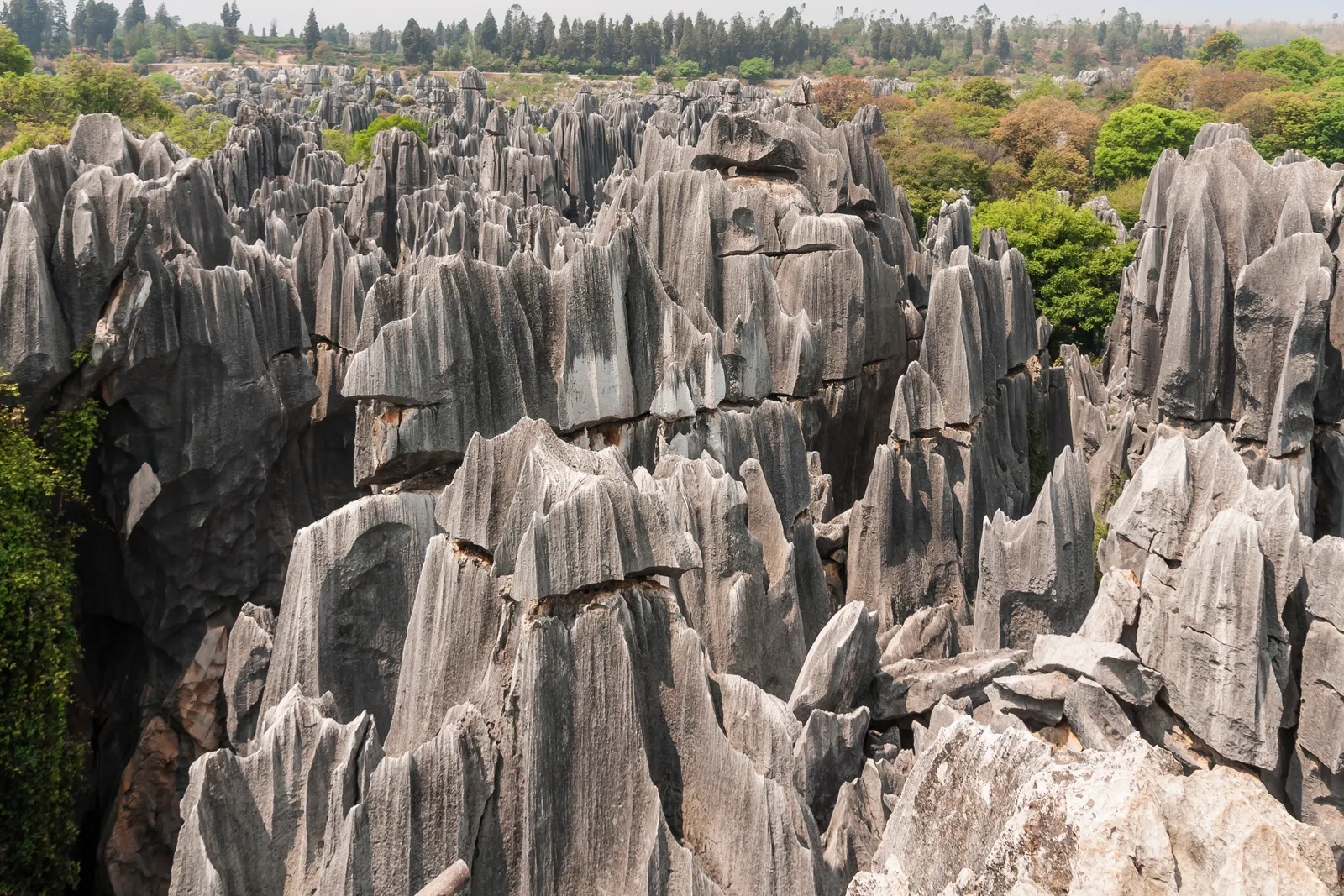
The Girl Who Became an Echo
Photo: CEphoto, Uwe Aranas · CC BY-SA 3.0
A rock in the Stone Forest is called Ashima. In most old versions of the Sani poem she does not turn to stone: she turns into an echo.
Ashima (阿诗玛, Āshīmǎ) is the heroine of a long narrative poem of the Sani, a branch of the Yi people who live around the Stone Forest (石林, Shílín) in Yunnan. Guides will point out a rock shaped like a girl and tell you she was turned to stone. That is one telling. The older one is stranger: legend says she became the echo you hear when you call out among the cliffs.
A poem that was sung
The poem belongs to the Sani. It was composed in their language in five-syllable lines, sung and recited from memory, and some versions were written down in old Yi script by *bimo*, the community's ritual specialists. The Sani call it "the song of our people". According to China's heritage register, it is part of daily life, weddings and funerals. It joined the national list of intangible heritage in 2006.
Because it was passed on by singers, there is no one correct text. A collection published in 1986 gathers 29 source versions, and they disagree on quite a lot.
The story most singers tell
Legend says Ashima was born to a poor family in the Sani village of Azhedi, in the year, month, day and hour of the snake. Her name is often explained by that, though another explanation says it means "precious as gold". She grew up clever and hard-working, and word of her reached Rebubala, a powerful headman, whose son Azhi wanted her as a bride.
Rebubala sent a matchmaker named Haire. In some versions her parents give in and she is married off. In others she refuses and is carried away by force.
Her brother Ahei was far away herding sheep. He had a dream that something was wrong at home, came back, and rode straight to the headman's house to bring her home.
The headman's family set him one contest after another: farm work, singing, then tigers let loose to attack him. He won each time. Some singers add that he shot arrows into the door, the altar table and the house pillars until the family gave up. Brother and sister were allowed to leave.
Then comes the turn that many visitors never hear. On the way home a spirit of the cliffs seized Ashima. It held her against the rock face, or in other versions took her in a flood, and it demanded a white pig and a white sheep as ransom. Ahei could not find a white pig, so he painted a black one white. The spirit saw through the trick and made Ashima an echo.
So when you shout at a cliff here and something answers, the story says, that is her.
Lovers or siblings?
Most visitors hear a different version: Ashima and Ahei as lovers, torn apart by a rich man's son, who breaks a dam and drowns her. A goddess of stone then turns her into the rock you see, and Ahei calls to her for the rest of his life.
That version is widely told and moving, and China's own heritage site summarises the story this way, but it is mostly a modern one. All 29 source versions in the 1986 collection make the two brother and sister. A 2012 study that interviewed folk performers and *bimo* in the Stone Forest reported that almost all of them said the same. The lovers version spread through a 1960s film and through Chinese-language printed editions from the 1950s, whose editors changed parts of the plot. Some scholars have found scattered Sani stories that support a romance, so the question is not fully closed.
The endings vary too. In the 1986 collection, 18 versions end in tragedy, most of them with the echo or a cliff spirit. Six let Ashima stay in the headman's house. A few have everyone content, and those may have been the versions sung at weddings, when a tragic ending would not do.
What it means to the Sani
The heritage register reads the poem as a picture of the Sani character. It quotes a saying: "can break, will not bend" (断得弯不得). You do not have to choose one version to see why the story has lasted. A girl refuses to bend, a brother rides to get her, and the land itself keeps her voice.
Finding her
The rock named after her stands in the Lesser Stone Forest. It looks like a girl with a kerchief on her head and a basket on her back. The limestone around it was laid down in a sea about 270 million years ago, and water and weather carved the pillars from it much later. Two parts of the wider Stone Forest area have been on UNESCO's World Heritage list since 2007 as part of the South China Karst.
Ask for 阿诗玛 and any guide will know the rock. Check dates and hours before you go on the Stone Forest page.
 Sight in KunmingStone Forest (Shilin) 石林风景区A UNESCO-listed maze of grey limestone pillars, 90 km southeast of Kunming.
Places in this story
Sources
- China Intangible Cultural Heritage Network: Ashima (Chinese) (ihchina.cn)
- China Intangible Cultural Heritage Network: Ashima, national representative bearer entry (Chinese) (ihchina.cn)
- Wikipedia (Chinese): Ashima, on the 29 source versions and later editions (secondary) (zh.wikipedia.org)
- Circle of Blue: Romeo and Juliet of China, captured in karst (2010), for the popular lovers version (circleofblue.org)
- Wikipedia: Stone Forest (secondary) (en.wikipedia.org)
Legends are told as legends. Where historians disagree, we say so.
More stories
 HistoryThe well that found an armyIn 1974 farmers digging a well near Xi’an hit pieces of clay. They had found the First Emperor’s army, and the tomb it guards is still sealed.
 LegendsThe White Snake and Leifeng PagodaA snake spirit in love, a monk who stood in her way, and a real pagoda on West Lake that fell in 1924 and rose again.
 Travelers of the pastMarco Polo’s City of HeavenIn the 13th century a Venetian called Hangzhou the finest city in the world. What did he really see, and what is still there at West Lake?