
China arrival card and immigration, step by step (2026)
How to fill in China's online arrival card, who is exempt, who gives fingerprints, what immigration officers ask and which documents to have in your hand.
Foreign visitors who need an arrival card can submit it online before travel through official NIA channels, or complete it at the port on arrival. At immigration, use the appropriate foreign-passenger lane, present your original passport and visa or visa-free basis, and provide fingerprints if the border system requires them. Keep supporting itinerary and accommodation details ready in case officers ask.
Step 1: the arrival card
Since 20 November 2025, the foreigner arrival card (外国人入境卡) can be submitted online before entering China. Travelers who cannot file online may still use port smart devices or a paper card on arrival.
Where to fill it in:
- the NIA website: s.nia.gov.cn
- the NIA 12367 app (移民局12367)
- the NIA 12367 mini program inside WeChat or Alipay
- the QR code on the signs in the arrivals hall, if you did not do it before you flew
You need your passport, your flight number and your address in China; the first hotel is enough. Some channels also ask for a photo of your passport's photo page.
There is no official deadline. Doing it in the last few days before your flight is sensible, so the details match your plans. Take a screenshot of the confirmation in case the airport Wi-Fi is slow.
If you did not file online, scan the official QR code or use a smart device at the immigration inspection area, or fill in a paper arrival card. Paper cards remain officially available; online filing is optional, not a condition of entry.
Who does not need an arrival card
The NIA lists seven groups:
- Holders of a Chinese Foreign Permanent Resident ID Card.
- Foreign holders of the Mainland Travel Permit for Hong Kong and Macao Residents.
- Travellers on a group visa or group visa-free entry.
- 24-hour direct transit passengers who stay inside the airport.
- Cruise passengers who arrive and leave on the same ship.
- Travellers who use the e-channel (fast-track gates).
- Foreign crew members.
Ordinary residence permit holders are not on the list. Everyone else, including visitors on 30-day visa-free entry and 240-hour visa-free transit, needs a card.
Step 2: fingerprints and photo
Border officers take the fingerprints of foreigners aged 14 to 70 when they enter China, a rule in force since 2017. Children under 14 and people over 70 are exempt, as are diplomatic passport holders and some others covered by agreements between countries. The officer also takes your photo at the counter.
Some airports have machines in the queue that scan your fingerprints in advance; staff will point you to them if they are in use. Otherwise the officer tells you which fingers to place on the scanner at the counter.
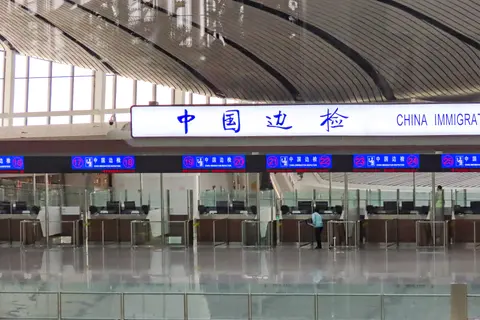
Step 3: the immigration counter
Follow signs for Foreigners (外国人). Use a staffed counter unless signs or officers direct you to an e-channel for which you are eligible.
Have these in your hand, not in a checked bag:
- Original passport. It must be valid for the entry policy you use. The 240-hour transit guidance requires at least three months remaining; visa and carrier rules can differ, so do not treat a general six-month suggestion as the legal rule for every traveler.
- Visa, if you need one. If you come visa-free, know which scheme you are using: 30-day visa-free entry or 240-hour transit. Our visa checker tells you.
- Onward itinerary when your entry basis requires it. For 240-hour transit, carry a confirmed air, ship or rail ticket with a fixed date and itinerary to a third country or region within 240 hours. Other visa-free schemes have different requirements; supporting return/onward and accommodation details can help answer border questions.
- Your accommodation details. Save the first hotel's Chinese name and address, or the private host's address and contact details. You may be asked where you will stay; the same Chinese address is useful for a taxi driver. Save it on a help card.
Typical questions are short: why you are visiting, how long you will stay, where you are staying and where you go next. Answer briefly and in line with your arrival card. Under the Exit and Entry Administration Law (Article 25), officers can refuse entry without giving a reason, so a calm answer backed by documents is worth more than a long story.
If something does not match, for example your 240-hour "onward" flight goes back to where you came from, you may be taken aside for more questions. That is why it pays to check your scheme before you book. See who gets visa-free entry.
Step 4: bags and customs
After immigration, collect your bags and walk through customs.
- Nothing to declare: green channel (无申报通道). No form.
- Something to declare: red channel (申报通道). This applies if you carry more than ¥20,000 in Chinese cash or more than US$5,000 in foreign cash, goods worth over ¥2,000 that will stay in China, more alcohol or tobacco than the allowance, animal or plant products, or controlled medicines.
You can fill in the customs declaration in advance in the WeChat or Alipay mini program 海关进出境人员指尖服务. Details: what you can bring into China and bringing medicine into China.
After the airport
- Accommodation registration: hotels register foreign guests when they check in. If you stay in a home or other non-hotel accommodation, you or your host must register within 24 hours. Since 21 September 2026 this can be done nationwide through the NIA government-service website, the NIA 12367 app, or its WeChat/Alipay mini programs; in-person registration with the local public-security authority remains available.
- Carry your passport. You need it for hotels, trains, many museums and SIM cards.
- Count your days. Visa-free stays are counted from 00:00 on the day after you arrive. Overstaying can bring a fine of ¥500 a day up to ¥10,000, or detention. Our departure checklist covers the way out.
Quick checklist
- Arrival card filed online, screenshot saved.
- Original passport valid for your entry policy, plus a visa if required; 240-hour transit needs at least three months' validity.
- Confirmed onward air, ship or rail ticket to a third country or region if using 240-hour transit.
- First hotel's address in Chinese.
- Cash, medicines and food checked against the customs rules.
All arrival guides are collected in our Arrive in China section.
Sources
- NIA: Announcement on 10 innovative measures, incl. the online arrival card and exemptions (3 Nov 2025, Chinese) (nia.gov.cn)
- Embassy of China in the US: China launches online arrival card for international travelers (Dec 2025) (us.china-embassy.gov.cn)
- NIA: online arrival card filing (s.nia.gov.cn)
- Exit and Entry Administration Law of the PRC (NIA, Chinese) (nia.gov.cn)
- China Law Translate: MPS notice on retaining fingerprints of foreigners aged 14–70 at entry (2017) (chinalawtranslate.com)
- GOV.UK: China entry requirements (gov.uk)
- GACC Announcement 2025 No. 43 on passenger declarations (red and green channels, Chinese PDF) (gov.cn)
- NIA: nationwide online accommodation registration for non-hotel stays from 21 September 2026 (en.nia.gov.cn)
- NIA: official foreigner entry guidance, including entry fingerprint ages and exemptions (nia.gov.cn)
- NIA: paper arrival cards remain available and official online filing is free (en.nia.gov.cn)
- China Customs online service guide: passenger declaration thresholds (online.customs.gov.cn)
Checked against these sources on 2026-10-25. Rules change often, so confirm on the official site before you go.
Read next
More on Planning
 China visa-free countries: who gets 30 days without a visa (2026)78 passports can enter China without a visa: 50 for 30 days until set end dates, 28 under permanent agreements. Who qualifies and what to carry.
 How many days in China? What fits in 7, 10 and 14 daysTen days is the sweet spot for a first trip. What you can realistically see in one week, ten days or two weeks, and how visa rules cap your stay.
 240-hour visa-free transit in China: how it works (2026)Up to 10 days in China without a visa while transiting to a third country or region: eligibility, 65 entry ports, permitted areas, documents and refusal risks.