
Yurt
蒙古包měnggǔbāo
The round, felt-covered tent of Mongolian and Central Asian herders, a lattice frame that can be packed on animals and put up again in a few hours.
A yurt, called a ger in Mongolian and menggubao in Chinese, is the round portable home of the herders of the Mongolian steppe and Central Asia. A folding lattice wall of wood is tied into a circle, roof poles run up to a wooden crown ring that lets out smoke and lets in light, and the whole frame is wrapped in layers of felt and canvas and tied down with ropes against the wind. A family can take it down, load it onto camels, horses or a truck and put it up at a new pasture in a few hours; the door traditionally faces south, with the stove in the middle. Traditional Mongol ger craftsmanship is inscribed, for the country of Mongolia, on UNESCO’s intangible heritage list, and in China yurts are still used by Mongol herders in Inner Mongolia and by Kazakh herders in Xinjiang. On the grasslands near Hohhot, tourist yurt camps, some built as permanent concrete copies, offer meals and overnight stays; guests are often welcomed with salty milk tea.

Where to see it in China
 HohhotXilamuren Grassland (day trip) 希拉穆仁草原The closest grassland to Hohhot, dotted with yurt camps offering horse riding, wrestling shows and roast lamb.HohhotGegentala Grassland (day trip) 格根塔拉草原Flat, open steppe with a large tourist centre of yurt camps and Naadam-style events in summer.
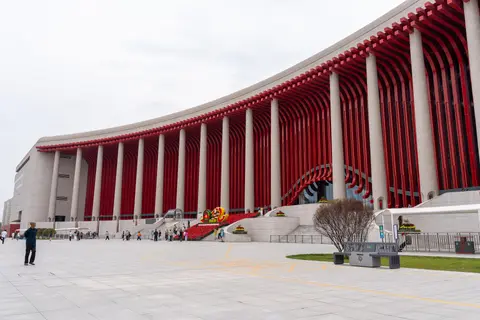 HohhotInner Mongolia Museum 内蒙古博物院Galleries on nomad life, from saddles to a full ger set up inside the museum.
Where we mention it
Related entries
Sources
- Traditional craftsmanship of the Mongol Ger and its associated customs — UNESCO Intangible Cultural Heritage (ich.unesco.org)
- Inner Mongolia Museum — Wikipedia (en.wikipedia.org)
- Yurt — Wikipedia (en.wikipedia.org)